8

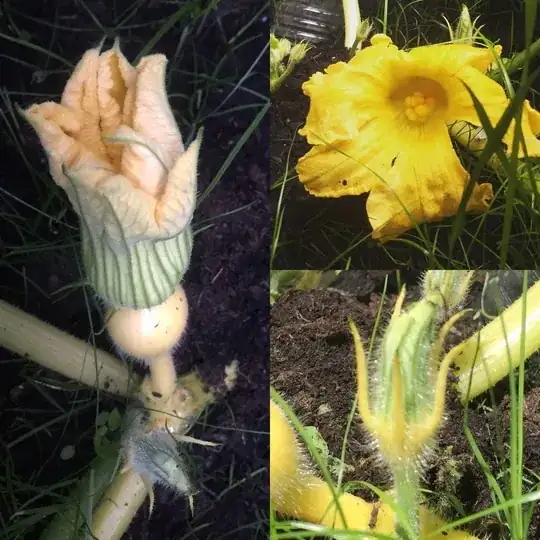
I planted two Giant Atlantic pumpkin plants in my garden around 9 weeks or so ago. The male flowers where the first to show, many of them but haven't bloomed and are quite firm to the touch still. Since then three females (1 on one plant, 2 on the other) have grown, bloomed and started to wilt (in the last couple of days) without any sign of the males blooming so that I can pollinate.

I understand that the male pumpkins are supposed to bloom first. Is something wrong? what? and is there anything I can do?

More details

They were bred indoors for the first 6 weeks and transplanted outdoors in new soil/compost 13 foot holes. The rest of the garden (which they are now creeping over) is old soil, which I've been loosely mixing with compost as they grow over it. I've watered them 4-8 litres a day, at the base and also via funnel to the roots. Once or twice a week, adding high potash feed. There's not much else in the garden except some very new sunflower sprouts. I don't know the pH of the soil and have no way to find out.

I am in the U.K. (Scotland) it's been a combination of hot and sunny and cold and rainy although the soil has been no lower than 12C the entire time, that I can see. For most of their life they have been under a plastic, flexible greenhouse-type cover (until the last week or so).

(This is also my first foray into gardening)Clockwise: Female flower before then after flowering and most developed male flower I have
Ross Drew
  • 253
  • 3
  • 10

3 Answers3

3

I don't know what's going on with your pumpkin. Usually male flowers form and bloom first, except for some varieties, maybe. Maybe it's a partially gynoecious variety, which would mean it should mostly produce female flowers. It might be a mutant, though, or maybe there is a pest or disease that is influencing it with regulators.

If you'll plant this kind again in future, and suspect the female flowers will blossom first, again, you might try planting another variety of the same species with it for pollination, unless you'll be saving seeds and don't want a cross. You may also try growing other giant varieties (like Weeks NC Giant), which may not have the same condition.

As for this year, if you don't want to wait it out and see what happens, I would personally try nipping all the flowers off and giving it some phosphorus. If this pumpkin is like cucumbers and melons it should grow new flowers faster if you take the old ones off, whether or not they're mostly female still. I don't know why the male ones would form without blooming unless something is preventing them from blooming or unless they do bloom, but just not when you're looking.

Brōtsyorfuzthrāx
  • 18,694
  • 6
  • 30
  • 70
3

Turns out this isn't really a problem.

(I waited to see if any of the commentors who suggested this would post an answer)

It's unusual that male pumpkins bloom after the female ones but not unheard of. A matter of weeks after posting this question I started to get many male and some female blooms in a much more expected pattern.

Ross Drew
  • 253
  • 3
  • 10
0

I have planted ‘regular’-sized pumpkins in years passed; and, yes, the males typically bloom before the females in those jack-o-lantern sized pumpkins. However, with regards to this year’s MAX pumpkins I planted…the females bloomed first. I did have problems with no males fully developed enough to pollinate the females, and subsequently the early females wilted before pollination was possible. Then, about 6 weeks into the growth, a few males were close to opening (size-wise, if not with just a slight hint of yellow at the tips). I thought I would try manual pollination by opening the largest males manually. What do you know…I successfully pollinated the first female by doing this??!! I don’t know if this is something anyone else has tried…but I figured I would lose both anyway if I didn’t try something. Both of my vines are producing so many females it is insane. In a 12 foot vine, I have 8 female flowers; I have never seen so many females on one vine. I do prune offshoots/auxiliary vines…maybe that plays a part in this.

Now…I will say this about the MAX variety; my limited experience has resulted in proving it nearly if not actually impossible to successfully pollinate a max female unless it is at least 7 or 8 feet out in the vine. All females, many of which were very large, failed to manually pollinate, even when pollen was verified on the males. For some reason the females closer to the root base just wilt and deteriorate, even with immediate stringing the petals closed and even covering with cheesecloth to keep the bees from stealing the pollen.

Lastly, I can add that it seems to me a sure-fire way of determining if pollination was successful is looking at the female a day after attempting to pollinate; if the female turned on its side and laid down on the ground, it’s the equivalent of a satisfied human partner lighting up a smoke after love-making. Is this an accurate identifier of successful pollination or is it just coincidence? If anyone can provide feedback, I would greatly appreciate it.

THANKS!

P.S. I am in the US, but have family who lived and taught in Oxford…for all the Brits on this post.