6

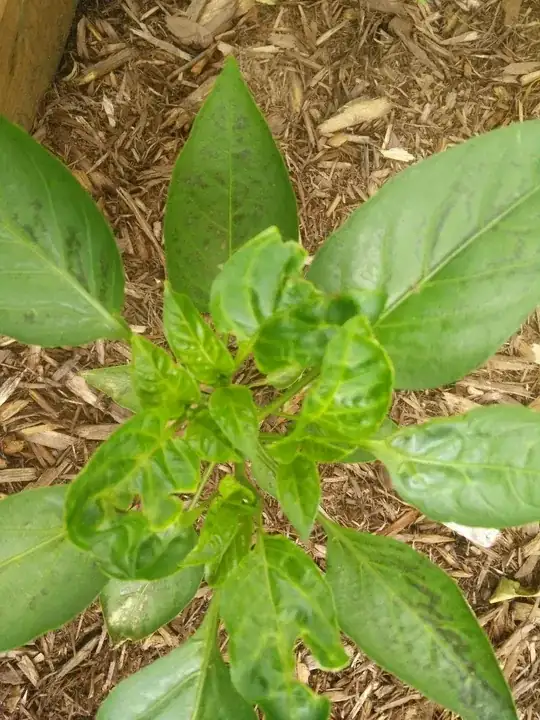
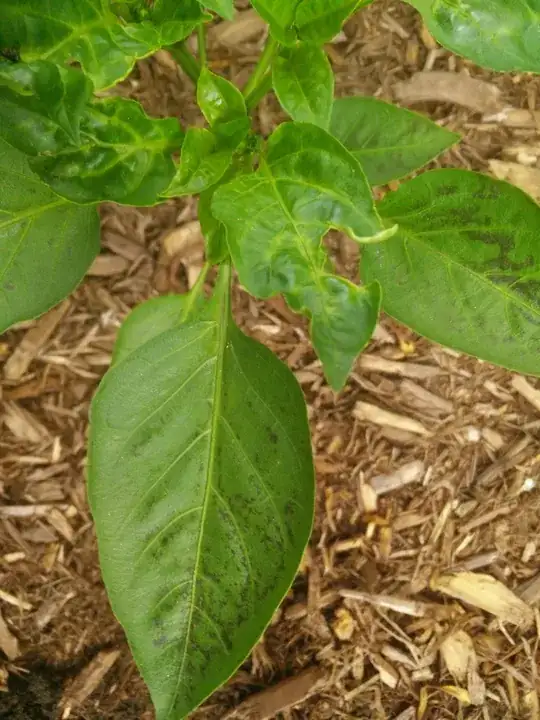
I live in Montreal Québec and have planted bell peppers in a new raised bed. All was well for two weeks and then the leaves started to cup, develop holes and now are now starting to have black marks on them.

I have looked for bugs under the leaves but have found nothing. We have been getting a lot of rain.

Any idea what might be causing this?

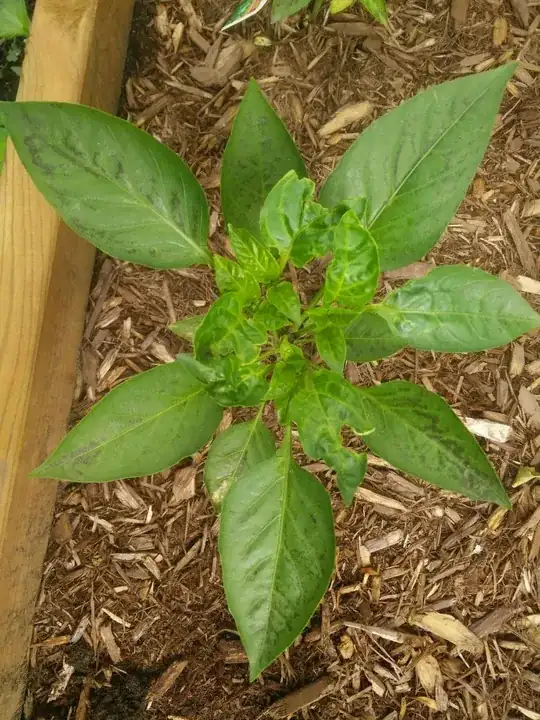
enter image description here enter image description here enter image description here enter image description here

Edit :added another photo

Edit: More images, garden shot and eggplants enter image description here enter image description here

Edit 3: Week or so later, after applying some controlled release fertilize, posting this as an imgur album as the photos were to large for direct posting. I think they are looking a lot better, which makes me hope that the issue is not a virus, rather just an amateur gardener not giving the plants what they need. Also got a pepper growing, and a few flowers. https://i.sstatic.net/UZMQJ.jpg

Stephen Fritz
  • 163
  • 1
  • 6

4 Answers4

5

No you didn't need to leave a gap between the wood and the soil, and there's clearly drainage because its open at the bottom and you dug that soil over.

I'm hesitant about what's wrong, there are so many things that can affect bell peppers (see list of possible problems here http://www.ipm.ucdavis.edu/PMG/GARDEN/VEGES/peppers.html). Something has been eating the leaves, which is not the major issue, but not sure what's causing the black markings, and the upper leaves appear puckered or bubbled, slightly deformed and somewhat yellow, so I'm wondering about a viral infection. I hope it isn't, but if it is, there's no treatment. The other possibility is oedema, if you've had lots of rain and the plant's taken too much up, that will cause some puckering too, but usually with bumps beneath the leaves. Thrips infestation can also cause puckering, but not yellowing, though that could be accounted for by low nitrogen availability - I'm not really being much use, am I, because I'm unable to isolate the cause, sorry. The list of possible problems in the link above might be useful - if you click on any one, it takes you to another page with information about that problem.

UPDATE; to include information in comments. Yes, you can transmit tobacco mosaic virus to peppers and tomatoes if you handle them after smoking, see here http://www.missouribotanicalgarden.org/gardens-gardening/your-garden/help-for-the-home-gardener/advice-tips-resources/pests-and-problems/diseases/viruses/tobacco-mosaic-virus.aspx. That does not mean that's what's happened though, most viruses present in the same manner, with torsion of the leaves and yellowing in mosaic or band patterns, which I'm not seeing yet on yours, the yellowing is more generalised. Time will tell if it's a virus.

Bamboo
  • 135,647
  • 3
  • 80
  • 169
5

The twisted and deformed new leaves tell me this is calcium deficiency. Sometimes just too wet of soil and/or cold soil will cause this. Then there is the yellowing of the young leaves that could mean iron, zinc or manganese deficiency. The 'rosetting' of the top leaves where the internodes are serverely shortened is definitive of lack of zinc.

These nutrients or chemicals could be present in the soil but have just been made unavailable by temperature, moisture, an overabundance of one or more chemicals and most certainly pH. So don't apply anything until we have a better idea what is in that soil.

I am lost with the statement 'should I have left a gap between the wood and soil'. You did well by digging the soil up beneath but is there a wood bottom? Just would like that clarified. Also need to know have you used any fertilizer at all? If so really need to know the list of macronutrients as well and micronutrients if any. Do you still have the bag the soil came in?

What causes problems some bagged soils have added fertilizers. They need to be accounted for before adding any other fertilizer. Were these peppers planted as starts from the store? The older leaves look a little too green (too much nitrogen) and the streaks indicate phosporous deficiency. It is hard to tell in photographs. Those leaves would be the leaves that came with the plant when you purchased them from the nursery/store.

Then there is the non decomposed bark chip mulch. As we speak decomposers are furiously working to decompose that wood. Decomposers use lots of nitrogen as an energy source depleting nitrogen availability to the plants.

Please get back to us with more details, Stephen. Try to get a pH test of your soil, via at least 2 methods that agree. If it has been raining a lot has it also been cool temperatures? What are the temperatures at night? Is the only wood the sides or is there a bottom? Raised beds are great for drainage and helping soils warm, unless there is a bottom. Find those bags and list of ingredients to pass that information on to us. Sorry this isn't a definitive answer as yet. Oh, and did you use your garden soil with the bagged soil? Or is this all bagged 'soil' that sits on the garden soil?

This is a multidimensional and interesting problem, Stephen! We'll be back with more information soon. Please send us more details, asap...thanks!

stormy
  • 40,664
  • 4
  • 33
  • 76
4

Possibly the use of CCA-Treated wood (aka Copper-Chromium-Arsenic pressure-treated lumber) might be the source of such an issue. I say that because of the green color of your wooden pot.

From this resource:

Low concentrations of arsenic, chromium, and copper occur naturally in water, soil, plants, and the human body[...]. Intake of excessive amounts, however, can have adverse effects on plants and humans.

[...]

Several studies have clearly shown that As, Cr, and Cu can leach from (be removed from) CCA-treated lumber when it comes in contact with water, soil, and/or compost. The amounts of these elements that are leached from the wood depend on several factors.

Increasing factors:

  • if the whole pot is completely soaked with water that never drains
  • acidic soil
  • organic matter

    Loss of CCA metals is increased when CCA-treated wood is in contact with certain materials, such as silage or compost, that are high in organic matter and have an abundance of organic acids. Such organic acids are formed during production of silage and compost. Because organic matter strongly binds CCA metals, little of what is released into these materials can be taken up by plants.

J. Chomel
  • 3,770
  • 3
  • 17
  • 36
1

This looks like a lack of available calcium to the plant (with some sunscald that is probably on leaves that grew before the transplant, not being used to the full sun; northern regions can get a lot of sun).

I'm guessing, if this isn't a virus or pest causing the symptoms, that your soil has too much available potassium in it, which can interfere with calcium and magnesium absorption. Potassium is supposed to be more available when it's cool, which could explain why my plants with similar symptoms recover when it gets consistently hotter.

Wood chips are high in both calcium and potassium, but I know from experience that adding large amounts of both calcium and potassium seems to contribute to blossom end rot in Martino's Roma tomatoes. So, I'm guessing potassium wins when there are large amounts of both nutrients.

Adding extra nitrogen might help, if it wouldn't be too much for your soil. I believe nitrogen can inhibit potassium and vice versa. I believe I've also heard or read that calcium and nitrogen need to be in balance.

I also have experience giving tomatoes and peppers with too much potassium extra magnesium to treat apparent magnesium deficiency (but it didn't do much; I'm guessing the extra potassium stopped the plant from using it).

Calcium, potassium and silica are all important for strengthening plants. If a plant is deficient in calcium, it may be more susceptible to insect damage.

Magnesium is more available when it's cool than when it's hot (so, that might explain why you don't see obvious magnesium deficiency symptoms). Plus, it probably takes quite a bit of heat before you'd notice it, anyway.

Anyway, I could be wrong. Stormy's answer is very helpful, I think.
Brōtsyorfuzthrāx
  • 18,694
  • 6
  • 30
  • 70