13

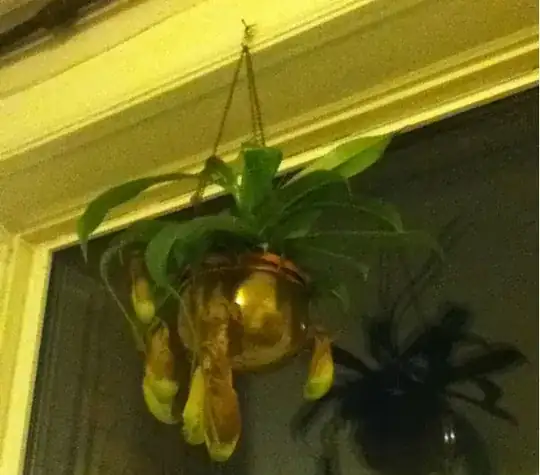
I received what I guess is a Nepenthes last month, but the pitchers have all dried out by now. It starts with the lid drying up and once that happens it takes 10 days until the entire pitcher is all dried up. I cut it off before this happens.

I read that its soil may never dry out and that it needs much light but not direct sunlight.

What am I doing wrong?

  1. I wait until the soil is almost dry and then give it lots of water. This is around each fifth day.
  2. I placed it in a hanging pot in a window over the kitchen sink, where there is never any direct sunlight but occasionally are lots of non direct sunlight. (Sweden, so sun is not strong.)
  3. I replanted it and gave it a bio-fertilizer that actually had a way expired date.
  4. ?

enter image description here

J. Musser
  • 52,241
  • 23
  • 122
  • 333
JOG
  • 251
  • 1
  • 2
  • 7

8 Answers8

6

It sounds like humidity is the problem.

If I understand correctly, you are growing it in a pot in a window sill? In non-tropical climates, I have only ever seen Nepenthes growing in tropical greenhouses (I find they are common plants in public tropical greenhouses in both the US and UK).

In the days when I grew CPs (Carnivorous Plants) myself, I never tried Nepenthes because the books said I would need a terrarium. The only time I have seen them not in a terrarium or greenhouse, was in Costa Rica where I saw one growing in a hanging basket as a 'pot plant'. They are actually native to SE Asia tropical rainforest, and not Costa Rica - but the tropical conditions were sufficient.

As they like rainforest conditions, keeping it out of strong sun (as you are doing) sounds like a good idea. However I bet you are missing the warm humid conditions. I would try a terrarium or give up.

If you want to grow pitcher plants in temperate conditions, then Sarracenia ("Trumpet Pitcher Plant") are worth a try. I managed to grow them from seed on UK window sills. The other common one in cultivation (Darlingtonia) is considered difficult to grow, although it has a striking pitcher. It is sensitive to conditions but is native to Oregon,US - so you might need an unheated terrarium!

winwaed
  • 20,513
  • 4
  • 65
  • 118
5

Never let a nepenthes sit in water it will kill the plant I use a small terrarium for my nepenthes with a sphagnum moss and foam mix although many other pourous draining soils with lots of air spaces works great. This soil type has helped has kept my ventricosa x Mira hybrid alive for years and if yours is a highland species it needs a nightly tempurature drop which I supply to mine by bringing it downstairs every night where it is about fifty five to sixty degrees then back up to my room which is about eighty degrees. Also you should allow it to dry out somewhat but always remain moist. Give it almost direct slightly shaded light and if it sits in water it is doomed to root rot so never do that. I hope I helped and good luck

Connor
  • 211
  • 3
  • 4
4

First of all, you have a nice Nepenthes! Its a mythic plant :)

It looks like a Nepenthes ventrata, or a hybrid. It's not a Nepenthes ampullaria for sure.

  • Your plant needs rain or demineralized water
    Water the plant when the surface of the soil is a LITTLE BIT dry.
  • Your plant needs relative humidity of 70% or more.
  • Your plant needs a 4-5°C temperature drop each night.
  • Your plant needs very airy soil, like orchid mix (you can find this at Lowe's or Home Depot, or any gardening center in your area).

  • Your plant does NOT need a fertilizer. If you are not experienced, you will kill your plant. The only fertilizer I use is insects. You can drop a little insect in a pitcher each week. If your plant lost all their pitchers, just wait for new ones.

A terrarium is an easy way to cultivate your Nepenthes. You can grow the plant as a normal plant, outside a terrarium, but you need to maintain a minimum RH% (40-50%+), so you would have to mist the leaves 5-6 times a day.

Hope this helps!

Niall C.
  • 7,289
  • 11
  • 53
  • 81
3

Not all Nepenthes will work as house plants. I have tried N. alata with no luck.

N. miranda is a hybrid that I have had good luck with. I bought it at Lowest as an adult larger plant 5 years ago. It is a fussy plant as far as repotting. Taking several months to start growing well. Despite this it gets used to normal New England conditions. I grow it in a bay window and water it when the top of the bark mix gets dry. It sees winter humidity of 20 percent and strong summer sun. At most I mist once a week and under these conditions this Nepenthes has about 10 traps and 5 growths. The longest vine is about 5 feet long and has 4, and counting, upper pitchers. It has flowered twice.

So some nepenthes can be like a big bug eating house plant with no extra care. This plant has solved an ant problem in the house also. In my green house I have around 20 more Nepenthes. Not sure if any would do well in the house.

Most of my plants are hybrids crosses with truncata/merrilanna/maximal etc. So these plants get very large and will someday have two foot pitchers. As of now only 12 inch on some.

All these plants will have to go to my basement for the winter. It is too costly to heat the greenhouse but rather than going into wood boxes with lights they will go into a 6 x 8 greenhouse in the basement With lights.

I have rooted N. alata and grown it for a year in wet sand. In other words some things work for some and not for others. A plant that pitchers is happy having the light, humidity and soil mix/ water that it needs. N. miranda for me is a house plant and very easy to care for.

kevinskio
  • 62,221
  • 9
  • 80
  • 167
Tom
  • 31
  • 1
3

The fertiliser was a huge mistake, carnivorous plants hate root nutrients, so if you added any fertilizer, it would have to be extremely diluted, and apply it to the pitcher.

Water it more often, try misting it, too, with a cleaned spray-bottle.

Only use pure water; don't use tap water because it will kill the plant.

Anonymous
  • 31
  • 1
2

I'd just like to add that the suggestions saying tap water will kill your plants is a massive generalisation. Buy a TDS/PPM meter and check your tap water. If your tap water is around 100 PPM or less you'll be fine. Getting towards 200 PPM is dangerous for your carnivorous plants.

You'll want to test the calibration with some water with a known PPM (check at your local store for mineral water which has its PPM on the packaging). If you test water which has collected in a saucer of a plant with a fertilised growing medium, or directly in water which has fertiliser dissolved you'll see a reading of serveral hundred PPM.

It's a cheap (£3 including delivery), fairly reliable and quick test to see if your tap waters appropriate.

2

I got some advice from a colleague, that says he kept one alive for 4 years. He said:

  • It needs more than just get "watered"; It needs to "stand in water". He watered his everyday.
  • He tried to use mostly distilled water, as his tap water contained too much lime, which eventually would clog the roots. (I will not waste my money on buying distilled water though.)
  • Never mind the directions about non direct sunlight, because the sun is not too strong here anyway.
JOG
  • 251
  • 1
  • 2
  • 7
1

I attempted to make a tiny terrarium for a nepenthes out of a water bottle. Had some success, though if anything became too humid/ not enough aeration for the roots, and rotted from the base up.

TBF i wasn't living at the property the whole time either, so it did get a limited amount of love :(

I wrote up the process here: http://www.biomimicron.com/horticulture/nepenthes-bottle-greenhouse/

DaveRGP
  • 236
  • 2
  • 5