5

My father's neighbour keeps pigs. Father has no problem with this and indeed it amuses me somewhat that he's chosen to plant an apple orchard on that side of his plot. He doesn't really have any problems with noise from the pigs, but they do seem to attract an increased number of flies/biting insects

The border of the plot comprises a few overgrown sycamores with plenty of adventitious growth around the base, a couple of fir trees and a wire mesh fence. I'd like to pretty it up for him by planting a border hedge and I'm looking for something colourful for the garden aesthetic, and/or possibly something fragrant. What I'd really like to know is if there is any planting that would generally keep the insects more interested in the plants than roaming the rest of the garden/house, biting the occupants etc. Neighbour also has a few other farm animals (geese/ducks/dogs/horses) and father keeps chickens, so I'm keen to know whether there are any species of plant that should be avoided in terms of poisoning the animals if ingested

I realise stackexchange sites don't typically do "recommend me a" type questions, but I'm hoping that he gardening section is a bit more flexible in this regard/that the questions I'm asking are fairly fact/hard answer based -

  • Can plants be more attractive to insects/form an effective fly screen, and hence improve screening.
  • Can those plants also be attractive to look at or smell in human terms, and
  • Are there any to species to avoid avoid in terms of representing a poisoning danger to the resident animals?

Location is Scottish borders

Caius Jard
  • 335
  • 2
  • 8

3 Answers3

1

What the heck zoning are you living in? Residential, farming, forestry, commercial? Those flies are enormously not cool for your neighbor to be propagating! He needs a better hygienic program for sure such as always cleaning out the poop! I am glad you are asking us. We need to know your zone of climate, your covenants if any for your area of the city or zoning of your country. Scottish Borders might be a lot looser in rules and laws and regs than here in the states where the zoning and rules are almost too restrictive. I live on RR10 which means rural residential 10 acre plots minimum. Allows horses, Vicuna, chickens, goats but there is enough room to not cause problems for neighbors. Absolutely no commercial is allowed. No raising pigs to sell for meat. No raising chickens for sale for meat, no eggs for sale but everyone does it.

I own horses and flies are a major problem. A horse person neighbor two lots down has been using predatory flies for years. I used to spray my horse and dog dung with Permectrin II and realized I was killing the flies she'd released. So I got smart and got predatory flies, stopped spraying, too.

What animals are you worried about poisoning when you do a hedge? My recommendation is a soft hedge of Blue Arctic Willow; Salix purpurea 'Nana'. Fine textured, 1" by 1/4 inch blueish leaves, they are bright green in the spring then become a blue/gray color shrub. Blows in the wind like grasses. The stems are fine and flexible and in the winter shine a dark copper. I love this shrub. It will grow to 30 feet high and as wide with a trunk 18" in diameter. Easily maintained by shearing once or twice per year. Actually an enjoyable shrub to prune! Because of the fine texture of this dense shrub, this plant will absorb noise, smells and flies better than any other soft, hedge material.

Soft hedges as Bamboo describes are planted in two rows off set; one forward then 2 or 3 feet over and back another plant then another plant 2 or 3 feet forward and away from the second. Planting on the points of an equilateral triangle for more 'formal' or varying the pattern to include isosceles triangles for more au natural, soft hedge. Each shrub is meant to be pruned as a a rounded, upside down salad bowl. Undulates so to speak as a hedge. This Blue Arctic Shrub will not need any pruning if you allow it to take off to be 20+ feet high and wide. The spacing will be different depending on what you want, need and how much room you have. One of the best shrubs for 'foundation' or skeleton planting in a landscape and brutally hardy, no problems with disease or insects I have ever seen. Blue Arctic Willow Shrub
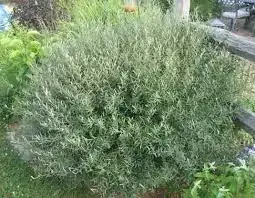
Blue Arctic Willow Shrubs after 2 years

sheared Blue Arctic Willows for small yard soft hedges

Blue Arctic Willow in a little park the second year without pruning

Seriously go order predatory flies! You sprinkle them around YOUR yard. Perhaps you could make a gift to your neighbor. I used to use Permectrin to spray my dung but that kills bees, predator flies (from my neighbor) and birds eat the insects that die from this very 'Organic' pesticide. Yet very gnarly. Made from daisies. Predator flies have been doing an even better job without adding toxic chemistry to sicken and kill birds, squirrels, rabbits and MY horses!

I use this stuff on their coats for fly protectant, lightly. Rarely. These fly predators work so very well and they breed and then they die in the winter. I can't imagine living next to a pig farm. Hey, I love pigs. They are one of the smartest animals in the same boat with whales, dolphin, African Grey Parrots and chimpanzees. They make incredible pets and can also be house trained. Their poop needs to be taken care of far better!

One more note; never use those fly zapping thingys. Those lights attract insects from as far away as 5 miles. Flies have zillions of viruses in their bodies and people put these zappers right above their picnic table? Give a neighbor a gift of a fly zapper. A neighbor you do not like at all. Grins!

Finally found the fly predators my neighborhood has been using and I am hands down impressed!
spalding fly predators for farms

stormy
  • 40,664
  • 4
  • 33
  • 76
1

There is really nothing you can do with plants that will reduce/attract flies and noxious odours from the pig farm. If your father lives there all the time, he's probably fairly used to the smell and may not notice it anywhere near as much as you do.

Flies are an issue - my in-laws had a chicken farm, and flies were a permanent feature of life there. The electronic zapper things which can be fixed to a wall are very useful inside the house if they're an issue indoors. If the property is on the Scottish borders, I imagine the infamous midges are in plentiful supply anyway, and they are biting insects so they are likely to be part of the issue, and they will be present, dung or no dung.

For your hedge, assuming there's the space, perhaps native, informal hedging is the way to go - it will support a large amount of indigenous life forms of all kinds (not flies though) and encouraging other insects and arachnids should help with reducing the fly population. This type of hedging is usually hedge trimmed a couple of times a year, just to keep it in bounds, not to create a formal, shaped hedge, and usually includes plants that flower, and is a great advantage to the general environment as well as being attractive, albeit in a 'wild' or natural way. Some suggestions for plants for that type of hedge here https://www.ashridgetrees.co.uk/gardening-advice/how-to-plant-hedge/hedge-plants-informal-hedging. UPDATE: Since I note that Stormy has now referred to my suggestion as something called 'soft hedging' in her answer, I'm obliged to add that is not what I'm suggesting at all. Informal hedging in the UK is more like hedgerow planting and usually uses native plants such as blackthorn, guelder rose, honeysuckle, hawthorn, dog rose and so on.

Chickens tend not to eat hedging plants nor large shrubs, but there's a list here of foods/plants that chickens should not be given nor have access to https://www.omlet.co.uk/guide/chickens/chicken_care/poisonous_plants_and_food/

Bamboo
  • 135,647
  • 3
  • 80
  • 169
1

Creating a barrier is unlikely to work (the insects fly) - indeed most flies prefer some shelter from the wind.

Whilst there are some plants which are claimed to deter flies, they are unlikely to solve your problem. Encouraging wildlife that can control flies might be a better option - a diverse native hedge will encourage small birds and insects that can predate upon the flies.

Most native hedgerow species are fairly safe (given hedges were originally designed for stock control, species that are likely to poison livestock were not included).