7

Problem

Anyone on the East Coast of the US is probably aware of what a rainy year it has been. As of my writing this, the last six months in Northern Virginia have had more rain (1149mm at Dulles Airport) than the yearly average (1021 mm).

This year's rain has exacerbated the swampy conditions of my backyard. After heavy rainfall, my yard gets so swampy that I can barely walk back there. Work boots tend to punch holes in the turf, and if I slip in the slick conditions, I'll tear up the grass. This year, the whole backyard has been so wet that I have not actually mowed a single time. The yard has been so soggy, that no one has been in it since April. I am barely exaggerating when I say that the soil has the consistency of mayonnaise.

The conditions

My backyard is more or less designed to be swampy. First, it is entirely in the shade of the house or backyard trees; it gets at most a few hours of partial sun a day. Second, most of it is at a 10% of higher grade, facing north-west, which is mostly away from the sun.

I thought the grade would help water to run off, but that hasn't been the case. Having dug some fenceposts, I can tell you the soil has about 4-6 inches of topsoil, followed by 1-2 feet of red dirt, then a pretty solid clay layer that is hard to dig through. I believe the problem is that drainage through the red dirt is slow, so the upper topsoil layer ends up super saturated.

What I need

I'm looking for some lawn-like vegetation to help control the swampiness problem. I am wondering if there are plants that can either

a. help to promote drainage, perhaps with deeper roots that let water get through that red dirt b. help solidify the soil someone, so that it can be walked on even if it has rained for a few days.

The grass that came with the house when I bought it (mostly fescue, I think) has survived for at least 4 years. I have no trouble with trying a more mixed lawn, even a 'lawn' of grass mixed with some other non-grass forbs, so long as they can help with drainage and be cut with a lawnmower.

For an alternate solution, the part of my backyard that is entirely underneath the trees has been overgrown with English Ivy. This looks fine, and is actually easier to walk on than the slippery lawn, but doesn't meet my requirements of looking somewhat lawn-like.


Edit for more info:
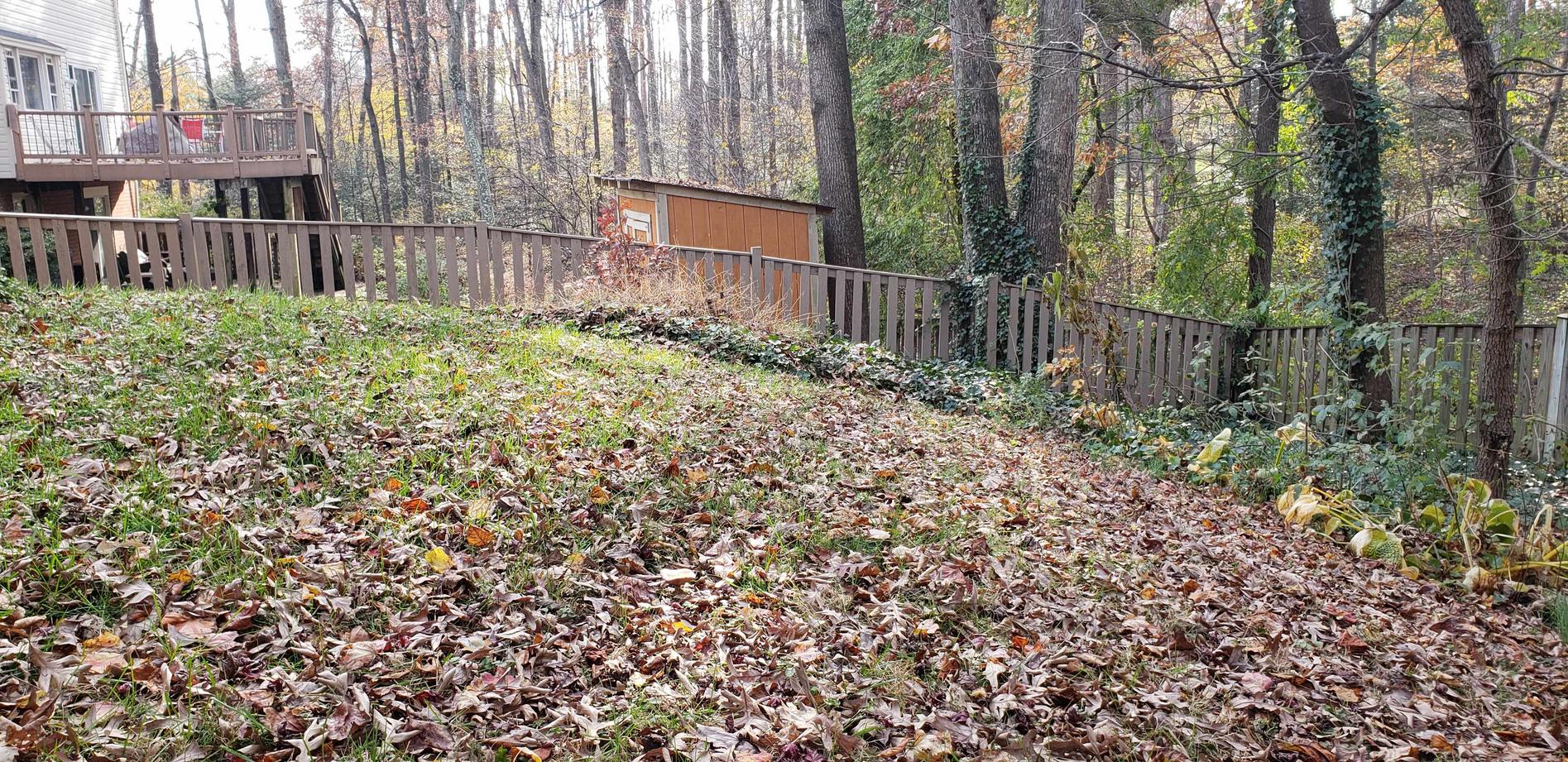
enter image description here

This shows the general slope and transition from grass to ivy. The stuff under the leaves is mostly grass, though mostly dead.

Beyond the end of the slope there is about 50 yards of woods until the next house. There is a stream back here that is perhaps another 10 feet in elevation below my back fence; this picks up whatever runoff there is.

If you look at the neighbor's house/deck, the deck is attached to the main level and the basement opens into the backyard. My house is the same way, so all this yard is below my basement level, so there are no flooding issues. We are on city water and sewer which comes in through the front. My front driveway is probably ~20 feet elevation-wise above the fence at the back end of the property.
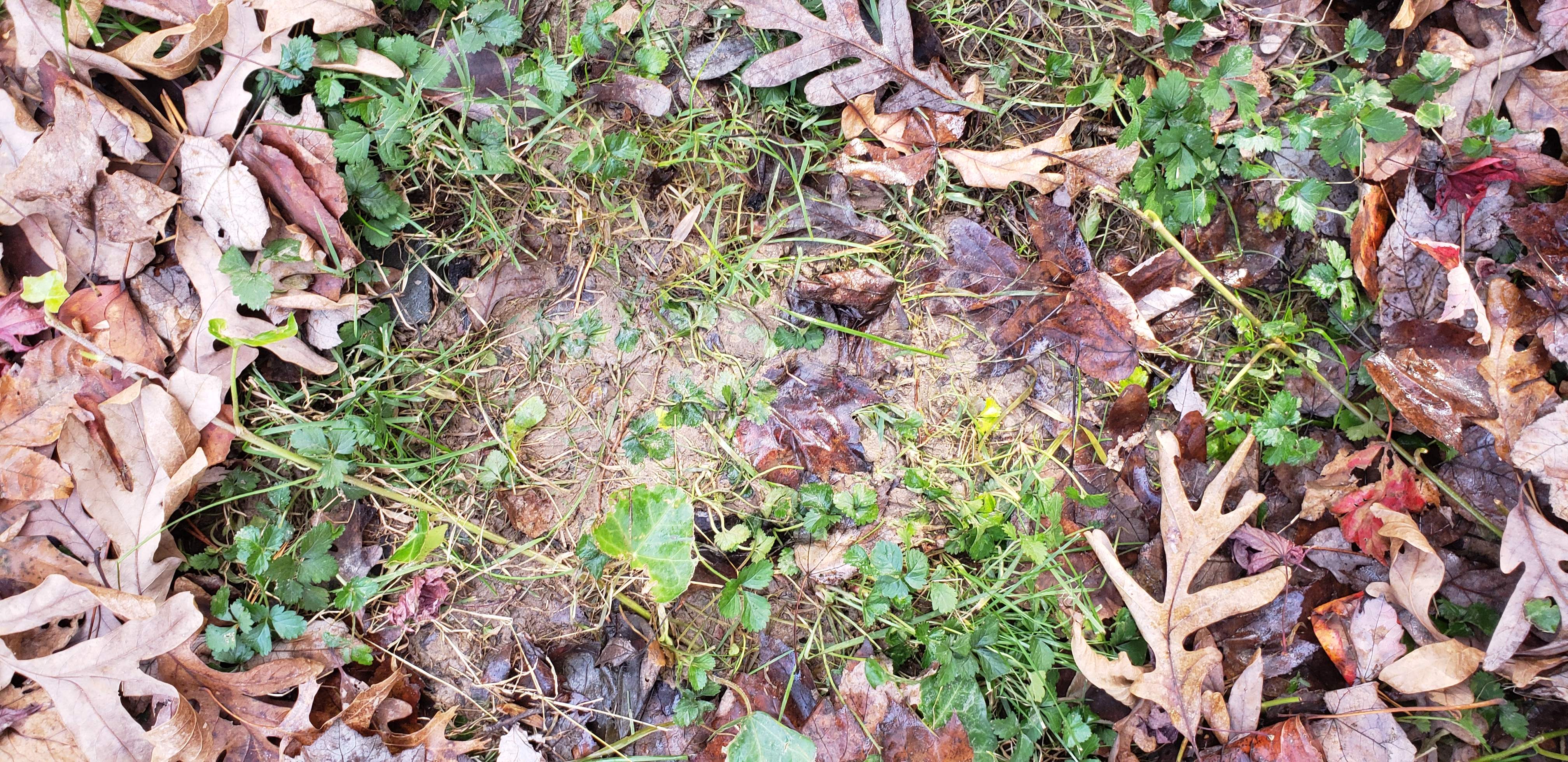
enter image description here

For reference, this is what a footprint looks like. It hasn't rained in about 72 hours, and there was a heavy rain about 90 hours ago. Note any footstep totally smashes the plants underneath, that's why no one in the family has been back here all summer, it just destroys what grass there is. Also note, there actually isn't much grass left. That footprint looks mostly like clover and wild strawberry.

kingledion
  • 173
  • 1
  • 6

2 Answers2

5

Most yards with this slope would drain better. It must rain an awful lot and your soil must be very high in clay. Nothing wrong with clay but this shows just how powerful water surface tension can be. Flat, electromagnetic tiny pieces of rock with little pore space and lots of rain will do this. I see lots of ranunculus in your lawn as well. I would assume a very low pH.

Installing a 'french drain' with herringbone tributaries, possibly 2 herringbone feeder lines into the central french drain might be enough to pull the surface water into the drain and away into a dry well?

You need to get that surface water being pulled out of the top 6 inches of soil. French drains will do that well. A central main vein and two, one on either side of this main line going from higher to lower and connecting to this central line/vein should cause that clay to give up its water, more quickly.

You have to have a dry well for all this water to be drained into; a hole 4'X4' and 3' deep, lined with l.s. fabric, filled with drain rock, covered with l.s. fabric and then covered with more rock or even duff from the forest.

The main french drain will day light into this hole. The angled collector lines will feed into the main line or 'vein'...think of a feather of a bird. The tip is uphill the quill is downhill. These french drains are easily dug using a 'trencher'. Easy to rent! If you had a viable lawn I would advise cutting the lawn and folding it back, trenching (16 to 18" deep), then laying drain pipe integrated with its own landscape fabric. Looks like 4 or more 3" PVC pipes, one on top of each other, covered with its own mesh and fits perfectly into this trench, no rock or anything else installed. Collects water and just the collecting of water PULLS more water from the soil and towards the main pipe which allows free fall of the water towards the dry well. The main vein/pipe can either be this high tech drain pipe or a solid pipe that takes the water to that dry well where is can slowly be absorbed into the ground.

Otherwise, you need to use 4" perforated drain pipe wrapped in landscape fabric that sits on a thin layer of pea gravel or just the soil itself. Usually the angled lateral pipes are perforated. The water then feeds into the main pipe which is usually not perforated and this causes positive drainage, just getting the water moving faster which pulls even more water out of the soil.

You also have a bit of work to do getting all that debris off the lawn. It stops the photosynthesis during the fall and it will also cause fungal diseases during the winter. Make sure you do not fertilize too close to winter time.

There are solutions for afterwards, but growing plants to suck up the water won't be one of them. Some ideas are to define a beautifully shaped small lawn...or two, where there is more light and make the rest of this area into beefed up plant beds.

Think of 'terracing'. You could also consider gravel. 3/4 minus crushed gravel. I love this stuff and when done correctly will be there forever. No soggy feet for sure. Terracing allows you to make interesting platforms, rooms, patios...out into your landscape. Low voltage lighting (not talking about those flying saucer path lights at all)...powerful.

First, like Kevinsky says! Drainage system in place first! Then let's landscape using your chunk of land's personality and make problems into some great design?

stormy
  • 40,664
  • 4
  • 33
  • 76
2

For a lawn-like look (but one that may not require mowing), you should look into sedges (genus Carex). Here are some recommendations for your conditions:

Carex socialis

Carex rosea

Carex muskingumensis - Note that there are hybrids of this species that may be shorter than the species.

Most sedges (especially the more lawn-like ones) require dry or well-drained conditions, unfortunately. Note that sedges bloom like flowers, but their flowers are insignificant. You may find the seedheads objectionable, however, so it's a good idea to find photos of them if you're interested in planting a sedge.

The sedges I've listed may be best suited to your area covered with ivy rather than as a true lawn substitute.

Jurp
  • 20,993
  • 1
  • 19
  • 40