3

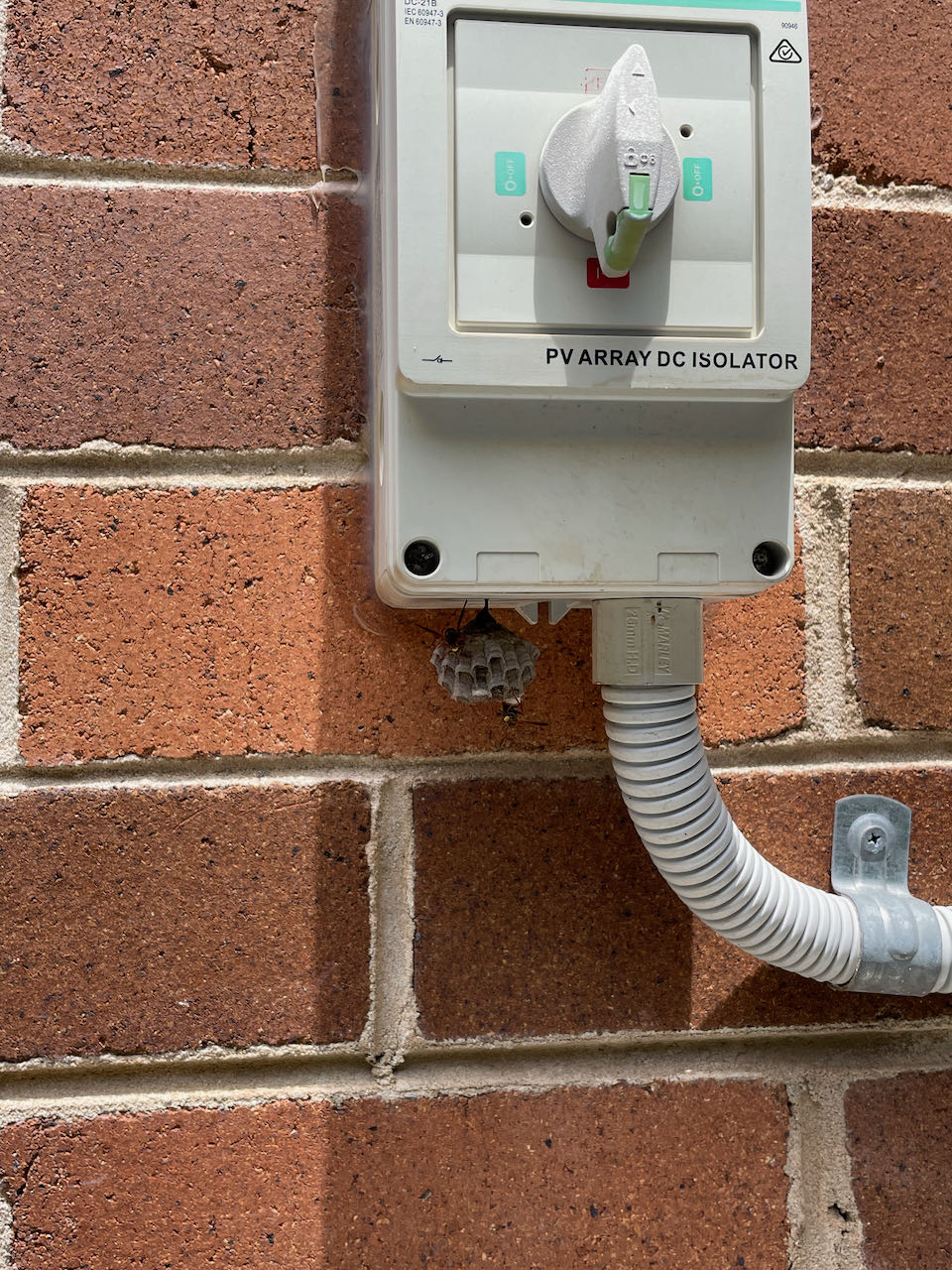
So I just discovered them under a solar panel switch ('isolator') today. I have no idea how long they have been there but I reckon it cannot be more than a month or so.
enter image description here

There are two of them and they look very guarded.

Question 1.

Are they wasps?

Question 2.

And what can I do to remove them? I am planning to expand the solar array so I think their removal is a necessity.

I have done a google, and here is a suggested method from rentokil.co.uk

  1. Approach the nest slowly and quietly at night time;
  2. Take a bin liner and slowly cover the wasp nest;
  3. Detach the wasp nest from the tree or wall it is attached to and seal the bag;
  4. Place the bin liner in an outside bin which has a tightly fitted lid, preferable away from the house.

I hope there is a method that does not require me to handle with close physical contact.

The switch is roughly at my eye level.

The location is in Sydney, Australia.

Anthony Kong
  • 451
  • 1
  • 5
  • 12

5 Answers5

9

Yes, that is a wasp nest in an early stage. If you can't just leave it be, act as soon as possible. (You may want to check the legal situation, though, some wasps are protected and their nests may be destroyed only in specific cases.) The instructions you found are also geared towards larger nests, remember that some can easily reach football size. Those are challenging, because you'll obviously deal with dozens or even hundreds of angry insects if done wrong.

For a nest that size, you can use a pole or broomstick to nudge it off the location. There won't be many adults to deal with and you can just shoo them away when you destroy the nest. If they are unharmed, they can and will build a new nest in a better location. At that size, there won't be many larvae in side, if they have started at all. So that would be the eco-friendly solution. Note that wasps do have their place in an intact eco system.

Stephie
  • 17,295
  • 5
  • 34
  • 61
7

I deal with wasps all the time. They like to build nests inside my ornamental aluminum fence posts. I used to go through wasp killer and while the residue would prevent them from coming back to the same pole, they still would come back several times per summer to other poles. Now, I simply use a few tablespoons of dishwashing detergent with a gallon of water in my lawn sprayer. They breathe through their exoskeletons, so once sprayed, they can't fly or breathe and they just drop down to the ground. Then I just soak the nest. Works perfectly and with the soap suds preventing them from flying, I am not scared of getting stun.

Evil Elf
  • 3,205
  • 3
  • 25
  • 32
2

About tablespoon or two of original Dawn dish soap mixed with water in a 32 fl. oz ( or I guess 15-30mL into a liter of water?) spray bottle will kill just about any invertebrate in a few minutes (including arachnids) and is effective against flying insects as well, from house fly's to hornets. The mixture coats or creates a film on their wings rendering them flightless as well as dispatching your pests by either dehydrating them or suffocating them, I can't recall.

1

It’s fairly expensive, but hundred percent pure peppermint essential oil diluted with water sprayed with preferably a long distance sprayer on the nest and also areas they frequent, such as holes in your walls where they going inside to build nests, will convince them to go somewhere else. I got stung three times in one week on my left wrist area and suffered lasting damage from them. So I ended up paying up to $30 a month for a sense of oil to make sure they didn’t come around my son's house where I was at at the time ultra eco-friendly but takes perseverance and patience my son does use the soap and water method!

Spectra
  • 1,333
  • 2
  • 13
  • 30
0

Put up fake nests. They are territorial and may stop future hives.