9

This guy has been growing like gang busters in a newly planted bed of ground covering sedums. It's actually kind of a nice ground cover but based on its rate of spread and the fact that I didn't plant it I'm thinking of yanking it all up.

It has oblong, almost jade-like leaves; grows from a ground hugging stem that sprouts radially from a rooted base. No flowers yet, but it spreads aggressively both in the garden and pavement cracks. Seems to prefer dry areas.
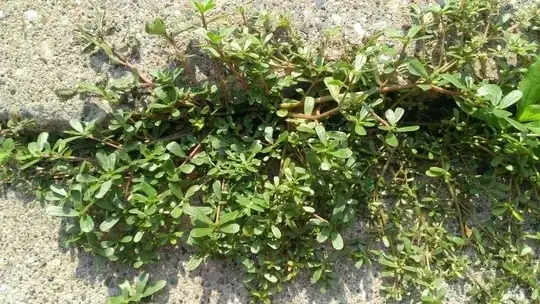
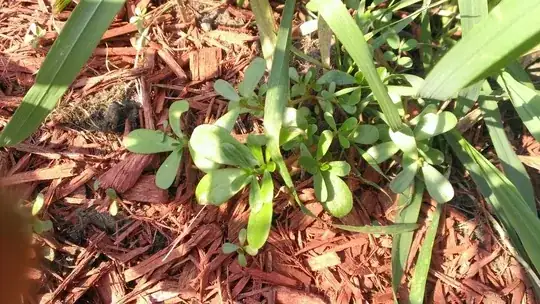
enter image description here enter image description here

dkackman
  • 403
  • 1
  • 4
  • 13

2 Answers2

13

This is Purslane (Portulaca oleracea). Identifying characteristics are the ground-hugging branched stems that you mentioned, and in the photos, the paddle-shaped leaves in pairs along the stems, with the leaves clumped closer together at the ends of the stems.

It's an annual weed that grows extremely quickly once hot weather arrives. When the flowers arrive, they'll be tiny and pale yellow in color.

It responds well to weedkillers such as RoundUp, but I usually find it in my vegetable beds so I tend to control it by hand using a hoe to cut the stems just below ground level. I also find it fairly easy to pull by hand if the ground is wet -- just grab the entire plant underneath the branching stems and pull straight up. It can re-root itself if you leave pieces lying around so be sure to remove them.

(It can also be eaten as a leaf vegetable, but personally I don't like the taste.)

Niall C.
  • 7,289
  • 11
  • 53
  • 81
0

Toxic Purslane

Needed a quick patch, tall rye was highly suggested, bought Pennington Tall Rye, got over run with Purslane. I have a pet friendly yard, now it's ruined!

Purslane contains soluble calcium oxalates, which are poisonous to cats, dogs and horses, according to the ASPCA. Cats who ingest part of the plant may drool, vomit, or show other signs of digestive stress such as diarrhea or bloody urine. Purslane toxic to cats and dogs