4

2009 BMW 328i (N91 Fuel pump) cranks but wont start, what I have checked thus far:

  • Sprayed starter fuel inside the throttle body and it starts up.
  • Verified proper voltage is being sent to the pump from the pump's control module.
  • Verified that the pump is working (bought and installed a new pump as well).

What else could be preventing the pump from pumping fuel to the car ?

The gas tank is shaped like a saddle, if something goes bad on the other side, could that stop the distribution of fuel to the car?

(I am almost sure that the pump is not pushing fuel to the line that distributes fuel to the car engine)

Thanks in advance guys.

Fuel Pump: enter image description here

Pᴀᴜʟsᴛᴇʀ2
  • 165,084
  • 32
  • 259
  • 508
andre3wap
  • 253
  • 2
  • 4
  • 11

3 Answers3

4

Let's start with some pictures to try and clear up the function of the fuel system.
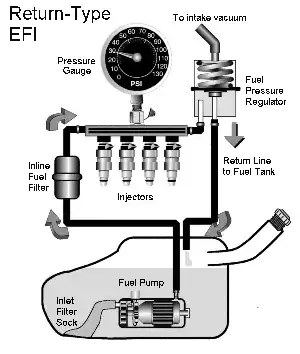
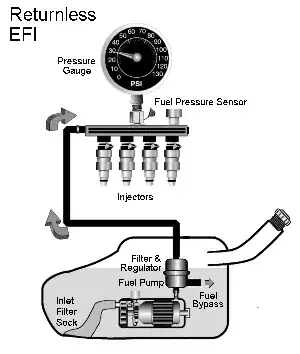
Return type EFI systemReturnless EFI system

Both images and a lot of the information comes from here: http://www.aa1car.com/library/returnless_efi.htm

There are two main types of Electronic Fuel Injection (EFI) systems. The return type, and the returnless type. In the return type, excess fuel is pumped to the fuel rail, and intake vacuum is used to regulate the pressure, and excess fuel is returned to the tank. In a returnless system the filter and regulator are often part of the pump assembly and are either inline, or submersed in the fuel. Sounds like yours is submersed in the fuel. The article talks about most modern cars, and your's would be included, are returnless systems. You would need to check the book on yours to find out for sure which your car uses.

Note that in both systems, the tank is not something in two halves, it's one large tank. There is no movement of fuel from one side of the tank to the other. Fuel tanks on street cars are generally one large tank. There may be systems (like baffles) that help prevent sloshing of the fuel, but there is one fuel pickup near the bottom of the tank, and if it's a return system, a single return. Nothing to move it back and forth across two halves of the tank.

Two things that may help you in finding the problem. First is that while research may show the common failures if your testing shows those systems to work well, then your cars fault lies elsewhere. Second, the other big difference between carbureted fuel systems and fuel injected systems is the fuel pressure. An injected car typically runs between 30 to 60 psi, much higher than the 6 to 8 psi for a carbureted car. You need to check the book on your car to see what the normal pressure should be. Your pump may move fuel, but if the pressure is way below where it should be, the car may not start.

Next, don't focus entirely on fuel. If your testing shows that the fuel system is delivering the right pressure, and the injectors are not clogged (which seems likely since they should generally not all fail at once) your problem is not fuel. Check for spark on each cylinder, and see if you are getting any.

I would also suggest using a scanner to see if the ECU is throwing any fault codes. If the check engine light is on, you will certainly find codes when you scan for them. That will also help diagnose the problem.

Hope that helps!

cdunn
  • 9,326
  • 8
  • 44
  • 76
4

Sorry for the long wait fellas, but after banging my head for a few days, I finally figured out what was the issue. It wasn't injector problem nor the fuel pump. It turned out to be a BMW clamp that got loose and pressure popped off the hose it held down inside the gas tank. Look at photo:

enter image description here

andre3wap
  • 253
  • 2
  • 4
  • 11
3

So, after the edits to the original question, the tenor of the question changed, and a new key piece of information has emerged. Spraying starter fluid into the throttle body gets the engine to turn over. So, clearly you have a fuel issue. It's an Electronic Fuel Injection (EFI) system, and I suspect it's a non-return EFI system. So for the fuel to get from the tank to the cylinder, several things must work:

  • Pump must pull fuel and get it through the regulator, and the filter
  • The regulator must allow the proper pressure get to the filter
  • The filter must pass the fuel to the fuel rail
  • The injectors must spray a reasonable enough pattern to get the fuel to ignite

Seems unlikely that all the injectors failed at once, so start by looking for proper fuel pressure at the fuel rail. Your pump may move fuel, but without the proper pressure the engine may not start.

If you have good pressure in the rail then it is likely the injectors. I suspect you will find that the pressure in the rail is not up to spec. The book on your car will tell you what that pressure should be. The pressure should be very close to that.

If the pressure is not what it should be, check your fuel filter. The regulator is probably part of the fuel pump assembly, so that's likely good, which means if pressure is bad at the rail, that the filter is clogged.

cdunn
  • 9,326
  • 8
  • 44
  • 76