This is not really an answer (well it sort of is), I just wanted to clear some things up from the comments.
First those little tabs covering the holes in some plastic boxes, are NOT knockouts. They are clamps.
In this case, however, they do appear to be knockouts.
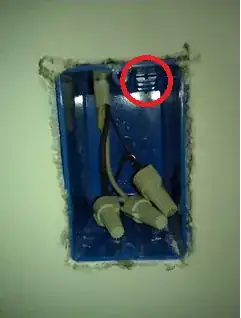
If they were clamps you'd push the cable into the box past the clamps, then the clamps prevent the cable from being pulled out of the box. They can be a pain in the butt to work with, but they hold the cable fairly well.
Second, lets see what NEC 2008 says about securing the cable.
334.30 Securing and Supporting. Nonmetallic-sheathed cable shall be supported and secured by staples, cable ties, straps, hangers, or
similar fittings designed and installed so as not to damage the cable,
at intervals not exceeding 1.4 m (4 1⁄2 ft) and within 300 mm (12 in.)
of every outlet box, junction box, cabinet, or fitting. Flat cables
shall not be stapled on edge. Sections of cable protected from
physical damage by raceway shall not be required to be secured within
the raceway.
(A) Horizontal Runs Through Holes and Notches. In other than vertical runs, cables installed in accordance with 300.4 shall be
considered to be supported and secured where such support does not
exceed 1.4-m (4 1⁄2-ft) intervals and the nonmetallic-sheathed cable
is securely fastened in place by an approved means within 300 mm (12
in.) of each box, cabinet, conduit body, or other nonmetallicsheathed
cable termination.
FPN: See 314.17(C) for support where nonmetallic boxes are used.
(B) Unsupported Cables. Nonmetallic-sheathed cable shall be permitted to be unsupported where the cable:
(1) Is fished between access points through concealed spaces in finished buildings or structures and supporting is impracticable.
(2) Is not more than 1.4 m (4 1⁄2 ft) from the last point of cable support to the point of connection to a luminaire or other piece of
electrical equipment and the cable and point of connection are within
an accessible ceiling.
(C) Wiring Device Without a Separate Outlet Box. A wiring device identified for the use, without a separate outlet box, and
incorporating an integral cable clamp shall be permitted where the
cable is secured in place at intervals not exceeding 1.4 m (4 1⁄2 ft)
and within 300 mm (12 in.) from the wiring device wall opening, and
there shall be at least a 300 mm (12 in.) loop of unbroken cable or
150 mm (6 in.) of a cable end available on the interior side of the
finished wall to permit replacement.
314.17 Conductors Entering Boxes, Conduit Bodies, or Fittings. Conductors entering boxes, conduit bodies, or fittings shall be
protected from abrasion and shall comply with 314.17(A) through (D).
(C) Nonmetallic Boxes and Conduit Bodies. Nonmetallic boxes and conduit bodies shall be suitable for the lowest temperature-rated
conductor entering the box. Where nonmetallic boxes and conduit bodies
are used with messengersupported wiring, open wiring on insulators, or
concealed knob-and-tube wiring, the conductors shall enter the box
through individual holes. Where flexible tubing is used to enclose the
conductors, the tubing shall extend from the last insulating support
to not less than 6 mm (1⁄4 in.) inside the box and beyond any cable
clamp. Where nonmetallicsheathed cable or multiconductor Type UF cable
is used, the sheath shall extend not less than 6 mm (1⁄4 in.) inside
the box and beyond any cable clamp. In all instances, all permitted
wiring methods shall be secured to the boxes.
Exception: Where nonmetallic-sheathed cable or multiconductor Type UF cable is used with single gang boxes not larger than a nominal size 57
mm × 100 mm (2 1⁄4 in.× 4 in.) mounted in walls or ceilings, and where
the cable is fastened within 200 mm (8 in.) of the box measured along
the sheath and where the sheath extends through a cable knockout not
less than 6 mm (1⁄4 in.), securing the cable to the box shall not be
required. Multiple cable entries shall be permitted in a single cable
knockout opening.
So what does this all mean?
334.30 says we have to secure the cable every 4 1/2' and 12" from each box, however, 334.30(B)(1) says if we are fishing the cable through finished surfaces the cable does not have to be secured. So we can have an unsecured cable in the wall, but 314.17(C) says if we are using a nonmetallic box the cable must be secured to the box (this is where the clamps come in). The exception to this rule, is if the cable is secured within 8" of the box. If we secure the cable within 8" of the box, we don't have to secure the cable to the box.


