TLDR: Ask the power company what size your service is. There may also be evidence on the meter or meter pan.
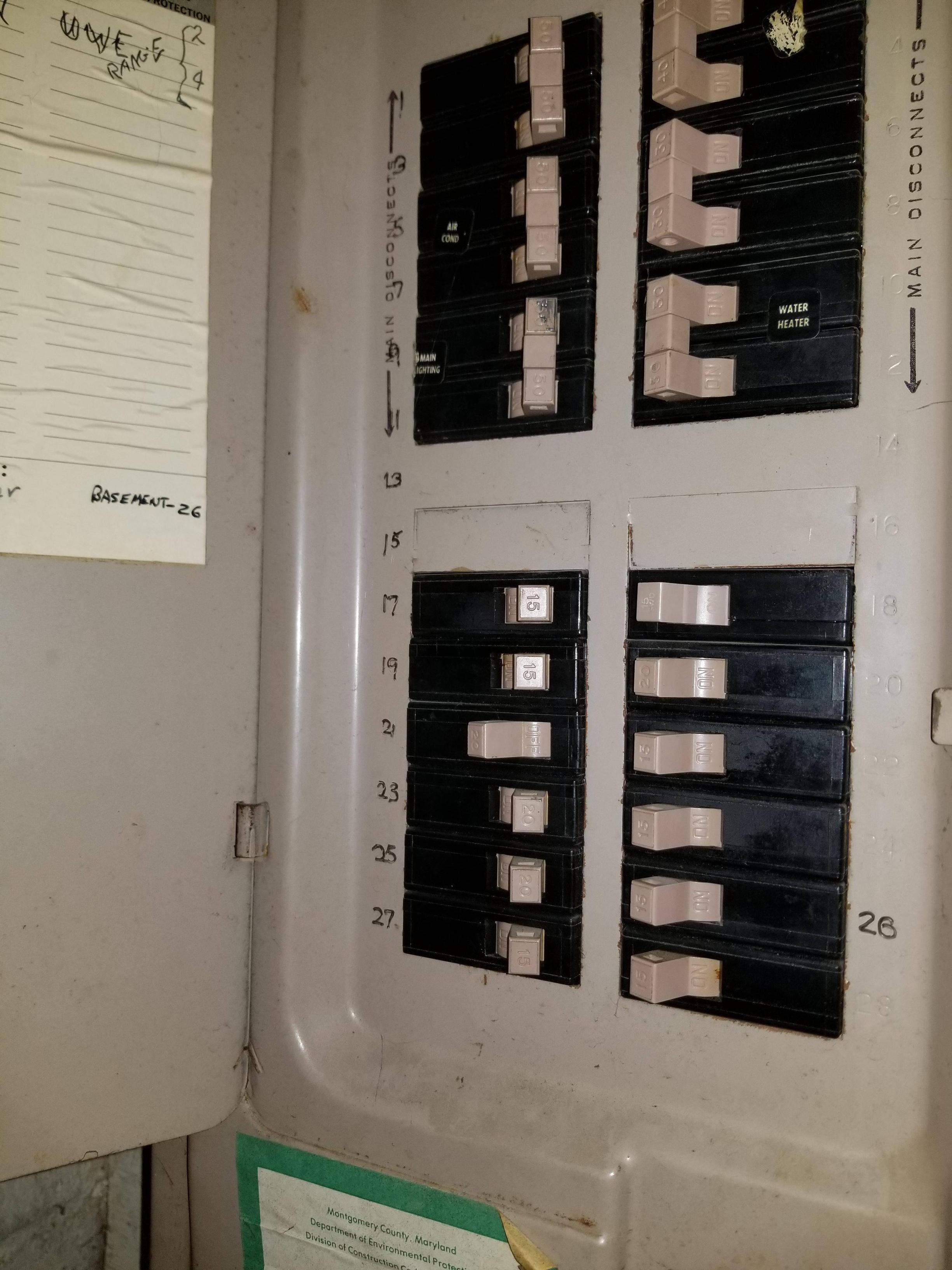
This is a classic "Rule of Six" panel
Where's the main breaker? Electrical service to houses used to be 60A. As it got bigger, there was a problem - large breakers like 100A or 200A were very expensive. A compromise was struck where the "main breaker" could be up to six smaller breakers. That's what you see in the upper part of this panel.
They are not paralleled! Each of the breakers serves a different load.
This panel, like many "Rule of Six" panels, has its own built-in subpanel - that's what you see in spaces 17-28. The subpanel area is fed by one of the six breakers in the "Rule of Six" area. This feeds all other loads in the house.
(Space 15-16 are not spaces, the lids are renovable but there are no busbars behind them.)
Your loads
What is in the upper area? Probably, based on labeling,
- space 1,3 50A ??????
- space 5,7 50A air conditioner (a little large? Maybe a heat pump with aux heat?)
- space 9,11 50A the subpanel below
- space 2,4 40A range/oven
- space 6,8 30A ?? likely an electric dryer
- space 10,12 30A water heater
You notice this adds up to 250A -- there's no such service size. You also notice the subpanel breakers add up to way, way more than 50A, so you can see it's normal to oversubscribe breakers on a service. Actually, breakers are there to protect wires and appliances. Wire size (e.g. 12 AWG) decides breaker size (e.g. 20A).
What size is my service?
As far as the subpanel area, your service is 50A, but hold that thought.
As far as the capacity of the "Rule of Six" area, you'd need to consult with your power company or look for evidence at your meter or your meter base.
EDIT: You could also pop off the panel cover and inspect (carefully, from a respectful distance) the fat wires landing on the main lugs at the top of your panel. Look for a size number right before the letters "AWG". Expect 2, 1, 0, 00, 000, 0000, 1/0, 2/0, 3/0, 4/0 (these are the same as 0 thru 0000). Or right before the letters "MCM" or "KCMIL" expect 250, 300, 350, 400 or 500. Those wires come from your meter and will inform the size of your service, as these are the wires that will burn your house down if you overload them.
EDIT: Your other limiting factor is the capacity of the panel. Search it for marks as to its maximum capacity in amps, typically 100, 125, 150, 200 or 225. Exceeding this is out of the question.
Keep in mind you only have 5 breakers in the "Rule of Six" area and you are full. You can get CH breakers up to 100A ($50) or 125A ($110) in the normal shape (which would force you to abandon one large appliance)... or 150+ amps in "beast mode" packaging, where the breaker is 4 spaces wide (eliminating two large appliances, ouch).
The problem with the "Rule of Six" design is there is no main breaker to keep you honest, so nothing really keeps you from putting in six large things and overloading the circuit and burning those wires. That's why Rule of Six was outlawed. You can't buy a panel like that today, and you shouldn't continue this one in service any longer than you have to. Dismantle it lovingly, and offer it up on eBay. It'll save someone's bacon. But only sell it to a licensed electrician.
Get a better panel and make this a "Rule of One" panel
If it was my house, I would add an additional sub-panel quite near this one, and move all my loads to it. Then I would fit one of those big CH breakers in the "Rule of Six" area and have it only power that subpanel. Put blanking plates over every other space in the old panel, and you now have reduced it to a giant main breaker only.
EDIT: Alternately 2 or 3 subpanels, as I would not be inclined to pay the big bucks for the 150A jumbo breaker.
I am very picky about panel brands. CH is a fine type (other than this one being "Rule of Six"), and I would even consider CH for my new subpanel. Reuse all your breakers!
It needn't be done in one sitting. Find a period when you can do without enough loads out of the Rule of Six area to make room for the new breaker (like A/C in winter). Once you wire up the new panel, at that point both panels are live, and you can move the other loads at your leisure, one per Saturday or whatever works for you.