3

I have two old thermostats (one for heating, the other for cooling) that I would like to replace with a single Nest E unit. I have central air and gas heating.

Cooling thermostat has the following connections: R (Rh and Rc are jumped) G and Y

Heating thermostat has these connections: R (Rh and Rc are jumped) and W

Combining these two into a single unit like Nest E seems simple - Nest has G W Y and R connections, HOWEVER - there is only a single R connection and from these two thermostats I have two R wires.

My question is 1) Do I have two transformers and therefore I need a unit that can support two transformers with separate Rh and Rc connections? Is there any way for me to check if my HVAC system is running from a single or two transformers? 2) If I do have a single transformer (again, how to confirm this) - can I connect just one of the two red wires and cap the other one off?

Thanks for any advice!

John
  • 31
  • 1
  • 1
  • 2

3 Answers3

2

If you have forced air A/C and radiant heat, you almost certainly have two separate transformers. So you'll have to use a thermostat that can work with separate transformers.

If the thermostat you choose requires a C wire, you'll likely want to supply the C from the A/C transformer. It's almost always easier to get the C wire from a forced air system, than from a boiler. Also, some thermostats actually require that the C wire come from the cooling system.

Once you've selected the thermostat you want, connect the wires as follows:

  • Remove any jumpers between Rc and Rh.
  • R from the A/C to Rc.
  • Y from the A/C to Y.
  • G from the A/C to G.
  • C from the A/C to C. (Where required)
  • R from the boiler to Rh.
  • W from the boiler to W.

Extra reading

With two separate transformers, the wiring should look something like this.
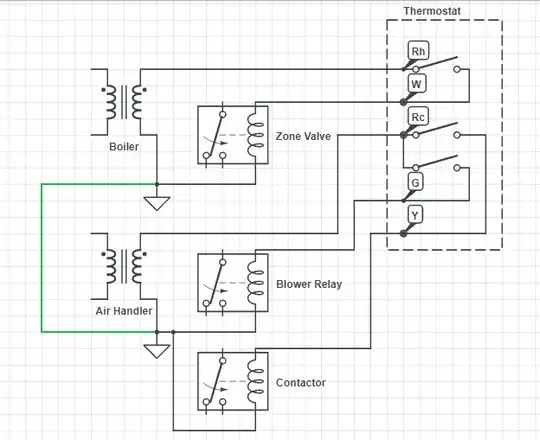
Two separate transformers

Notice there's no jumper between Rh and Rc.
The green line represents the equipment grounding in the building.

In this situation, everything works as expected.

If you have two separate transformers, but only connect one of the R wires. You could still have a complete circuit, if the transformers secondaries are bonded. However, since you're using the buildings grounding system to complete the circuit, you may find that there's not enough power to get things to work properly. You might find that the A/C works fine, but the heat doesn't (or vise versa, depending on how it's wired).
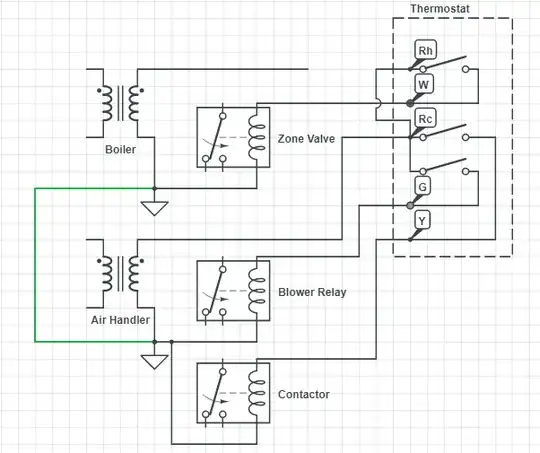
Two transformers one connected.

Two separate transformers, with only one supplying the thermostat.
Notice there's a jumper between Rh and Rc.

If you have one transformer that is supplying two R wires. It's the same as having one transformer, and using a jumper to connect Rh and Rc. It's just a really long jumper.
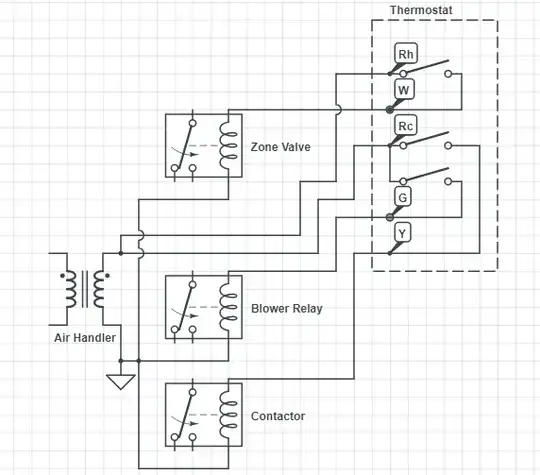
One transformer two wires

If you have two transformers, and you connect a jumper between Rh and Rc. You'd be connecting the transformers in parallel. If the transformers are identical (or close enough), this may not be a problem. As long as the transformers are in phase (and identical), everything should be at the same voltage potential. If the transformers are not in phase (or not identical), you'd be creating a short-circuit.
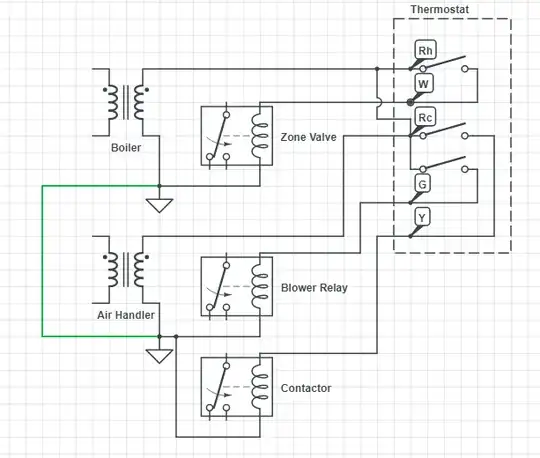
Paralleled transformers


If you have two R wires at the thermostat. The best bet is to remove the jumper between Rh and Rc, and connect the separate wires to separate R terminals.

Tester101
  • 133,087
  • 80
  • 327
  • 617
1

The reason why most thermostats have a Rh and Rc is for systems with two transformers. The furnace transformer red wire goes to Rh, and the cooling (A/C) transformer red wire goes to Rc. In a home with one transformer, there is a jumper wire to connect Rc and Rh. You have two thermostats, so you're not really using the Rc-Rh as designed. If you had one thermostat, you would have one red going to Rh, one going to Rc, and no jumper wire.

Now the Nest E installation manual specifically says:

IMPORTANT: If you have Rh and Rc wires, you have a dual transformer system. The Nest Thermostat E is not compatible with dual transformer systems, but you may be able to use the 3rd generation Nest Learning Thermostat.

So, if you have two transformers you are out of luck.

Now, the easiest way to test if there is one or two transformers is to use a continuity tester and touch both red wires. If the tester shows continuity, that means someone has run both red wires from the same transformer. If that is the case, you can just use one red and cap the other.

Another way, if the wires are all close enough to touch each other, would be to connect the A/C red wire to the heat thermostat (instead of the heat red wire, not with it) and turn on the heat. If the heat turns on, everything is running from the same thermostat. Even with two transformers this might work because if the transformers are in phase, the hot from one and the neutral of the other will give you 24v, but its probably not good to wire the thermostat that way. Stick to the continuity test.

Depending on how everything is installed and how the wires are run, you may be able to convert your system to use one transformer, but just getting the right thermostat is going to be your best bet.

JPhi1618
  • 28,377
  • 5
  • 56
  • 93
0

If there is no C wire anywhere, the usual way is to jumper the Y and G posts at the AC unit side then repurpose the G wire as C, at the cost of losing separate fan control.

If tying the two transformers via ground doesn't work, a 24V relay can be used. Again, this requires a C wire because the relay is energized by the first transformer.

 --Y-----#  o-----R----
Prim     #==|\       Sec
 --C-----#  o o---Y----
Stavr00
  • 263
  • 1
  • 7