25

My breaker box is very poorly labeled and I want to figure out which circuits may have overloaded (or close to it) and which could reasonably handle a little more.

In the past I have just tried flipping one of the breakers and then running around the house flipping switches and trying receptacles. Surely there is a better way?

If there is a reasonably priced tool that would make this a lot easier I would consider it.

auujay
  • 5,315
  • 15
  • 44
  • 55

13 Answers13

14

I tried one of the breaker finders, but it was worse than useless. So my solution was simple. I took a piece of paper and drew maps of every room in the house. On the map I located every outlet, light switch, etc. Then I turned off each breaker one at a time, and tested every outlet in a room, every switch. It helps to have a few items to plug into different outlets so you can test more than one outlet at a time.

For some boxes, you must be careful, as you may have two circuits going into the box in some cases. And some outlets may even be split in two, or some outlets are set up as switched outlets. Identify all of these things, taking careful notes on the map.

This all took little time, and perhaps even less time than it would have taken with a breaker finder. In the end, I have those maps, so whenever anything needs doing, I pull out the map and shut down the correct breaker easily before I do any work. Even so, I STILL check the box to test if the lines into it are dead. You can never be too careful with electricity.

10

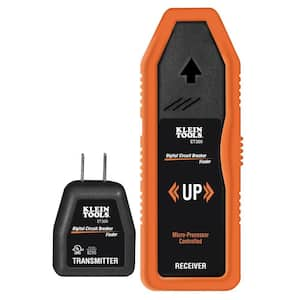
They make Circuit Breaker Tracers for this purpose

Tracer
(source: homedepot.com)

You plug in one end to the circuit you want to trace, then use the probe to identify which breaker in your panel the tracer is connected to. These devices differ from a telco tracer tool in that they work on live elctrical circuits.

This particular model is about $45USD at the time of writing.

Glorfindel
  • 1,187
  • 2
  • 14
  • 20
Steven
  • 27,770
  • 10
  • 56
  • 90
10

For one person, a loud portable radio (preferably one old enough that it turns on when power is restored, but a modern one that does not is usable, since the primary method of use is to plug it in, turn it up, and listen for when it shuts off as you turn off breakers. Saves on the running up and down part, a bit, at least for outlets.

For more than one person, lamps, lights, outlet testers and some communication make the process pretty fast.

Ecnerwal
  • 235,314
  • 11
  • 293
  • 637
7

I have a better solution if your by yourself than running around or running extension cords. Although it may not be feasible for everyone, I had used my security camera that’s powered by batteries so I was able to move it around the house and would turn the lights on in a particular room along with lamps and other devices plugged into the outlets. Then watching the camera on my phone, I’d flip through the breakers to find out which ones correlated with that particular room and jot it down. Another solution, if no camera is available, if you have a iPad there is an app that can be downloaded to be able to use your iPad as a security camera/baby monitor and view it through your phone. Although these options may not be the most “ideal” it has saved me a ton of time vs going up and down several flights of stairs to just check to see if it was the correct breaker I needed.

Ash
  • 71
  • 1
  • 1
6

Buy cheap night lights in bulk (less than $2 each), plug one into each outlet & turn them on, then all you have to do is turn off one circuit breaker at a time and walk around the house writing down what lights are off for that corresponding circuit breaker.

Dollartree.com & Opentip.com sell large quantities from $1.10 to $2 each.

Dave
  • 61
  • 1
  • 1
6

Night lights is a great idea. I find strings of cheap christmas lights useful, in different colors even. I can stretch them to where I can see them with less running around than if I had to go all the way to each receptacle or room. For exterior receptacles I route them in front of a window so I can see from inside. Funny, I usually turn everything off, then flip circuits on one at a time (instead of other way around)... am I missing something?

Sammity
  • 61
  • 1
  • 1
5

Call a friend and have them come help you. Tell them to bring a cell phone.

They will go from room to room and floor to floor with you on the phone, as you switch off each breaker one by one. When the power goes off in the room they are in, mark on your electrical panel which breaker/fuse you pushed and confirm what room your friend is in. No matter the size of your house, it is way easier and faster than buying a circuit finder. All it will cost you is maybe a beer.

Niall C.
  • 20,909
  • 19
  • 95
  • 135
casey
  • 59
  • 1
  • 1
4

I suggest running a long extension cord (if you have one) plugged into the outlet and run it to the breaker box. Then you can have a radio, lamp, Christmas lights or whatever tickles your fancy right next to you as you flick breakers off and on. I did this and dropped an extension cord through my laundry chute to my basement and eliminated the need to yell at my children. I also found I trusted the answer I got a lot more... :-)

Clarence
  • 41
  • 1
3

As Steven says, what you need is a circuit breaker finder. In addition to the components he shows in that picture, there is also an adapter kit available that will allow you to plug the tone generator into a light socket, or even clip onto bare wires (that should ONLY be done on a dead circuit, but it can be invaluable for finding out what a switch controls).

In addition to finding out which breaker controls a particular plug or light fixture, the probe of the breaker will also be able to detect the tone in other plugs and switches on the same circuit. So, you can plug into one outlet, identify the breaker, then take the probe around to other switches and outlets in the same area to determine which others are on that same circuit. Coupled with a simple floor plan diagram of the house, you can map out what circuits control which fixtures with a number or color-code system, then code or number the breakers to match and put the map on the inside of the panel cover.

KeithS
  • 14,367
  • 7
  • 45
  • 74
1

Try Using A radio, Plug it in, Turn it on, and set the volume to full. Then go to your circuit breakers and start switching them on and off until you hear the radio turn off.

0

if you have a cordless phone for your landline: connect the base to the outlet you want to test, take the handset with you, then flip a breaker and wait 10 seconds, when the cordless say 'No power to the base' bingo! you found the breaker to which your phone is connected, then bring the base to another outlet and test again.

for faster response: push the 'call' button, as soon as the base goes dark, the 'connection' will drop (even if the base isn't connected to an actual landline : thr only 'feature' you need is 'powered vs unpowered base')

DDS
  • 2,402
  • 11
  • 15
0

I have one thought on this very interesting conversation which I didn’t see. For example, you might have a living room lamp outlet that is also attached to a on/off switch. If, as you know, that switch is in the opened or off position, the outlet plug will be off. Also, for wall plug outlets, test all the plug outlets. In my bedroom I have one 2 plug wall outlet. The top was connected to one circuit breaker and the 2nd one to a different circuit breaker. This was shocking for me to find out. Further I think that the night light suggestion was excellent.

JACK
  • 89,902
  • 21
  • 80
  • 214
-1

If you just need to find which breaker a single outlet is attached to you can short the hot and common wires together. It'll trip the breaker in the box. That's what breakers are for. I know there will be some people fuss but I've been doing this for years and I know many other electricians that do the same thing.

Eric
  • 21