I've just moved house and my clothes dryer has a four prong plug but on the wall there's a three prong socket. Do adapters exist for this? Or do I need to get a new cord for my dryer? Or is there another solution?
Asked
Active
Viewed 1.5e+01k times


6 Answers
5
You could replace the cord on the dryer, but you'd have to bond the chassis of the dryer to make that acceptable to current NEC codes (Article 250.140). This can be a safety hazard if done incorrectly, and it may or may not void the warranty on the dryer.
Since your dryer is set up to use a 4 prong receptacle, the optimal solution would be to update the receptacle to a 4 prong (NEMA 14-30R if I remember correctly). However, this will require you to run new cable to the receptacle, since you'll need a cable with a ground. Depending on the draw of the dryer and the length of the run, you'll either have to pull new 10-3 /w ground or 8-3 /w ground cable.
EDIT:
As @TheEvilGreebo pointed out, you may be able to simply swap out the cord on the dryer for a 3 prong version. Check the manufacturers documentation to verify the procedure, and to make sure your model supports this.
EDIT:
This schematic for an electric dryer might help you understand how the dryer could be wired (depending on make/model/manufacture date).
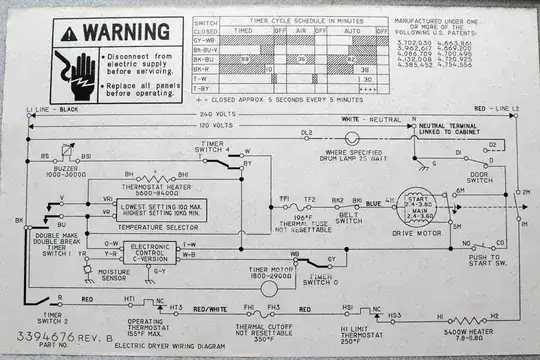

0
For those who say this can't be done it is possible that at some point the wiring may be set up for a 220v thirty amp system, and then down graded to a 120v 20 amp circuit. See what wires are in the box after assuring there is no power. If you have the heavier wire in the right array, you lucked out.

0
There are two options.
1) You either have to update the outlet on the wall to a 4-prong and the wiring that runs to it from the breaker panel. 4-prong outlets have two hot wires, a neutral, and ground.
OR
2) You install a 3-prong plug on your dryer.
The cheaper option would be to replace the plug on the dryer. 4-prong plug is the current standard, so if you do upgrade the outlet, you'll be set for future.

almostengr
- 76
- 3
0
the easiest thing to do is to replace the outlet, wire a new outlet in, assuming they both use the same type of cable (typically 10-3). you flip the circuit off before you do it, of course. much simpler than looking for an adapter (and probably safer)

amphibient
- 7,702
- 52
- 152
- 238
0
Dryer cords are designed to be replaced. It's apparently even common for them to ship without a cord so that you can install the appropriate cord for your outlet. Houses built before 1996 typically need a 3-wire cord with a NEMA 10-30 connector. Houses built after 1996 (in the US) typically have a NEMA 14-30 outlet, and will require a 4-wire cord. (FWIW, a new cord seems to run around $11-$25 (as of 2015), depending on how long you need it and where you buy it.)
Whirlpool has detailed wiring instructions so you can make sure you are wiring it properly. Other manufacturers will likely have similar instructions.
Home Depot has some generic wiring instructions. Contrary to people here, they recommend not updating the outlet to NEMA 14 yourself, but having a licensed electrician do it if that's the way you want to go.
Having a separate ground sounds like a good idea at first, but if your dryer is like mine, it's not going to make a lot of difference. Mine came with a 4-wire cord, but ground and neutral were wired to the same terminal internally. I first thought that was crazy, but it is consistent with the installation instructions (although it is possible to keep them separate). So, depending on your dryer, you may not get a separate ground even with a 14-30 connector.

aij
- 101
- 1
-2
EDITED for clarification:
The three prong plug has two hot legs for the two bus voltages to add up to 220 volts, plus a neutral wire. Prior to 1998 the neutral was also grounded to the dryer case. A four prong plug has the two bus connections, a ground, and a neutral return. Often these are used if the dryer circuit requires 120 volts at some point, the current would flow from one bus and return through the neutral. If you were to change from a four prong to a three prong and your dryer is designed to use 120 volts at some point, then that current will have to be returned on the ground leg. This is not acceptable by NEC code, nor is it safe. If the 120 Volt circuit were to short, the full 120 volt potential could be present on the dryer case! Imagine touching the dryer at that time, and maybe on a wet floor!
If you can determine that the dryer does not require 120 volts, and that no current is returned on a neutral leg, then I see no reason not to use the three prong (although why does it have a neutral leg at all?). I would ONLY do the conversion if it is recomended by the manufacture. With todays economy I don't think that a manufacture would go to the expense of a four prong plug if it was not required.
The conversion kits mentioned by others may be to convert from a three prong dryer to a four prong receptacle. That is okay, being that the neutral wire is not used.
EDIT:
Wiki tells it like it is. "Modern appliances require 4 conductor cordsets (separate conductors or wires for line 1, line 2, ground and neutral). Generally, this setup is safer, because the current-carrying neutral is not connected to the dryer case. However, it is useless if the wall receptacle does not have a separate ground slot. In that case, you'll have to do the very simple procedure of converting a 4-wire dryer to a 3-wire setup. Conversion of these appliances in the U.S. is prohibited by the NEC (National Electric Code). The receptacle and wiring should be modernized to a 4 conductor arrangement instead."

SteveR
- 3,889
- 1
- 19
- 17