31

Context
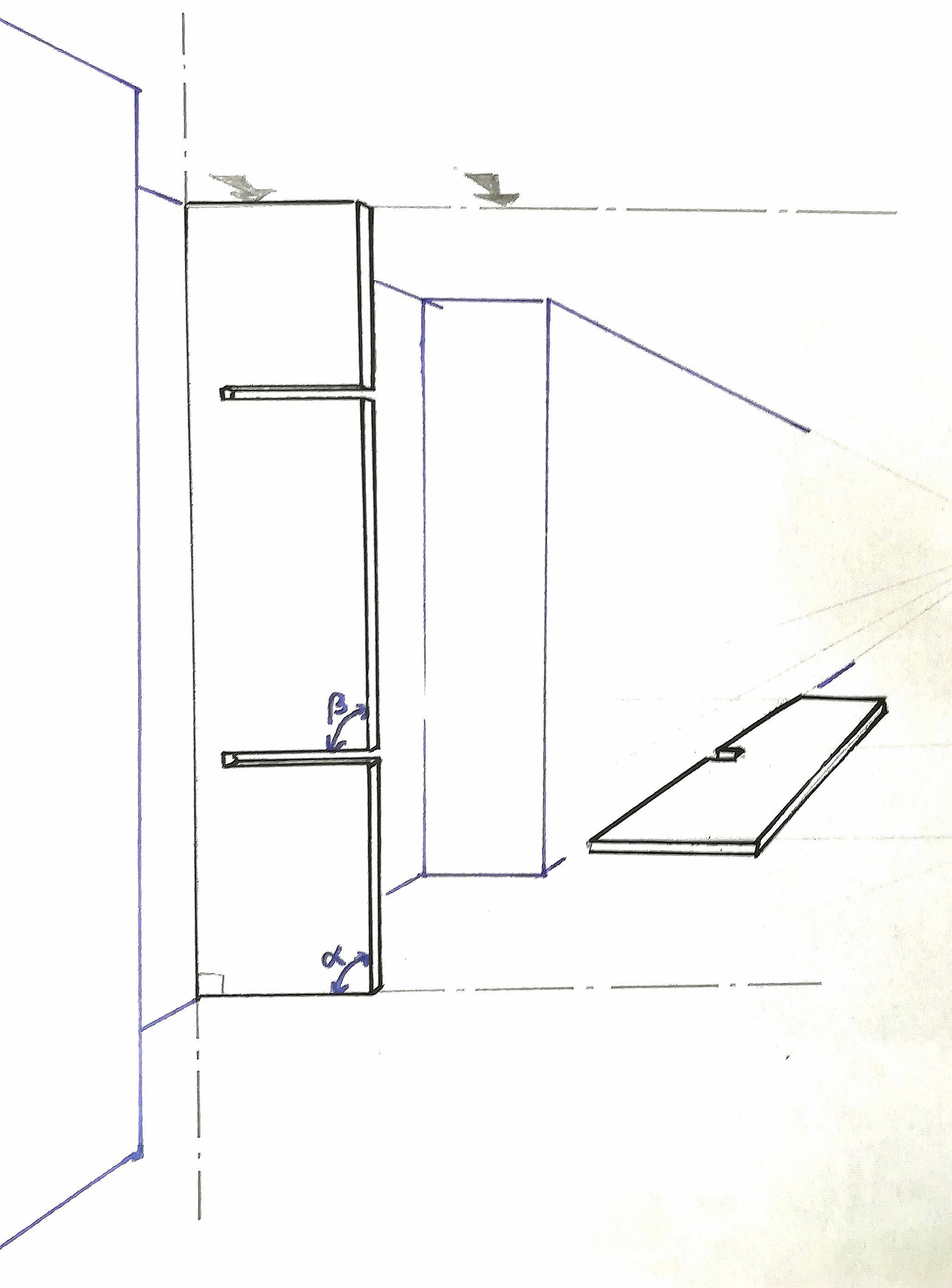
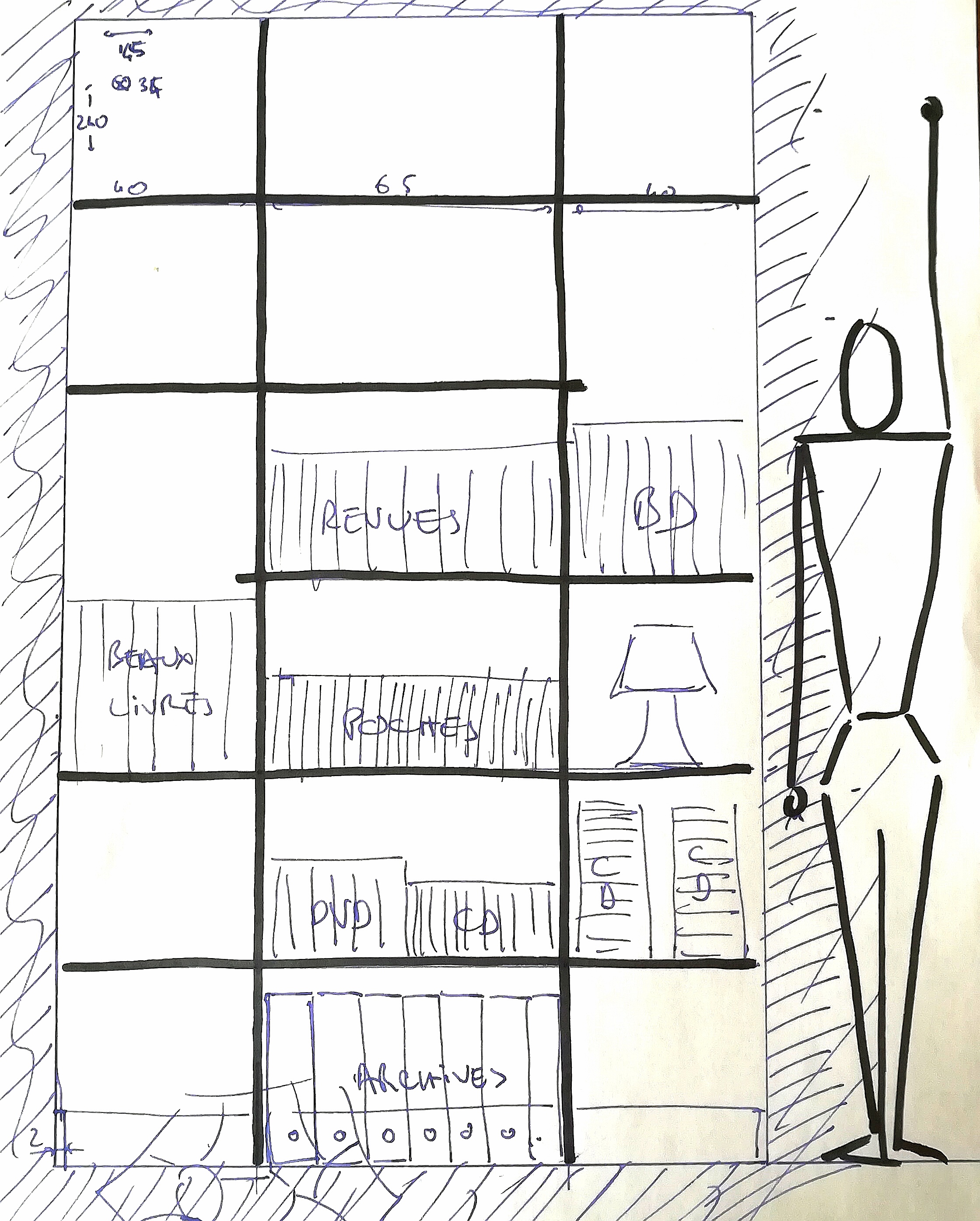
I intend to build a self-standing bookshelf using 18mm-thick, CNC-router-cut plywood. The bookshelf is made of nested planks, and entirely fits a 35cm-deep recess in my wall.

Following pictures display first a sketch of the global design, and second, how I intend to nest planks (click on picture to see them full size):


1/ sketch of the bookshelf 2/enter image description here

Problem:
Although I don't have any children and don't really expect some at my home during the lifespan of the bookshelf, I kind of fear that it could topple frontwards. I am not allowed to secure it using screws in the wall.

Question:
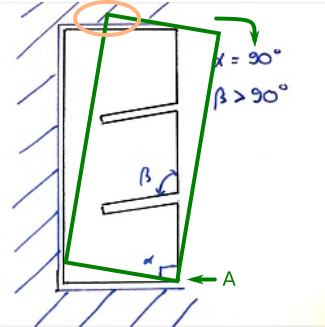
Should I consider tilting either the supports (picture A: α<90°), or the shelves (picture B: β>90°) — or even both — backward by a few degrees to prevent the bookshelf to topple? If yes, which solution is the best, and what angle would be advisable?

A/enter image description here B/enter image description here

Question:

ebosi
  • 445
  • 1
  • 4
  • 12

11 Answers11

51

Use Screws Anyway

If it was me, I would quietly ignore "I am not allowed to secure it using screws in the wall." We are talking about a couple of screws here, which would leave ~ 1/4" holes, not cutting out large sections of the wall.

Assuming it is drywall or plaster over studs, as opposed to a brick wall, I would put in two screws (~ 2" long) through brackets on the top shelf positioned so that the screws go into studs. The patching needed when you leave, if any, is minimal - really would get taken care of trivially as part of a routine "get ready for a new tenant paint job". You'll sleep much better.

manassehkatz-Moving 2 Codidact
  • 139,495
  • 14
  • 149
  • 386
19

I haven't built anything into a recess like you describe so this is conjecture.

If you're fitting it into a recess and it is encased on all 5 sides (ceiling, floor, left side, right side, back wall), you could get away with not anchoring it. Since when it tips, it would strike against the ceiling. I'd also put wedges on all sides because it's probably not a perfectly shaped recess and you want the bookshelf to not move at all when shaken. Though, they would probably leave more marks than a few screws at the top to be honest.

If the ceiling is some how just drywall in that area (unlikely) this wouldn't work.

Wood also bends so even if something sits flush in a recess it could be bent out potentially. Assuming you got 10ft high walls and your book shelf is 1ft deep. Tipping from the front bottom means the recess/bookshelf would have to give by .6in for the back top to clear and tip.

Anyway, when you're done building it, give it a climb and pull from the top while empty, if it feels like its going to fall, anchor it with screws and ask for forgiveness later.

jmathew
  • 291
  • 1
  • 4
17

It is impossible for the bookshelf to rotate forwards and crush anyone, child or not, the way you have drawn it. For it to fall on someone (who pulled on it, or climbed it) it would have to rotate around point A on this diagram:

Bookshelf leaning forwards

As you can see, before it becomes dangerously tilted the back will hit the enclosure at the top and stop it tilting further. In the event that there is a much larger gap at the top you could push in a block of wood or similar at the back which effectively extends the height so that it can't tilt.

The only way it could become hazardous would be if someone had the strength to pull it directly towards themselves to clear the enclosure, and then tilt it. This is unlikely if it is full of books.

Nick Gammon
  • 431
  • 1
  • 3
  • 8
7

In order for a bookshelf to topple forwards, it is necessary to have some force applied to the structure. Typically, that force is gravity. Gravity will not usually push a bookshelf out of plumb, disregarding earthquake activity for the purposes of this discussion.

Your floor must be level. If not, adjust the base of the bookshelf to keep the structure perpendicular to local gravity.

When objects are placed on the bookshelf, they will exert force on the bookshelf in a vertical manner. As long as no component of this force extends outside of the rectangular structure of the bookshelf, these objects will make the bookshelf more stable, not less.

It is not necessary to have slopes in the structure of the bookshelf, nor in the shelf sections. Sloped side plates as shown in drawing A would be more cosmetic than supportive. Sloped shelves as shown in both drawings would create inconvenient book placement and increase book toppling to one side or the other.

Build square and be confident that gravity is your friend.

fred_dot_u
  • 11,958
  • 2
  • 21
  • 35
5

The first drawing is superior with regards to stability. Objects topple when the center of gravity moves beyond the area of the base. In your first drawing the base is enlarged, and the center of gravity must travel further in the horizontal plane to cause a fall. (i.e. You need to pull the bookcase further before it will fall forward.) In the second picture the center of gravity is lowered, which also increases stability. It's not quite as good, however, because odds are good you'll create a situation where the center of gravity must move the same distance but moving it requires more force.

You can, by the way, combine them in other ways to make things stable. Wider shelves on the bottom helps but can be two different sized sections fastened together. (Hutches with large bases, mirrors fastened to dressers, etc.) You can also place heavier objects on the bottom shelves to lower the center of gravity. In your specific case a thick hollow shelf hiding ballast (sandbags or weights) would make it significantly more difficult to tip over.

You may also be able to fasten it to something besides the wall. If the floor is carpeted you may be able to run cables from floor to ceiling through the front of the shelves. If the base board is painted to may be able to run a safety cable from there to the top behind the unit.

One thing you should definitely avoid is drawers in the top half, which will move the center of gravity forward when opened. Heavy objects stored up high is also ill advised. That being said, if the design works and you are disciplined enough to not overload shelves you can get some small gains by increasing the distance between shelves on the way up, which will tend to keep the weight lower.
Matthew Gauthier
  • 3,470
  • 1
  • 10
  • 12
4

Let me suggest a different approach: shims under the base of the bookshelf. I have several sets of IKEA "Billy" bookshelves and, when I was renting, was reluctant to put holes in the walls. I noticed the bookshelves were leaning forward a bit and asked a friend with serious carpenter skills what to do. (The bookshelves were NOT recessed like yours and the floor had wall-to-wall carpeting.) He suggested shims, which we found very cheaply at Home Depot. (I'm not sure where you are but you presumably have some kind of store that sells lumber that you could try if you don't have Home Depot in your area.) I shoved the shims under the bookshelf feet (not really feet, as such, just the part of the side pieces that touched the floor) until the bookshelf units felt quite stable, then broke off the parts of the shim that stuck out beyond the front of the bookshelves. This worked great for many years until I moved somewhere that I could screw the bookshelves to the wall with a bracket.

I should caution you that I never had children trying to "climb" the bookshelves so I don't know if they would have fallen forward in that case. (Mind you, four of the shelves on the Billy bookcases are not attached to the frame, they just sit on pins, so a child might well have pulled the shelf out and fallen back with it for all I know.) You say you don't expect kids to climb the shelves so this probably isn't a concern for you.

This is a very inexpensive solution and requires no modification of the bookshelves, the recessed area you describe, the walls or the floor. (If you're building the bookshelves yourself, you may well be able to make your own shims from the scraps from the project.)

user90094
  • 41
  • 1
3

Put something heavy at the back of the bottom shelf.

Anything found at the back of the bottom shelf will rise if the bookcase starts tipping forward. The heavier and further back you can put things there, the greater the force needed to tip over the bookcase. Marble is extremely dense, and marble strips not only look very nice but they are freely available at any place that cuts marble countertops. Alternatively, put books there.

dotancohen
  • 393
  • 1
  • 10
1

Either your digram is in error or I just don't understand it. However, it seems to me that your bookcase top and bottom portions are not parallel with the shelves. I had the same problem, but I didn't want to drill holes into the wood paneling on the wall to secure the bookcase, so I built the entire bookcase to lean against the wall. This means that the bottom panel, the foundation panel (the panel that touches the floor) of the bookcase is connected to the vertical supports AT AN ANGLE, the same angle as all of the shelves. In other words (I find this difficult to explain), all horizontal panels are parallel with the floor, but the vertical panels and supports are at an angle to the floor. This confused me during its construction an embarrassing number of times, but I finally got it right. Anyway, the only thing I would change if I did it again, would be to use lighter vertical construction. My bookcase has seven shelves and contains many very heavy books, so I made it too strong. If I did it again, it would look less like a battleship. [The top shelf rests against the wall and the bottom shelf is 6-1/2" from the wall. The bookcase is 83" high]

Niku
  • 11
  • 2
1

As others have said, safety is much more important than blindly following the rules. Anyway, you could ask your landlord for an exceptional permission just to use two screws to fix the upper part of the bookshelf.

If this is not an option, you could do it anyway and, before leaving the apartment, just remove the screws and fill the holes with plaster, so that the landlord doesn't complain.

However, another option is to use glue or bi-adhesive tape to anchor the back of the structure to the walls. It may be messy, difficult to implement in such a restricted space, but if you are not prohibited to gluing something on the walls, this could be compliant with the rules (even if when you'll remove the bookshelf it will leave nasty marks on the walls).

There are glues and tapes that are quite strong and are used for this kind of heavy stuff montages. It may be expensive, though, depending on how much area of the back of your shelf you'll be going to glue or tape.

1

Anecdotal information: Many years ago, my father and I built a pair of 2-metre-tall pine book cases about 50cm deep, with 6 shelves each. I specifically remember asking my father what would prevent the book cases from toppling over, and he looked at me oddly and said "their weight". And he wasn't wrong.

Put simply, any empty book case/shelf with the shelves at right angles is not going to simply fall over unless being pulled over because of the weight of its own construction; the deeper the case/shelf the less likely it is to fall. Then you have to consider all the items that you are going to put on the shelves, which are most likely going to be placed closer to the back and thus move the centre of gravity there, thus making it even less likely that the construction can be toppled.

On the other hand, if you intend to have a lot of relatively heavy items biasing the weight towards the front of the case/shelf, then angling the shelves as per your second set of illustrations will help... but not as much as a heavy piece of wood at the base/back of the construction, which would serve to "anchor" it.

Ian Kemp
  • 133
  • 6
1

I don't know if this adds any value to answering the question but if you do tilt it backwards, you can try to shove shims in the front to help it stay tilted backwards against the wall.

My friend did that to his bookshelf as extra reinforcement to the velcro earthquake straps he installed. His bookshelf was on carpet but even when placed against the wall, it was tilting forward. He put straps to hold the shelf against the wall but we could see there was pressure on the straps as the shelf was tilting forward. The shims in front helped relieve some of this pressure.

Classified
  • 830
  • 7
  • 21
  • 35