3

I am thinking of building some MDF build-in bookcases, dado joints are clearly stronger but creates lots of mess from a router and takes more time.

As the book case will be painted, I can hide any screw heads, so that is not an issue.

I see 4 options:

  • Just screw and glue the shelves to both the sides and back.
  • Dado, screw and glue the shelves to both the sides and back.
  • Dado to side, screw to back.
  • I could also make “cheat” Dados by gluing 6mm MDF onto 15mm MDF on make the sides

Dado at the back means I need a thicker back that will make then harder to build due to the mass. However I don’t know if screw joints into the end grain of MDF are strong enough, I am thinking of using 18mm MDF for the sites and 30mm MDF for the shelfs.

I am thinking of using spax MDF screws as they don't need predrilling etc.

(I am not asking this on a woodworking site as I do not have great woodworking stills and care more about the result then the process.)

Walker
  • 6,275
  • 22
  • 66
  • 87

4 Answers4

3

There's many variables, many choices. You could just slam some screws into the shelf edges and it may be adequate. Pocket screws are a big improvement because you are no longer screwing into the panel edges. They work really well in cabinet face frames because there is plenty of room for screw embedment. For a bookcase, embedment is limited, so you should plan on more screws to get adequate strength.

You can get more strength by providing support along the back, but the gain is marginal since the front will remain unsupported. The extra cost and weight of a structural back are typically not worth the gain in strength for bookcases.

Another problem with simple butt joints is the glue strength contributes to much less or even none of the overall strength, depending on the type of glue used. This is because butt joints move quite a bit under load, eventually breaking either the glue itself or the bond. Dados greatly restrict the joint movement, allowing glue to contribute a significant portion of the strength. Not to mention the huge strength from the continuous edge support.

But dados require a lot more work. A good compromise is the placement of cleats under the shelf ends, combined with the edge or pocket screws you would typically have used anyway. Nail or screw gluing cleats makes a very strong joint to the side support. The cleat does not move, so the glue bond is significant. The cleat does not need to be very thick, most of the strength is simply the continuous edge support. The height of the cleat should be a good amount to maximize the glue bond area. Use enough fasteners to fully clamp the cleat as the glue sets. Such a cleat reduces the number of edge or pocket screws you need from enough to support everything to enough to hold the shelf in place on the cleat.

Cleats provide much more strength than screws alone, getting you much closer to dado strength. Yet the extra amount of work is minimal, especially considering you'll need fewer edge or pocket screws.

bcworkz
  • 11,578
  • 21
  • 19
2

End-grain gluing does not work very well with MDF, if you want to use glue i would recommend using dados, but with 3/4" mdf it weakens it a lot, maybe gluing 2 planks and then cutting some dados. And if youre going to use screws you need long and coarse thread screws so the mdf doesn't get damaged.

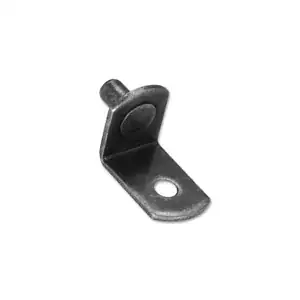
But there's an easier way than using screws: shelve pins

shelve pin

These industrial looking pins can be found like this or plastic and they come in diferent colors, you only have to make a little hole and thats it.

Javier
  • 114
  • 3
1

I built a bookcase from 3/4" (19 mm) MDF back in 1985 to hold heavy, oversize college textbooks. It's three feet wide with two twelve inch deep, fourteen inch tall shelves. It has not bowed under the weight in 27 years. The shelves are are attached to the side uprights with four screws on each end. The back is 1/8" masonite, well secured with screws. 1.5 inch rails attach the end boards at the bottom also at the back of the top.

Judging from the stability of the bookcase under heavy load for a quarter century, I'd say that dados are not necessary.

Walker
  • 6,275
  • 22
  • 66
  • 87
Wayfaring Stranger
  • 3,415
  • 1
  • 18
  • 17
1

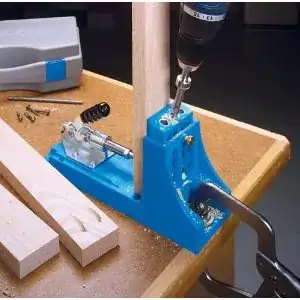
Kreg Pocket Hole Jig

If you are willing to invest a little, I would consider pocket screws.

The joint will be considerably stronger than edge-screwing. Just drill the pocket holes, apply glue, and screw together.

This joinery method is perfect for a novice woodworker. Simple, almost impossible to mess up, and does not require precision or specialized skills.

I have used them to build several bookcases (among many other things) with good results.

James Van Huis
  • 3,547
  • 18
  • 26