0

I'm renovating the 4th and top floor of a house built in 1906 in Rotterdam, the Netherlands. The house has masonry load-bearing walls and wooden beams. The current situation is shown in the image below. enter image description here
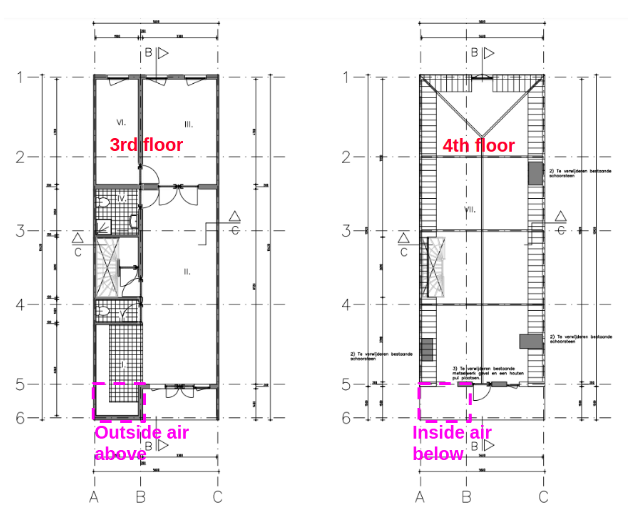
The area in pink has the building envelope as shown in the B-B section cut below somewhere between grid lines 5 and 6. Note: This space currently is not insulated.
enter image description here

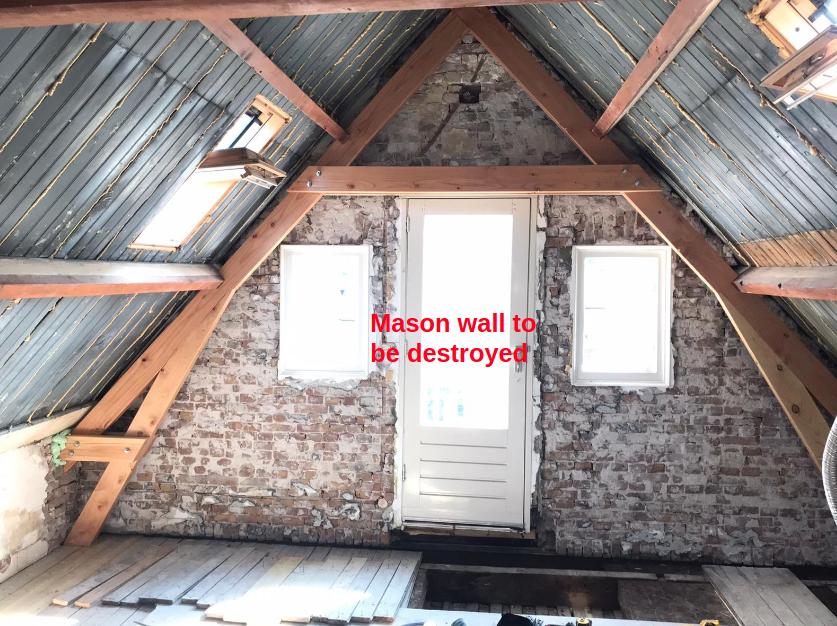
The mason wall shown in the image below will be destroyed.
enter image description here

The image below is taken from the 4th floor looking at the top of the 3rd floor ceiling after the floorboards were removed.
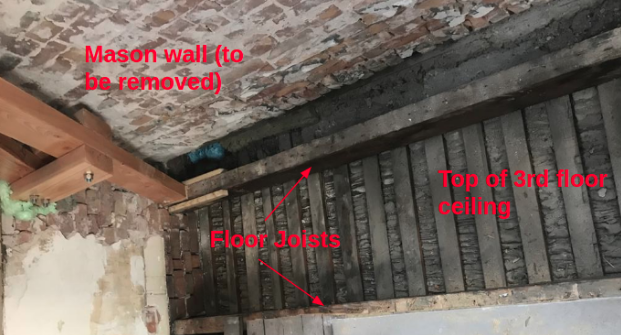
enter image description here

A glass facade will be installed 1 meter behind the location of the existing masonry wall thus creating a balcony that is 1 meter longer than it is currently. This is shown in the proposed floor plan below.
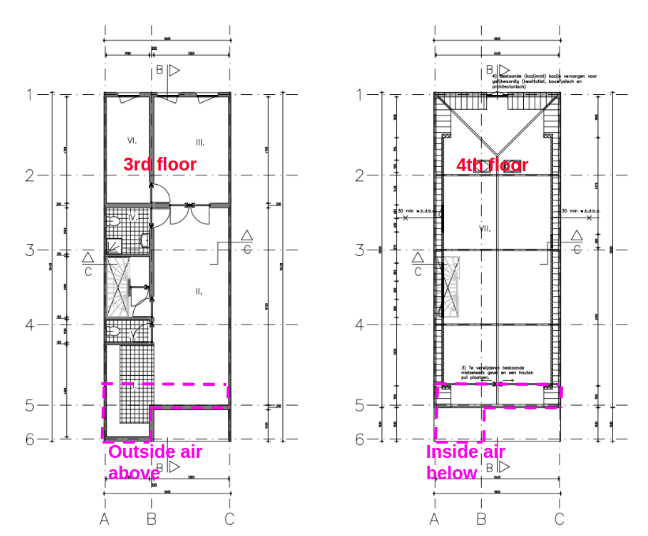
enter image description here

In an ideal scenario, this entire 3rd to 4th-floor building envelope would look like the following section. Note: Rockwool insulation and vapor barrier added
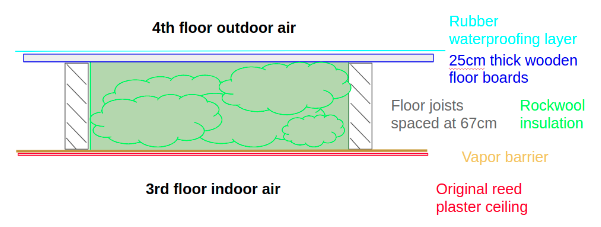
enter image description here

However, this is not possible since the 3rd-floor ceiling cannot be removed.

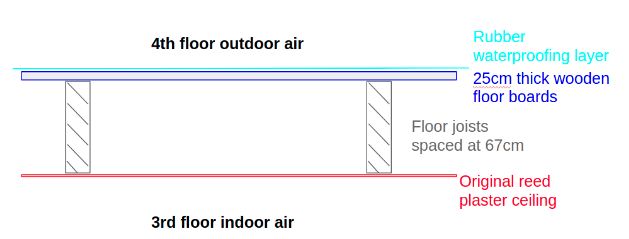
Ideally, there is insulation in the floor cavity and therefore a vapor barrier is required. Is it a good idea to wrap the vapor barrier around the floor joists as shown in the section below?
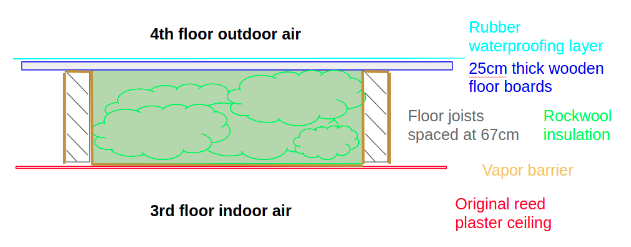
enter image description here

I’m worried this may cause condensation to occur around the floor joists which is the last thing I want. If that could happen I would prefer to leave the space un-insulated, unless someone has a different idea?

Eric
  • 185
  • 1
  • 11

3 Answers3

1

No, I do not think a vapor barrier should follow the profile of ceiling joists.

Condensation occurs when vapor reaches its dew point.

Placing a portion of a vapor barrier on one side of an insulation space and not on another side (where the wood joists occur), will stop the vapor from penetrating the insulation space but not the wood joist space.

Wood is porous and vapor will penetrate the wood. As it travels through the wood (vapor moves from warm to cool) it will hit its dew point and turn into condensation... causing the wood to turn into dryrot.

If you can’t remove the ceiling material, maybe you can paint it with a good finish paint material. (Paint is a vapor barrier too.)

Lee Sam
  • 23,527
  • 3
  • 21
  • 45
1

I don’t think you need a vapor barrier in the bottom of the joist space. The finish paint coat should suffice. Also, caulking at joints, etc. is not required if the entire ceiling is painted (it may take several coats to achieve the perm rating you’re looking for). BTW, If you live in an environment where summer and winter change temperatures, then it gets complex.

Lee Sam
  • 23,527
  • 3
  • 21
  • 45
0

No, a vapor barrier should not follow the profile of the floor joist because that could cause condensation to form on the floor joist.

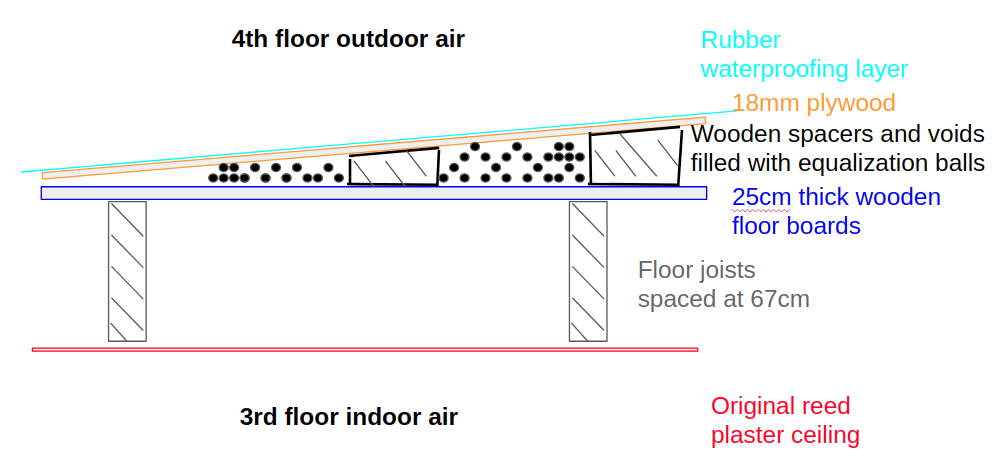
The system shown in the image below (as suggested by @edbeal), will be used to waterproof the structure and prevent water damage and fungis from forming on the floor joist. The floor joists were also painted to protect them from fungis as shown in this answer.

It is probably too risky to insulate between the floor joists at the moment. The heating costs saved do not outweigh the risk of condensation staying on the floor joist because air cannot travel in the ceiling cavity.

enter image description here

Eric
  • 185
  • 1
  • 11