12

A comment over on another SE got me thinking. With screw-in fuses, unscrewing it and then later screwing it back in causes negligible wear on either part of the installation. But what about modern "switch" overcurrent circuit breakers? Does manually turning them off and back on repeatedly over a period of time cause a noticeable amount of wear?

I am considering here the case of using the breakers to turn off power for example when going on vacation, so more often than only when doing things like working on the house electrical wiring but also less often than daily. Let's say on the order of ten times per year or something along the lines of that.

user
  • 225
  • 1
  • 3
  • 12

5 Answers5

17

As ChrisF mentions, any mechanical device causes some wear when it operates. With that said, let us start by checking with the National Electrical Code (NEC).

NEC 2011
404.11 Circuit Breakers as Switches. A hand-operable circuit breaker equipped with a lever or handle, or a power-operated circuit breaker capable of being opened by hand in the event of a power failure, shall be permitted to serve as a switch if it has the required number of poles.

Informational Note: See the provisions contained in 240.81 and 240.83.

So according to the NEC, circuit breakers can be used as switches with some provisions.

240.81 Indicating. Circuit breakers shall clearly indicate whether they are in the open “off” or closed “on” position. Where circuit breaker handles are operated vertically rather than rotationally or horizontally, the “up” position of the handle shall be the “on” position.

240.83 Marking. (D) Used as Switches. Circuit breakers used as switches in 120-volt and 277-volt fluorescent lighting circuits shall be listed and shall be marked SWD or HID. Circuit breakers used as switches in high-intensity discharge lighting circuits shall be listed and shall be marked as HID.

If the circuit breaker clearly indicates the "on" and "off" position ("on" being up in vertically oriented situations), and the breaker is labeled "SWD" and/or "HID". Then the circuit breaker can be used as a switch, as far as NEC is concerned.

As for whether or not using a circuit breaker in this way causes damage to the circuit breaker, we'll look to the NEC's definition of a circuit breaker.

Circuit Breaker. A device designed to open and close a circuit by nonautomatic means and to open the circuit automatically on a predetermined overcurrent without damage to itself when properly applied within its rating.

Notice it specifically mentions "without damage to itself". So in the eyes of the NEC. A device used manually or automatically to open a circuit that causes damage to itself, can not be used as a circuit breaker.

More evidence is provided in this pdf document from Schneider Electric describing the markings on a circuit breaker.
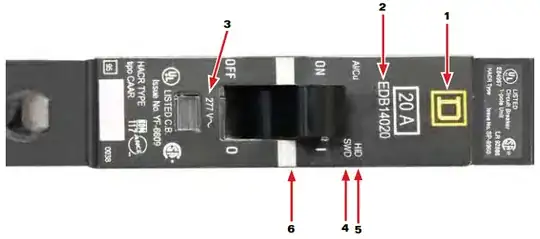
Circuit Breaker Image

4.) SWD – 15- or 20-A circuit breakers rated 347 V or less may be marked “SWD,” meaning that they are suitable for switching fluorescent lighting loads on a regular basis (NEC 240.83(D)). These circuit breakers are evaluated for high endurance use, since they will be used similar to a light switch.

5.) HID – 50 A or less circuit breakers rated 480 V or less may be marked “HID,” meaning they are suitable for switching high intensity discharge or fluorescent lighting loads on a regular basis. These circuit breakers may employ a different construction than a standard SWD circuit breaker in order to address the high inrush current resulting from the lower power factor created by the HID lighting (NEC 240.83(D)). These circuit breakers also undergo additional endurance evaluation to demonstrate their ability to perform the switching duty.


While the information presented here, is based on information that may only pertain to the United States. Other countries will have similar rule and markings, to indicate which devices can be used safely in different situations. Circuit breakers rated for this use are tested for durability similarly to switches, and can safely be used to manually open and close a circuit without too much wear and tear.

Tester101
  • 133,087
  • 80
  • 327
  • 617
7

The basic answer is that as the breaker is a mechanical device there will be wear, however I'd suspect that it would be negligible over the lifetime of the breaker - unless you are turning them on and off several times a day.

They are obviously designed to be switched on and off, but the number of times this happens under normal conditions is very few. So turning them off once or twice a year (for example) to do work on the electrics isn't going to produce noticeable wear.

ChrisF
  • 16,973
  • 5
  • 51
  • 74
5

Generally, home circuit breakers have 10 000 or 10 000's of guaranteed operating cycles, but only 1000's of guaranteed tripping cycles. Consult the circuit breaker's datasheet for exact numbers - search for operating cycles or switching operations.

Then you can estimate the wear caused by your activities.

Peter Ivan
  • 358
  • 5
  • 22
1

Last answer is the answer, circuit breakers are built to withstand a number of cycles and tripping cycles, that can be found in manufacturer data sheets. It is a mechanical device that when closed maintains contact between two metal low resistance surfaces. There are levers, shafts, pivots and springs involved to do just that. Than there is a coil/bi-metal over-current sensing device that can trip the mechanics inside and release the contacts at a fairly high speed to clear the fault current in short circuit circumstances up to 10,000 AMPS. So there are more levers and pivots and a spring to power the over current release part. So breakers wear down using them as switching elements on a daily basis. Especially for "making" and "breaking" highly inductive loads like HID lighting, Fluorescent lighting, motors, transformers and high inrush current loads like tungsten (regular) and halogen light bulbs. The switch part of circuit breakers have fast switching speed like the over current protection mechanism has. Contacts bounce and lead to contact wear and corrosion.

0

A homeowner using a circuit breaker as a switch in their home seems okay because the maximum fault current is not enough to make a serious arc flash. And the code does not regulate homeowner use. When working an industrial context, do not assume you can casually operate a circuit breaker. In places where they follow every rule to the extreme, you can get in trouble if you even touch a circuit breaker without wearing rubber gloves, face shield, fireproof clothing - full flash-arc protection resembling a welder's outfit. Resetting a tripped breaker can be a safety violation - are you a "qualified person"? Did you "evaluate" before resetting the breaker? You're extremely unlikely to get arc-flashed, but they will bury you for violating their interpretation of NFPA 70E + OSHA + state regs + local policy.