5

I am trying to figure out my options for installing a smart switch in my configuration without running a new wire with a neutral. This is quite similar to other questions I'll reference later, so apologies in advance if I am failing to take the right lessons from them.

Here's my configuration:

  • Two circuits on adjacent breakers, one serving outdoor lights and the other serving outdoor outlets.
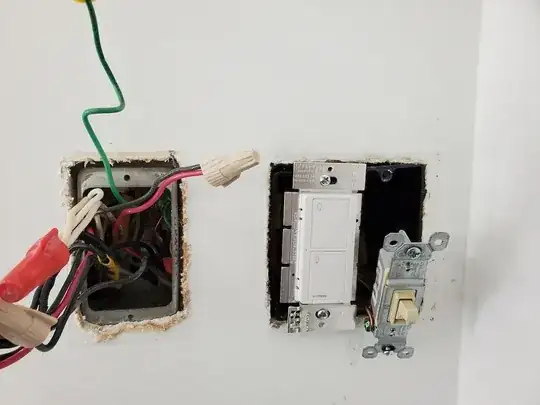
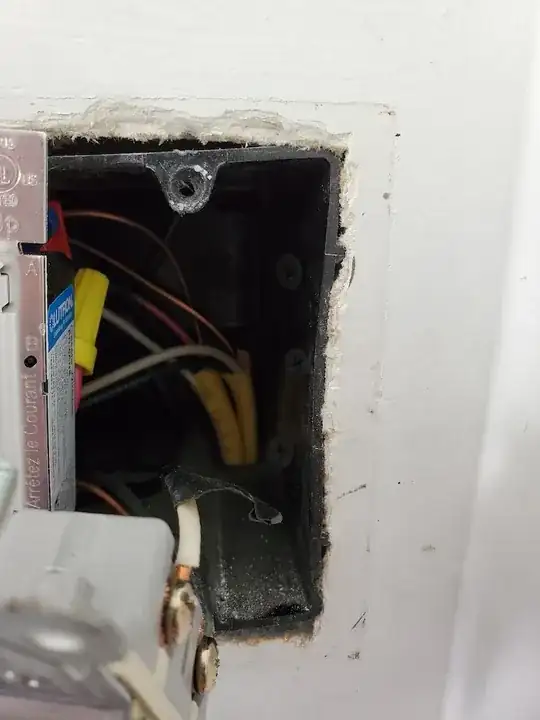
  • A 2-gang box has two switches, a smart switch controlling the lights and a basic single-pole switch controlling the outlets. One of those switches is already a smart switch (controlling the lights). The other switch is a basic single pole switch.
  • A junction box sits between the electrical panel and the switches
    • A Black/red/white/ground cable goes to the panel, with black being hot for one circuit, red hot for the second circuit, and white a shared neutral.
    • Two cables go from the the junction box to the box with the switches. A black/red/white/ground cable carries the hot/load/neutral for the smart switch and a black/white/ground cable carries the hot/load for the single pole switch.
    • Two other cables (black/white/ground I believe) leave the junction box, one for the lights and another for the outlets.

Can I replace the single-pole switch with a smart switch and use the same neutral wire that the existing smart switch is using, given that the two circuits are sharing a neutral at the junction box? My impression from a few answers is that it should be a code problem more than an electrical one. My read of the answer to this question is that even if it would be electrically okay it's a code violation because the neutral for the smart switch isn't in the same cable as the hot between the junction box and the switch. On the other hand, nobody raised an objection to this question where it was deemed to take the neutral from another switch in the box as long as it was the right neutral and presumably they were not in the same cable, so maybe there's something okay here?

If I can replace the switch the easy way I will do that, but if I can't, another option would be to move the lights and outlets to the same circuit. The lights are now LEDs and the outlets will only be used to power LED lights, so they do not require much current. Is this viable/better?

Edit: Adding some pictures...

  • The boxes The boxes (the panel is a foot or two to the left)
  • The cables leaving the junction box for the switch box In the junction box, the cables leaving for the switch box
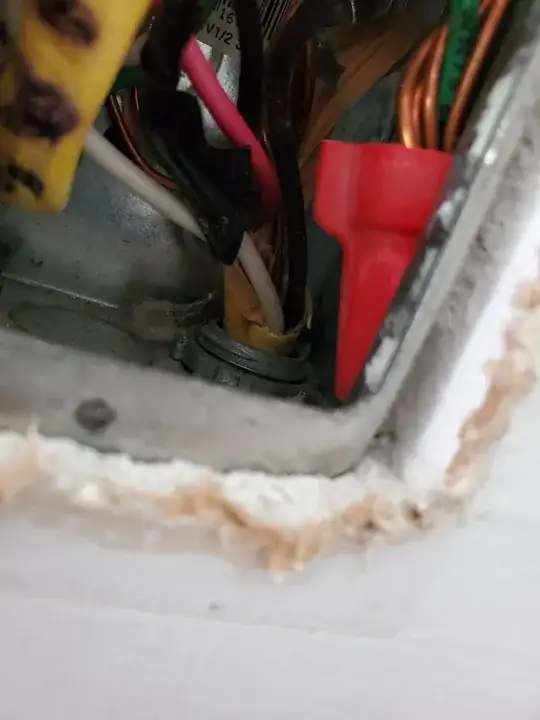
  • the incoming cables in the switch box The incoming cables in the switch box
cw94706
  • 53
  • 1
  • 5

3 Answers3

5

You'll have to either rearrange things or redo the wiring run

Your problem is that the original installer lashed this together from the 12/3 and 12/2 NM they had on their truck instead of stopping to think about this for a moment. Right now, it's not a Code issue, but it becomes one as soon as you add the second smart switch, whereas it wouldn't have been had the installer put a conduit between the two boxes instead of using cables for this run.

Why? It has nothing to do with the multi-wire branch circuit (a red herring in this case) and everything to do with the need to keep currents balanced in cables to avoid the generation of errant inductive loops in your walls. This stems from NEC 300.3(B) and 310.10(H), as those inductive loops can induce eddy currents in ferrous objects (such as fasteners and box-parts) inside them, which in turn heats them up with the attendant consequences of having hot nails in your wall.

Fortunately, it is possible to rearrange things to make it all work on one circuit. You'll have to use the /2 cable to bring always-hot and neutral from the lighting circuit to the switch box, then retask the /3 to bring both switched-hots and the load-side neutral back to the junction box, and not connect the two neutral bundles (line-side and load-side) together in the switch box. If that's not an option for you, then you'll need to take the two cables between the two boxes (junction and switch) out and replace them with a conduit run; a ½" ENT ("smurf tube") with individual THHN wires in it is inexpensive and will do the trick provided the cable runs themselves are within the walls.

ThreePhaseEel
  • 87,685
  • 36
  • 144
  • 243
4

What you have right now is a MultiWire Branch Circuit - MWBC. That is wonderful because it lets you get twice as much power over a 3-wire cable as over a 2-wire cable. But the way things are wired right now, it doesn't do what you need with the existing wires. However, rather than changing to a single switch, which would of course limit you to just 1/2 the circuit, you should be able to change to two smart switches using 1/2 the circuit. Here goes:

Panel

  • Remove the red wire from the breaker. You can use this breaker for a new circuit if you want to.

Junction Box

  • Incoming power - cap the red. Connect black and white to the 2-wire cable going to the switch box.
  • Outgoing (to lights) cable - connect black to black of 3-wire cable, connect white to white of 3-wire cable.
  • Outgoing (to receptacles) cable - connect black to red of 3-wire-cable, connect white to white of 3-wire cable.

Note that unlike a typical switch box, the whites here are not all together. There are two sets of neutral/white wires - one for the line side (from panel, to switch box) and one for the load side (from switch box, to lights & receptacles) and never the twain shall meet.

Switch Box

  • Connect black of 2-wire cable to "hot" of both switches (the old smart switch and the old dumb/new smart switch)
  • Connect white of 2-wire cable to "neutral" of both switches and to white of 3-wire cable.
  • Connect black of 3-wire cable to "load" of old smart switch.
  • Connect red of 3-wire cable to "load" of old dumb/new smart switch.

The end result of the switch box is that it will look like a typical light/fan setup with power in on one cable and two switch loads out on the other cable.

The key is that matching hot/load (switched hot) and neutral are always together:

  • Panel - 2 of 3 wires in the cable (3rd wire no longer used)
  • Junction to Switch - 2 of 2 wires in the cable
  • Switch to Junction - 3 of 3 wires in the cable
  • Junction to Lights, Junction to Receptacles - 2 of 2 wires in each cable
manassehkatz-Moving 2 Codidact
  • 139,495
  • 14
  • 149
  • 386
1

It should be fine to use the neutral in this situation because its already shared between the two circuits. This is a "multi-wire branch circuit" (MWBC) and the breakers that the red and black wires go back to should have their handles tied so that they trip at the same time. In the first question you linked, the objection was using a neutral from a unrelated circuit and the possibility of overloading stemming from that.

In a MWBC, the tied handles on the breakers protect the neutral from an overload on either the red or black circuit. Also, the neutral that goes to the smart switch is only used to power the switch electronics and not the load being switched. The current is going to be in the low milli-amp range and would not pose a hazard.

JPhi1618
  • 28,377
  • 5
  • 56
  • 93