11

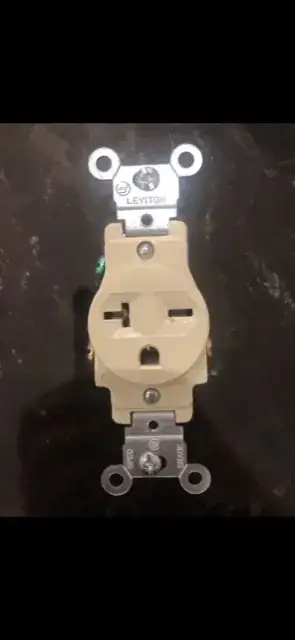
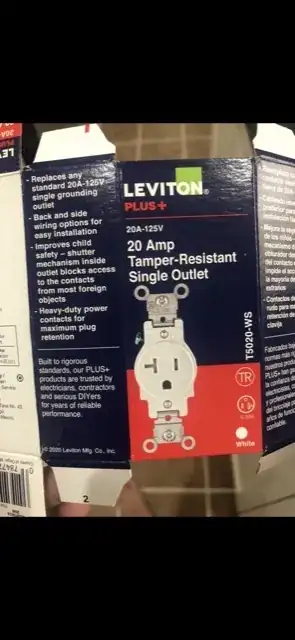
I recently replaced a 20 A 250 V single outlet with a 20 A 125 V single outlet so that I could use it for my microwave in the kitchen. The original outlet had two gold screws and a grounding screw. However, the new outlet has one gold screw, one silver screw, and a grounding screw. I hooked the new outlet up in the exact way the previous outlet was installed but when I went to plug in an extension cord, it made a popping noise and shut off my main breaker. Should I try to switch the wires? Or am I using the wrong replacement outlet?

Outlet Outlet packaging

Peter Mortensen
  • 335
  • 2
  • 8
Amy B
  • 119
  • 1
  • 3

5 Answers5

37

You can't do that! Don't switch any wires. That a 240 volt outlet, a 120 Volt line to each of the two brass screws and a ground on the old outlet. You plugged a 120 Volt appliance into a 120 Volt outlet wired for 240 Volts...... and probably ruined the microwave in the process.

You need a neutral, white wire and one of the existing hot wires. Is there one in the outlet box?. If not, you need to replace the cable with one that has a neutral or pull a neutral in the conduit if you have conduit or re purpose one of the hot wires and change the breaker to a single pole. You could also put the old outlet back in and get a microwave that's straight 240 Volt... since you probably blew out the existing one.

JACK
  • 89,902
  • 21
  • 80
  • 214
26

This could have easily been done correctly if you had done the research beforehand that you are doing now... as things are, you have created a 120V socket that is supplying 240V... it did fry your microwave (sorry), and WILL fry anything else you plug in there. Except for cell phone chargers, weirdly, but forget that - change it back, or turn the circuit breaker off.

It's possible to wire this correctly, but it needs someone with way less "Get-there-itis" and more appropriate fear of electricity and willingness to react to the concerning details they do find. (you found them, you just disregarded them. Signs: incompatible socket keying, obviously by design; voltage marking on sockets; colors of screws; and the breaker you turned off being double-width.)

If you want that to be you, you have the attention to detail; what you lack is the volume of core knowledge. That's a very fixable problem. Hit up a library and find their cache of books on DIY home electrical, find two that read well for you, and read at least two of them through.

wallyk
  • 12,399
  • 3
  • 24
  • 51
Harper - Reinstate Monica
  • 313,471
  • 28
  • 298
  • 772
18

Just to make it clear, in simple language, since some of the other answers are rather technical:

The outlet is just a connector - it just lets you plug in cords to the electricity supply. It doesn't actually change the electricity supply. You still have 240V electricity going to this outlet, even though it's now a 120V outlet.

The difference between a 240V outlet and a 120V outlet is the shape of the holes. They have different shapes so you can't accidentally plug in the wrong things. You can't plug 120V stuff into a 240V outlet and you can't plug 240V stuff into a 120V outlet.

Except that you changed the outlet, so now you can plug 120V stuff into 240V electricity. And it goes bang. Don't do that.

If you want 120V then you have to change the wiring so the outlet is getting 120V electricity instead of 240V. If there's more than one outlet on this circuit and you still want the other ones to be 240V, you'll need to add a new circuit; otherwise you should be able to convert the whole circuit to 120V, reusing the existing wiring, by rewiring it at the switchboard and replacing the outlets. Since you've indicated you don't really know what you're doing, I would hire a professional electrician.

6

You've probably noted that this outlet has that horizontal left plug (and correctly noted this is 240v)

240v

The reason why is anything plugged into this doesn't need a neutral. In your 120v outlet, power flows into the gold (hot) screw and back out of the silver (neutral) screw. But in a 240v setup you have two hot phases coming in (both are gold, as you noted). The reason is that 240v setup is its own circuit

In a 120/240V single split phase system, the two ungrounded (hot) legs are actually connected to the secondary winding of the distribution transformer. The transformer actually steps down the voltage to 240 volts, so the two legs are a complete 240 volt circuit.

The simplest fix (if you're a brave soul who wants to fix it in the panel) would be to remove one hot leg and re-attach it to the neutral in the panel (make sure this is the one connected to the silver screw). You'll want to switch from that double-breaker to a single 20 (and blank plate the open slot) if you do this. Then it would be 120v. Without a neutral, this won't work.

Machavity
  • 26,498
  • 8
  • 44
  • 100
3

The reason this happened is that your 2 hot wires are out of phase with each other. Instead of a neutral or ground wire that pairs with one wire to make it 120v, you have 2 wires that are 120v AC, but essentially in opposite directions to each other.

This Answer explains it a bit, and the pics are useful.

https://diy.stackexchange.com/a/67403/76159

This gives a technical explanation, but it's, well, extremely technical.

http://waterheatertimer.org/0-Electric-links/How-240V-circuit-works.html

Explanation

What normally happens in a 120v circuit is that you have one "hot" wire supplying 120v, one "neutral", and one ground.

The neutral and ground are essentially the same thing, but don't interchange them, since that's wrong on multiple levels, including the legal and safety levels. (The neutral wire is what's supposed to "bring down" the electricity from the hot wire, while the ground wire is there only in emergencies and shouldn't normally have current running through it.) These two wires are what the hot wire are essentially compared to, which is 0 (zero) volts.

The neutral wire at 0 (zero) volts means that the sine wave of the hot wire is never at a higher differential than 120v from that neutral wire, which is where we get the "120v" designation. This is essentially the 2nd pic on the first link, where the sine wave goes above and below zero by 120 volts.

However, when you are dealing with 240v, you have two hot 120v wires that are out of phase with each other (the first pic on that other Answer), you get a maximum difference of 240 volts, when one "hot" is +120v and the other is -120v.

Let me try this another way, if that wasn't clear, because it probably wasn't due to the jargon.

So, you have a mound of dirt that's 12 feet tall and you want to jump down off it to the sidewalk. This is 120v. Your max fall is 12 ft. You could also jump off the slope of the mound anywhere, but the highest point is 12 feet. The mound is the 120v hot wire and the sidewalk is the neutral wire.

Right next to that mound is a 12 ft deep hole. You can jump down to that from where you're standing on the sidewalk and the drop is still 12 ft. This is what happens when the 120v goes negative. No matter if you jump off the mound to the sidewalk or from the sidewalk to the hole, it's still 12 ft. The hole is part of the hot wire, but at a different point in time.

But, if you try jumping from the mound to the hole, that's a 24 ft drop. This is 240v. If you, as a person, are only prepared to make the 12 ft jump and end up going 24 ft, there will be a disaster. At best, your legs will break (this is the breakers in your electrical box*). At worst, you'll die (in the case of electronics, this will be a fire or massive overload of an appliance, also possibly causing you to die). In this last scenario, the mound is one hot wire and the hole is the other hot wire. The 24 ft jump is because these two wires are out of phase and no neutral wire, there's no middle-sidewalk for you to jump to first, it's just one big jump.

* FYI, every time you trip the breakers, you do damage to them.

Your microwave was expecting the 12 ft jump, not the 24 ft jump, so that's probably fried. At best, there's an internal fuse or breaker that can be replaced, but there's no guarantee other damage didn't happen. And there's no guarantee that fuse/breaker is easy to get to, or that it's designed to even be replaced. Likely, the chip(s) used to deal with the timer, LED display, and buttons has taken a jolt and is fried, meaning that even if some parts of the microwave are ok, the useful bits aren't.
computercarguy
  • 1,899
  • 1
  • 12
  • 18