31

I'm planning to mount LED strips under the treads of the outdoor wood staircase to our back yard. I'd like to avoid light shining into peoples' eyes while climbing stairs, so I'm considering mounting the LED strips in a 45-degree aluminum channel with the beam pointing back at the risers. My goal is to make the light source effectively invisible, even from the bottom of the staircase. Here's a not-to-scale rough idea of what I have in mind.

enter image description here

Is this a bad idea for any reason? For example, is it dangerous if most of the illumination is on the riser and the back part of the tread instead of on the front part of the tread where people step onto? Or is it more safe because people won't be blinded by the lights so are less likely to trip?

I've never seen LED strips mounted like this so I'm a bit nervous about it. But I also really like the way it looks! Here's a mockup I built tonight.

enter image description here

Justin Grant
  • 1,587
  • 8
  • 27
  • 35

10 Answers10

35

I really like the way your mock-up looks!

Additionally, as one whose eyes are extra sensitive to bright light, I would significantly prefer that to having any chance of light shining directly into my eyes.

Even if the edge of this step isn't perfectly lit by the light above it, it's location would be intuitively obvious to all but the youngest child by the location of the light below it. It's perfectly obvious that you simply step above where the brightest light is, and, after the first step, your brain will calculate the distance between the location of the light and the top of the tread above and will compensate. Us humans, we're pretty adaptable that way.

FreeMan
  • 48,261
  • 26
  • 101
  • 206
11

I don't see any problem with mounting them in that way.
Effectively you just use them as indirect lighting. They still provide some illumination to the steps themselves, just at lower intensity.

Just make sure your aluminum bracket doesn't make electrical contact with the LED strip. (I would put a layer of water-proof insulation tape on the inside of the bracket before mounting the LED-strip to it.)

Tonny
  • 755
  • 5
  • 12
11

It's a bit 'form over function'. It's the kind of lighting bars trying to look 'cool' use & which three drunks a night fall down, because they can't figure out where to step.

Would it not be simpler [& probably far easier to see the stairs] to run the strip light [blue line] up the side of the staircase, angled down in a similar manner so it can't be seen from above?

'scuse the 'fine art'…

enter image description here

One strip of LED to encapsulate, one cable at one end.

If you wanted to be extra safe for those with limited vision, contrasting safety tape can be placed at the leading edge of each step. Maybe white, or if that feels a bit garish, black 'grip strip'.

Tetsujin
  • 11,635
  • 1
  • 22
  • 40
9

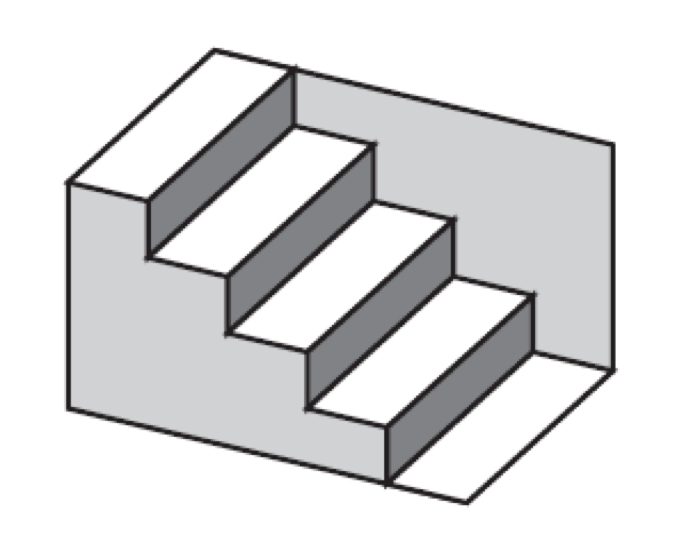
For someone who is partially sighted and doesn't have depth perception, it may easily look as though the lighted riser is the part you are supposed to step on. Do you remember those optical illusions and pictures where stairs will suddenly invert?

I'm not saying not to do it at all, but please be careful in your implementation & try looking at it in low-light or through just one eye, or through blurred glasses and envision it for those whose vision may not be as good as yours.

Dragonel
  • 191
  • 3
8

This is not an uncommon configuration. Case in point: there's a home renovation tv programme in The Netherlands, that is sponsored by a staircase renovation company. It has become a joke by now that each and every time, it just so happens that the staircase needs a renovation. The last couple of seasons has nothing but this design.

So if professionals do it, it must be not completely idiotic.

I would recommend doing it on every step, though, since the light makes it harder to see the parts that aren't illuminated. You might want to think about a solution for the landing as well.

SQB
  • 900
  • 10
  • 21
4

IMHO, you

  • want to make sure the parts one treads on are best illuminated. Most importantly the front edge and not the riser.
    You can get there by adjusting your shade(s).

  • LEDs are usually built so that they emit most intensity perpendicular to the mounting surface. I think it may be worth while experimenting with mounting the strip tilted towards the edge of the next step to get more (most?) intensity there.

  • A vision impaied friend tells me the most difficult thing for them is that stairs downwards often look all the same color/brightness to them (this already happens during daylight conditions).
    This would suggest that you want to produce a contrast at the edge when seen from above. I.e., brighter illumination of the edge and more dim light towards the riser in order to best illuminate the most important part.

  • The darker the material of your stairs, the more light you need to illuminate them. And the more blinding that light if it gets into the eyes of someone going up. While you'd ideally restrict the light to fall only on the next step, in practice also somewhat more flat angles are OK: it is sufficient that someone standing before the first step is not hit directly by light from the highest step.

  • (outdoors stairs have additional considerations because of reflections on wet surface)

  • IMHO if you do such an illumination, you also need a solution for the first step going down. Falling/stumbling at the very first step downwards is the worst case for accidents on stairs. Where I am, first step down is considered sufficiently important that it will be marked in workplaces etc. (by striped band) in many cases where no other step is marked.

  • the key to not blinding people by the illumination of the stairs is to have that illumination in a good relation to ambient light.

  • color is important, too: blue LED stripes may look cool, but many people have difficulties focussing blue in the dark. I'd probably go for orange on wooden stairs.

  • As someone with excellent night vision which however needs its time to fully adapt to low light conditions, I'd vote for a very dim solution plus dim ambient lighting, e.g. like Tetsujin suggests (also mounted so that the light goes downwards).
    You definitively want to ask people with poor night vision as well, though.

  • I'd think of putting the stripe into a groove (if practically possible) or making the front shade very sturdy.
    One doesn't believe where people inadvertendly kick things into pieces unless one sees it...

cbeleites
  • 351
  • 1
  • 5
3

It looks cool, but it's not very useful. The part of the stair you're lighting -- the risers -- are the one part that isn't important to someone using the stair. They need to see the treads (which will be quite dim), and in particular the nose (which will be the least lit of all). Essentially, you're asking them to "only step on the parts they can't see".

While I have seen this sort of lighting before, it is used in combination with other light sources (in particular, wall-recessed ground lights with downward baffles). If you insist on this, I suggest that you have only a shallow baffle in front of the light, and probably a baffle behind it as well, such that it illuminates the tread at least as much as it does the riser.

Sneftel
  • 555
  • 4
  • 8
3

Make sure you dim the LEDs properly. Those lights must be good to add design and provide visibility to the stairs so people don't fall. They don't need to illuminate. Make sure that, with a proper dimmer, the lights are not bright enough to illuminate the space and blind the people. You may want to illuminate the space with something else than those LEDs

2

Is this a bad idea for any reason?

With "mounting the LED strips in a 45-degree aluminum channel" and going up the stairs now has a bigger hook to catch shoes.

chux
  • 101
  • 5
1

This arrangement produces less glare than you'd get from an exposed LED, but the top of the riser is still brighter than everything else. This doesn't seem ideal.

What if you still pointed the LEDs down -- or, better yet, angled them so their beam pattern was more centered on the tread -- and then just used your angle strip to block direct glare anywhere beyond the tread? That would shield eyes from direct glare, but it would put more light onto the treads where it's needed.

jeffB
  • 111
  • 3