21

Several "continuous" dehumidifiers all had the same problem. There is a bucket to collect water, and also an outlet for a hose where the water can flow out so water does not collect in the bucket. With a hose connected, from time to time, the bucket does fill up with water and then the float switch stops the machine.

I had this problem with 5 machines from 3 manufacturers over the last 15 years. With each one:

  • The hose is not blocked. Water does flow from the unit into the drain. After I empty the bucket water continues to flow. The bucket does not immediately start to fill up again .... but sooner or later, weeks or months, it does.
  • I place the dehumidifier up on blocks and the end of the hose inside a sump pit, so there is about 3 feet of vertical fall through the hose. The hose is not very long. About 6 feet. It does not coil or rise back up at any point.

My point is, there is no blockage. There is something that causes water to enter the bucket and fill it up under certain circumstances.

There must be something about the design of all these that is causing this.. Any clues?

(I've had Frigidaire, Delonghi, Kenmore).

[Edit] Adding some pics and thoughts on answers and comments

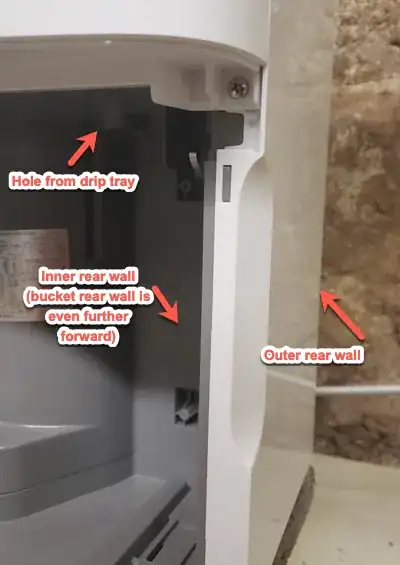
I disassembled several of the units, and they all used the same simple system to select hose or bucket: There is drip tray to collect moisture and the tray has two outlets, one higher than the other. The lower outlet goes to the hose. If it is sealed with a cap it fills up, and the water rises to the level of the higher outlet that goes to the bucket. It's impossible to photograph this without destroying the machine so here is a diagram: enter image description here

Answers to questions in comments:

  • Is there a valve that might be failing? No
  • Is the hose big enough? Yes, it’s a regular garden hose. The flow varies but at its greatest it’s a fast drip.
  • Ice because of dirty filter? No. I clean my filters regularly and at the most recent occurrence it was clean.
  • Ice because of low temp environment ? No. It’s a basement in the summer. About 70 degrees and 55% RH all the time (except after the bucket becomes full).
  • Ice, we don't know why? This one is intriguing me. It’s the only viable explanation so far. The only way for the water to rise to the bucket outlet is for the hose outlet to be blocked. The only way for the hose outlet to sometimes randomly be blocked, but never when I’m looking, is ice. I have to think about this one.
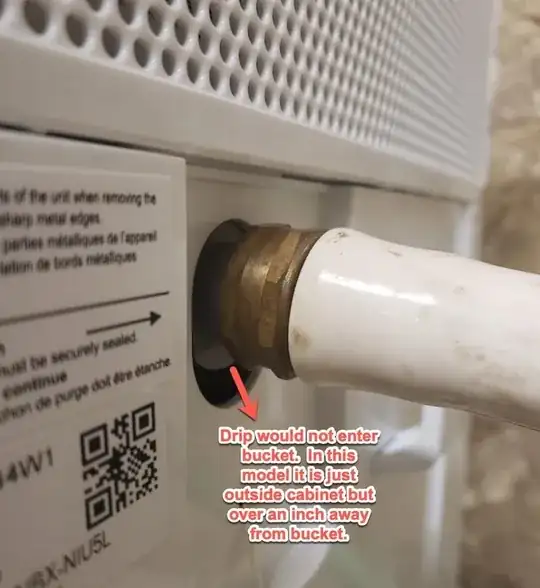
  • Hose not tight enough? That’s not the problem. In my current unit, and at least one other one, the hose outlet is outside the cabinet. If it were loose the water would drip on the floor. enter image description here enter image description here
[Edit 2] Leading theories

Some truly enlightening discussion in the answers and comments here. I'm going to summarize the leading theories that I intend to test through experimentation in the coming weeks:

  1. Negative Pressure at the continuous flow exit hole produces an inflow of air that prevents water from dripping out. Water collects in the pan. It drains out between cycles or, if there is enough humidity, it backs up to the point that it drains out to the bucket. The bucket exit hole is vertical, and it is usually larger than the continuous hole so it does not suffer the same problem.
  2. The negative pressure theory would be exacerbated by a dirty filter, and by periods of high humidity such as after a storm, and by setting the machine's fan to run continuously rather than in cycle with the dehumidification.
  3. Gunk buildup in the hose limits outflow, normally not significantly but during periods of peak humidity the limitation is enough to cause water to back up and overflow the pan into the bucket.
  4. Possibly the two above things combine. Possibly gunk buildup near the continuous exit hole increases air inflow velocity to exacerbate the problem.
  5. Possibly a P trap in the exit hose will help.
  6. Possibly flushing the exit hose periodically will help. Maybe manually annually, or maybe by connecting the hose to the bucket instead of the hose connection, as described in one of the answers.

[Edit 3] An update, one month later

Edit 3 is 33 days after Edit 2. I've been watching the bucket level indicator daily. We have had a couple of rain storms over the past month where there was more moisture in the basement walls and air than usual. The bucket remained empty throughout. Not a drop of water in the bucket, ever ... until today. Between yesterday and today, the bucket filled up and the machine stopped. It was a bone dry day. It rained lightly yesterday, nothing special. Temps are in the 70s. I checked the hose, and ran water through it from a garden faucet ... it's completely clear and unobstructed.

I can positively say that high humidity, ice, and gunk are not the cause. of the bucket filling up today.

The only remaining theory is negative pressure. This is corroborated by my internet tutorials on a similar problem with central A/Cs.

I have created a makeshift "trap" for my unit using its cord keeper. It will be hard to say conclusively if this is working or not, since I cannot correlate this with weather or anything else, and it's quite normal to go more than a month without the problem. But we'll see.

enter image description here

jay613
  • 49,543
  • 6
  • 70
  • 201

7 Answers7

10

This sounds like a leak at the internal connection from the bucket drip point to the hose adapter.

Internally, our Artic King dehumidifier has a small pipe coming out of the dehumidifier over the bucket. It also has an attachment to convert the unit from bucket to hose. The attachment consists of a plastic flange for the hose to attach to and a short piece of flexible plastic hose that press-fits over the bucket drip pipe. The plastic hose is only press-fit and I see how it could stiffen over time, no longer press firmly over the bucket pipe, and start leaking into the bucket.

Triplefault
  • 13,096
  • 1
  • 21
  • 52
7

Here's one further possibility: an ice blockage.

If the airflow is too weak (dirty filters, externally obstructed, or a failing fan), or the humidity very high at fairly low temperature, ice builds up on the coils. Then the heat pump cuts out, but the fan might keep running. The ice should melt and drip, but it can come off in lumps, and those can block the hose outlet. They'll melt by the time you can strip the machine down. I've had the same effect cause an intermittent leak onto the floor because the outlet from the drip tray to the bucket blocked.

Chris H
  • 9,091
  • 1
  • 22
  • 40
6

I want to give Glen Yates the credit for cracking this (at least for my situation, which may or may not be the same as the OPs) but his comment on the question about p-trap put this together for me. My basement is pretty damp without dehumidification. Better drainage has helped but if I don't run a dehumidifier 3-seasons of the year, my tools rust, and anything that absorbs humidity like paper or cardboard will be damp to the touch. I've dealt with a number of issues like the tilt of the dehumidifier, pinched hose, clogged hose, etc. and it works reliably now, with one particular exception: when we get heavy rains, I have learned that I need to go down and check the bucket. It will often be filled and the dehumidifier stopped.

This didn't make sense to me. How could it be that the dehumidifier was pulling more water out of the air than a garden hose can handle? But then Glen mentioned a p-trap. And I looked into it and it all makes sense. The p-trap on a AC unit is there to prevent air from coming into the unit through the condensate drain as described here:

Since the Air Conditioner is at a negative pressure relative to the outside air, the outside air will rush into the air conditioner through any openings (the condensation drain, is an opening). On our A/C the air rushing in through the condensation drain was preventing the water from exiting through the drain.

Now it makes sense why I'm seeing that. A dehumidifier is very similar to an AC unit. If it's pulling air through the drain line, water can't exit through it and it ends up in the bucket. In normal circumstances, the unit will cycle frequently enough that the water doesn't reach the level required to go into the bucket (per your drawing.) But if it's running continuously for a long time, there's no pause in the negative pressure and it will drain to the bucket and then stop running once it's full.

So I'm going to be hooking up a p-trap on the drain connection of my unit. Maybe this will help you as well. I found this page which has a lot of technical details around p-traps and includes this helpful image:

enter image description here

Initially I wrote that I thought the image is inaccurate because water will find it's level. But if it's under negative pressure, perhaps the image shows the amount of water column height needed to keep it from being pulled into the pan. I just had this happen again and it was after a heavy rainfall that lasted for multiple days.

3

If the dehumidifier uses a pump to actively remove water from the collection bucket, then it could be an issue with the controls system. We had a cheap dehumidifier that had to be set explicitly to "continuous mode" before it would employ the pump. Unfortunately if the device lost power at any time, it would forget and reset itself to the default "bucket mode" when it booted back up.

The solution was to return it and buy a more expensive brand that the manufacturer confirmed would remember its settings between power cycles.

This problem seems less likely if your system relies on gravity to drain, but it's still possible that there is some electronically controlled valve that's getting shut off.

alexw
  • 525
  • 3
  • 6
  • 19
3

Having had this many times on various dehs over the years it seemed to be a consequence of the drain hose becoming blocked with some sort of slime that presumably grew in the presence of moisture and dust in the circulated air that would contaminate the condensate

The slow flow experienced by a relatively narrow hose seemed to further exacerbate the problem as did the small amount of water emitted regularly in continuous drain mode. In the end I made a modification to the bucket that resolved things and have since run a deh for several years without tending to it at all:

enter image description here

I drilled a hole in the side of the bucket (blue), below the maximum water level (yellow) defined by the float mechanism that shuts off the deh, and slightly smaller than the hose (red) outer diameter, so that the hose made a good seal when pushed through the hole. The end of the hose was cut at an angle to prevent it sucking flat against the base of the bucket. The deh was placed higher than the end of the hose outlet (only about 6 inches; deh on a worktop next to a sink).

The deh would dump into its bucket continuously, eventually filling the bucket to a level where a siphon started down the hose, at which point the hose would rapidly empty the bucket. The higher velocity of the water seems to keep the inside of the hose clear of slime and also cope with any slime in the bucket; far from the hose there appears to be some buildup on the bucket floor but near where the hose picks up it's relatively clean..

Caius Jard
  • 1,347
  • 7
  • 13
1

Unlike the OP, I was experiencing this issue consistently (most of the water went into the tank and not into the drain hose).

In my case, the issue appears to have been caused by having double P-traps in the drain line. These were not literal P-traps but rather loops/sags in the drain hose (5/8" garden hose). Once I eliminated one of them, proper draining commenced. In the process I wound up raising the humidifier even further, so that may have been a factor (although overall downward slope was always present).

I have since watched some youtube videos attempting to experimentally determine what's wrong with double P-traps, but double p-traps drained fine in those videos. Thus I still don't know why it was an issue. My theory is that even slight backpressure of water having to overcome some combination of air/water in the traps overwhelms the automatic selector in the dehumidifer (diagram in original question). Double P-traps may be fine for sinks where flow rates are high, but not for a gentle trickle of a dehumidifier.

Akom
  • 111
  • 3
0

I've seen gelatinous blobs of some kind of fungus living in a dehumidifier. You might have one of these blobs occasionally getting big enough to block the channel that leads to the the drain hose, backing up the condensate until it spills into the tank.

Unscrew the hose and have a look into the nipple with a flashlight to see if something is growing in there. If you can see the drainage channel from another angle, that would be helpful. If something is growing in there, it's time for a cleanout. Follow your dehumidifier manufacturer's instructions for cleaning and sanitizing the unit.

MTA
  • 15,038
  • 1
  • 22
  • 53