7

I'm emigrating from the UK to the US. I had assumed that both my Blendtec blender and KitchenAid mixer would not work well in the US not least because the higher mains frequency would make them spin faster and cause overheating.

However I've just noticed both appliances say "50/60Hz" and "220-240V" on the name plate. From what I've read, it's possible and legal to have an electrician install a 240V NEMA 14 receptacle from the two 120V feeds.

Does this mean I could theoretically use these appliances in the US?

Is there anything else to consider e.g. efficiency, fuses, codes, etc? Locality would be Philadelphia, likely a rowhouse.

Perhaps the real question is: even if I can, would you say that I should? E.g. it might cost hundreds and/or have questionable legality or horrible efficiency.

Oddly the US KitchenAid is actually higher power (325W vs 300W).

Bonus points of keeping them are that they were wedding gifts and I'd be able to plug in a decent kettle if I had a 240V receptacle! We're sending a part container load anyway so it's not like we'd be paying to mail them.

sjmeverett
  • 175
  • 1
  • 7

3 Answers3

7

You should be able to do this, but there are a few things to consider:

  • Any 240V receptacles should be in addition to the required 120V receptacles. In a kitchen you need at least 2 counter-top circuits and a receptacle every 4 feet (there are some exceptions).
  • An MWBC (2 x 120V on a matched pair of breakers) can power both a 240V and a pair of 120V receptacles. Alternatively, you could run a separate 240V-only circuit. But you can't simply "take 2 120V and pair them" - for a bunch of reasons including GFCI.
  • Any regular kitchen circuits (as opposed to oven) need GFCI. For 240V that will normally mean at the breaker, not at the receptacle.
  • Plugs and cords need to match. So either you install a standard NEMA 6-15 or NEMA 6-20 (US 240V circuit standard receptacles) and change the plug on the appliance, or you install a UK-standard socket and use the appliances as-is. I'd recommend NEMA 6-15 or NEMA 6-20 sockets, as that keeps the physical installation standard (so no problem from inspector, standard UL-listed parts, etc.).
manassehkatz-Moving 2 Codidact
  • 139,495
  • 14
  • 149
  • 386
5

Not a problem. We have outlets for that :)

You may have heard of the outlandish number of receptacle types that we Americans have. That's because your 240V 1-of-3-phase is basically equivalent to our 277V/480V industrial power, so it accomplishes everything you need "in one". But we have many sockets because of many ways to get 120V from 1- or 3-phase power.

And each type has 6 sizes (15, 20, 30, 50, 60 amp) because we are sticklers on matching socket size to supply size, and 2 types because some people want locking connectors. So here are the ones of interest to you.

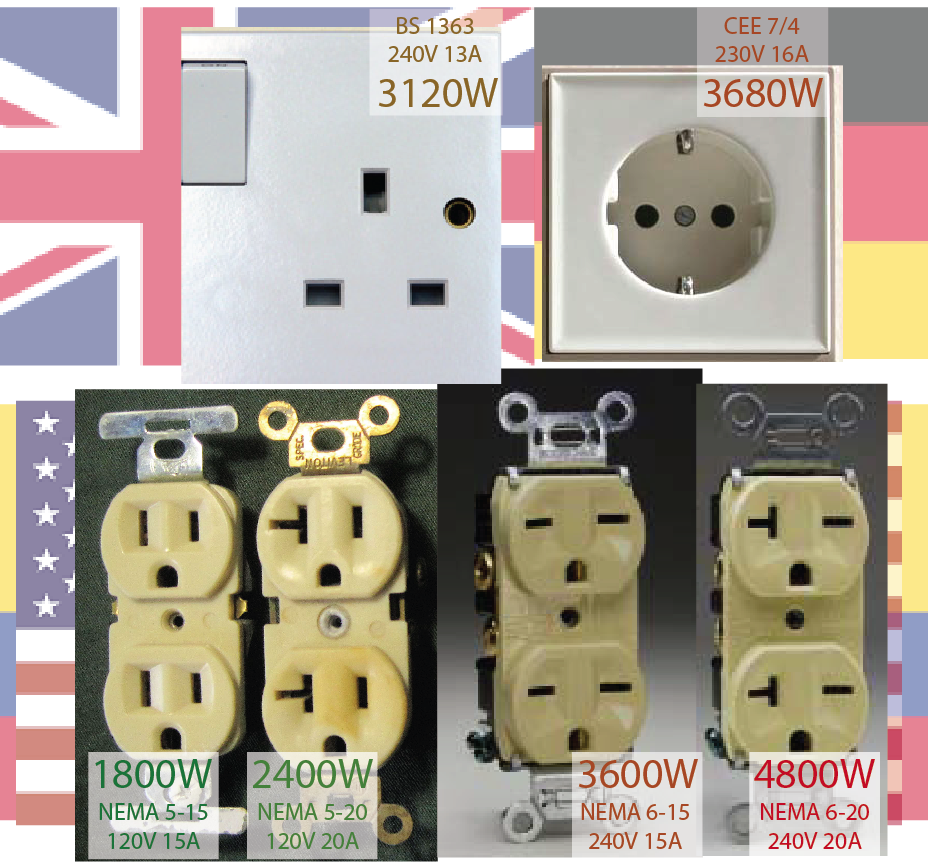
enter image description here

The ubiquitous USA socket is to the left, of course. The right two are the two 240V variants you're looking for. Isn't that clever, how they're the same form-factor, with a twist?

These are NEMA 6 type, which delete the center neutral which your appliance has no use for.

The circuit rules

Firstly, the 125% rule: an appliance's plug must be sized for 125% of amp draw. So 0-12A uses a 15A socket. 12-16A uses a 20A socket.

As for the socket wiring, this is a surprise to most Americans, but these 240V circuits have the same rules as 120V circuits.

  • No limit to the number of receptacles on a circuit. (some localities limit to 8 or 12 receptacles, but the pictured receptacles have 2 sockets each).
  • 15A receptacles are allowed on 20A circuits.
  • 20A receptacles are keyed to accept 15A plugs.
  • However the rule requiring 20A circuits serving kitchen receptacles does not apply to 240V circuits.

By the way, the 240V ones in the photo have funny wires on the mounting screw holes. They can pick up earth from the mounting screws, if they go into a metal junction box - since incoming cables must earth to the junction box. Better 120V sockets have this feature also.

The USA requires junction boxes inside the wall for all electrical connections, because our walls are not stone. However our boxes are often plastic. For every reason we use junction boxes, metal boxes are superior. Plastic boxes are only cheaper.


There's a minor glitch with this, but given British love of earthing I don't see it as a problem: USA 240V power is like UK construction site power, both conductors are live with earth in the middle. Britain's requirement for earth means every single electrical device is polarized (neutral is known). That differs from Europe proper, where the sockets are flippable and you never know which leg will be live. It's possible a builder of a UK-only appliance might take shortcuts and not insulate the neutral wire very well. That would be a problem here (or in Europe). But like I say, not likely if they sell the appliance in Europe.

Harper - Reinstate Monica
  • 313,471
  • 28
  • 298
  • 772
2

If your kitchen outlets are wired as multi-wire branch circuits (MWBC), where the top and bottom outlets of each duplex receptacle are on different circuits, adding a 240 volt receptacle is extremely easy and only requires swapping out the receptacle and doesn't require any wiring or breaker changes.

The good news is that this is a fairly common configuration in older kitchens that predate GFCI requirements (because GFCI receptacles make this configuration more difficult), and it's really easy to tell if your receptacles are wired this way. All you need to do is take off the faceplate and check the right-hand (hot) side of the receptacle to see if the breakaway tab connecting the two receptacles is broken off and that there are two wires (usually red and black) connected to the screws.

These two wires should be each 120v half of your 240v split-phase service. Any one phase to neutral results in 120v, but put the two together without a neutral and you get 240v again. You should measure the voltage across the two hot wires to confirm before proceeding. This works because MWBCs already use double breakers across both phases, so instead of connecting to one of the hot wires and the neutral, you connect to both hot wires. Since you have both hot wires in the box, it's a simple job to swap out the receptacle with a 240v version. MWBCs already use a double breaker, so it's perfectly safe and code compliant to do this if your double breaker has common trip functionality (meaning that tripping one leg of the circuit will also trip the other; this is different from tied handles, which is only for maintenance safety).

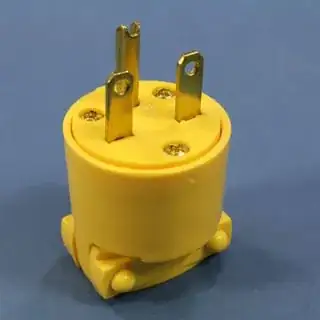
If your existing receptacles are the standard 15 Amp type with two vertical slots, you would install a 240v 15A receptacle (6-15R), where both hot slots are horizontal, and install the corresponding 6-15P male plug on your 240v kettle.
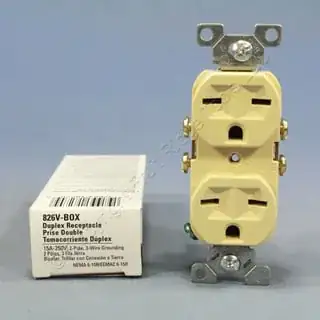
6-15R duplex receptacle

6-15P male plug

If your existing outlets are 20A, you could alternatively install a 240v 20A receptacle (6-20R), where the right slot is horizontal and the left slot is vertical, and the corresponding mirror image 6-20P male plug on the kettle. (20A receptacles also accept 15A plugs, hence the T-shaped slots.)
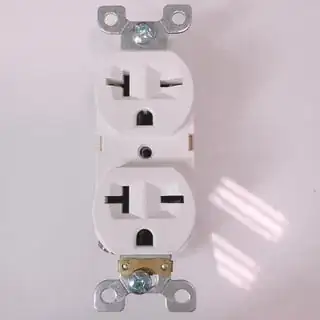
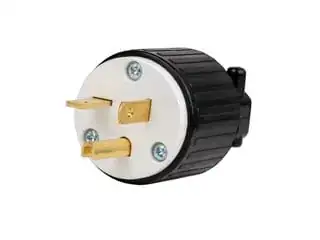
6-20R duplex receptacle

6-20P male plug

These parts are commonly available at hardware stores, and the receptacles are available in single and duplex versions.

What is not commonly available in stores but can easily be ordered online is a combo 120v and 240v duplex receptacle, so that you don't lose both of your 120v receptacles, and so you can also satisfy code requirements of having receptacles a minimum distance apart. These combo outlets are available in different versions, either as 15A (5-15R/6-15R, pictured) or 20A (5-20R/6-20R).
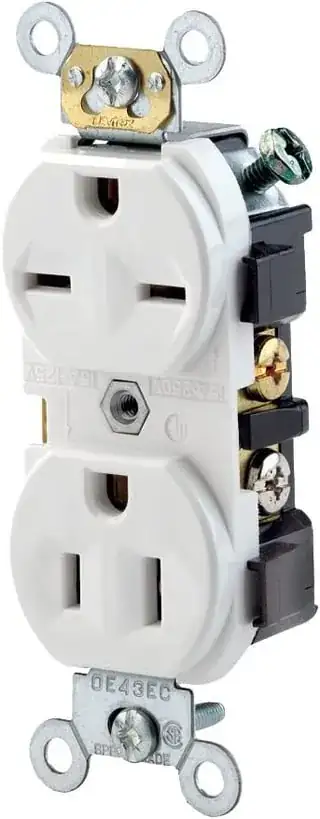
5-15R/6-15R duplex receptacle

GFCI

This doesn't cover GFCI protection though. I don't think 240v receptacles in kitchens generally need to be GFCI-protected by code (not verified), but if your kitchen isn't currently GFCI-protected I would either install a double GFCI breaker (if you can find one), or not worry about it. GFCI receptacles won't work with 240v unless the 240v receptacle is upstream of the GFCI devices.

user5670895
  • 159
  • 6