3

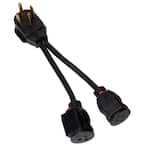
Adapters exist for providing 120V from a 240V receptacle, such as for powering a gas range or dryer from the original electric range or dryer outlet:

240V to 120V adapter

Does anyone make a similar adapter that goes in the other direction?
Specifically it would plug into an existing 120V split kitchen receptacle and provide a 240V outlet for a European kitchen appliance. (It would be for resistance appliances only, so the 50Hz vs. 60Hz is not an issue.)

It would be easy to construct one, but the result would be potentially dangerous.
(Two separate 120V plugs means that when one is plugged in the other has a live exposed prong.)

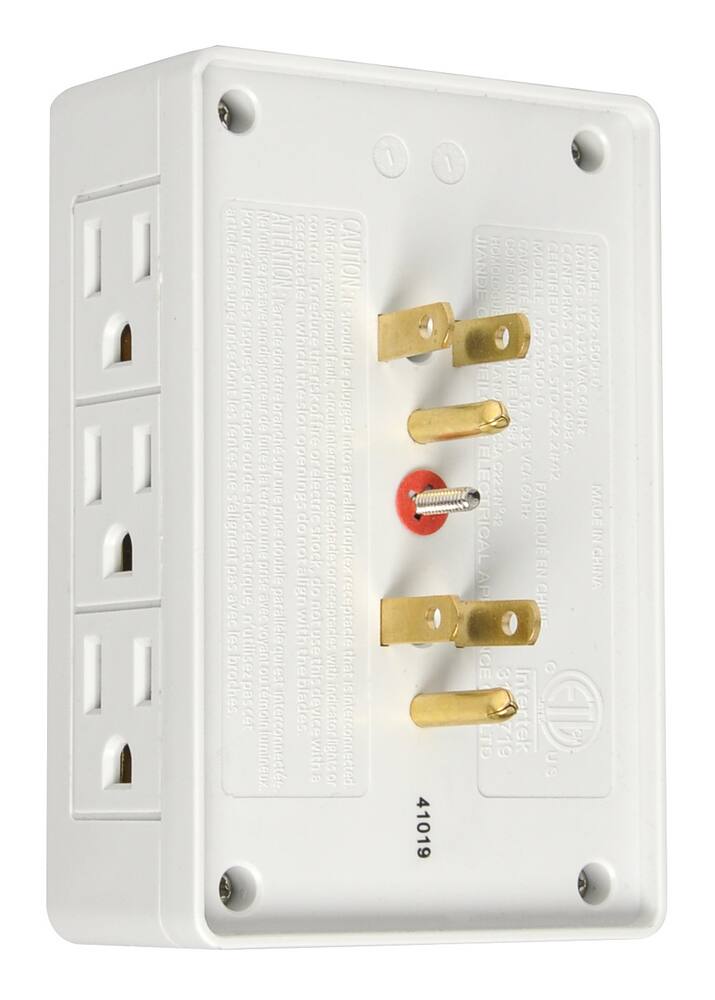
What would be needed is a dual plug, such as this wall-tap has, but with only a single 240V outlet:

2-to-6 outlet 120V wall adapter

Ray Butterworth
  • 1,217
  • 1
  • 8
  • 18

4 Answers4

9

What would be needed is a dual plug, such as this wall-tap has, but with only a single 240V outlet

Such a dual plug wall tap would be unreliable, because it can only work correctly on a MWBC.

If both sides of the receptacle are on the same (regular) circuit, your wall-tap would have 0V. If both sides are on different circuits, it is harder to impossible to guarantee that the wires take the same route from panel to receptacle and that the breakers are handle-tied.

As you state that you already have 240V at the location, a better option is to look for a 120V/240V receptacle combination. Then you can just plug in your European appliance into the 240V receptacle (with an appropriate plug converter) and it even leaves you a 120V receptacle as spare. See also the answers to Can I install a 240V outlet in my new US home for my UK kitchen appliances?.

3

Yes

There are several products that do this with a box and two input cords. They incorporate a monitoring circuit and relays to ensure the two inputs have incoming voltage with correct phasing before connecting the output. This prevents a shock from prongs of a disconnected input cable, the hazard identified by the OP.

One product, the Quick 220 is claimed to be ETL listed to UL 1012.

I was at a site which required these boxes instead of step-up transformers due to a history of shoddy transformers catching on fire.

user71659
  • 1,278
  • 8
  • 11
2

No inexpensive way to do this safely or reliably. (See user71659's answer for an approved device, but the cost and "no GFCI/AFCI" constraints are important.)

The reason 240V -> 120V works is the principle of the Multi-Wire Branch Circuit. This is a 240V circuit that uses one neutral together with two 120V hot wires that are on different "legs". That means there is 240V between the two hots, so you can power either 240V or 2 x 120V or both from the same circuit.

There are a number of safeguards involved, particularly to make sure that (a) if you turn off one 120V hot wire in the breaker panel that you turn off the other at the same time and (b) that the two 120V hot wires are on different legs and not on the same leg.

While using a crazy adapter is not the normal way to create a 120V receptacle on a 240V circuit, it is not inherently wrong. There is a current overload protection issue - e.g., using a 30A 240V receptacle to power a 15A or 20A 120V receptacle requires providing 15A or 20A overcurrent protection for the 120V receptacle, but that can be done. The cheap adapter cables are not UL or ETL listed because they don't provide this protection. However, this GE adapter from Home Depot:
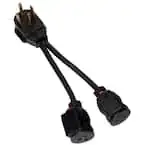
GE adapter 240 to 2 x 120

does provide protection - a circuit breaker on each 120V socket.

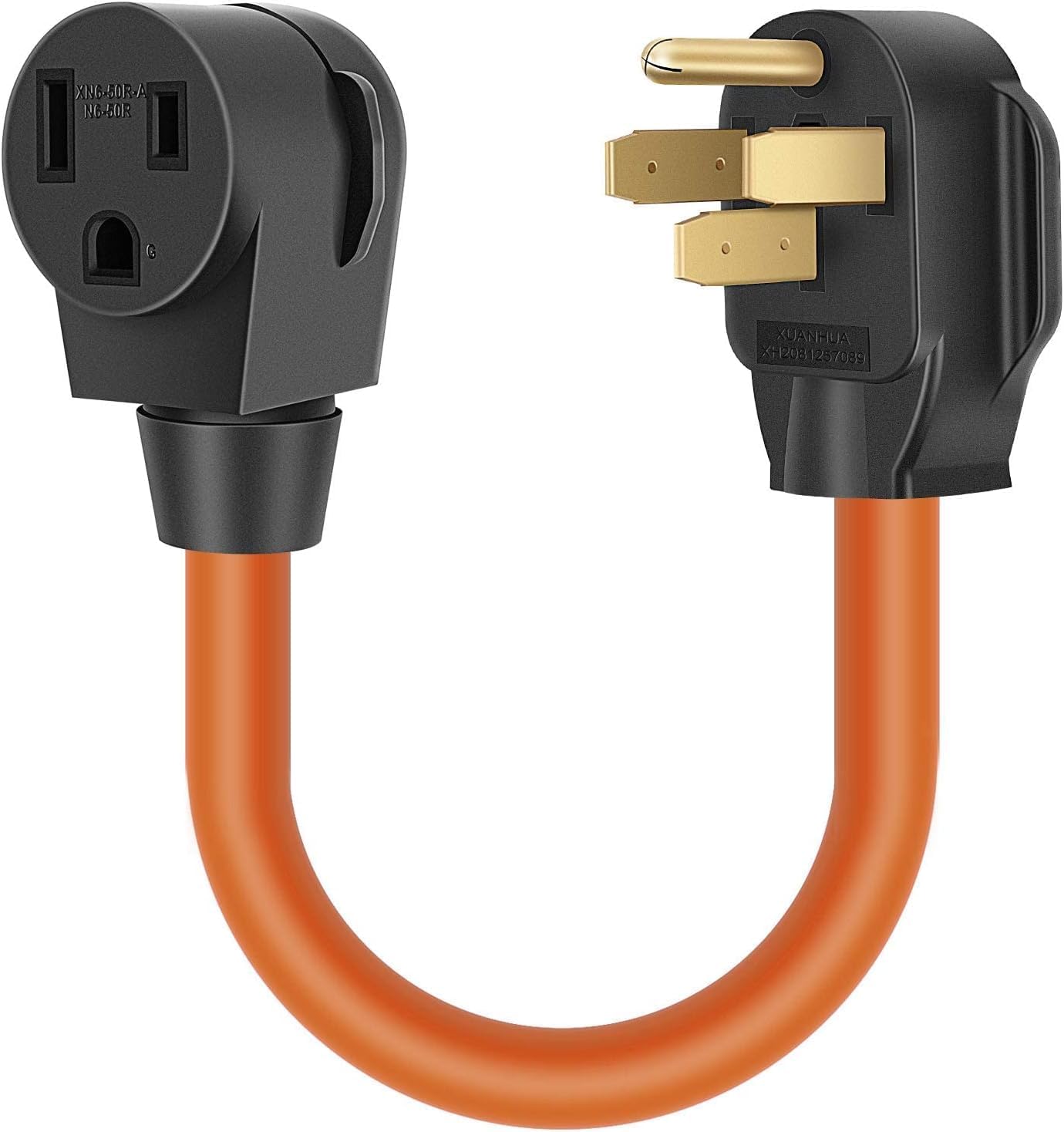
However, going the other direction you have to make 100% certain that the two "source" receptacles are on opposite legs. That is easier said than done. MWBCs are relatively common in kitchens, but even then they could be configured for top/bottom in each duplex receptacle (in which case this type of adapter would work well) or for alternating duplex receptacles (i.e., the MWBC splits in the first receptacle box), which has the advantage of allowing for GFCI/receptacles to provide GFCI protection.

You are really much better off running a new 240V 20A circuit and installing a standard NEMA 6-20 receptacle. Then you can put a 6-20 plug on the end of the appliance cord and you're all set. But remember, this will need GFCI protection, which means a GFCI/breaker as GFCI/receptacles are only generally available for 120V circuits.
manassehkatz-Moving 2 Codidact
  • 139,495
  • 14
  • 149
  • 386
0

Yes.

If you are looking to power an ordinary single-phase 240V device, such as one that is used in a country where 240V is the standard line voltage (Europe, etc.), there is a very simple and completely normal solution. It's called a travel adapter (that is an Amazon link, I don't endorse them either way, but I take this as de facto proof that this is fairly common). Make sure the total wattage matches (the device must do more than 240 x # of amps drawn by the device).

If you want a 3-phase US 240V outlet, not without problems. In general, no. It is possible to do this but it is going to be complicated and much, much more expensive than running a separate 240V from the panel to your load.

Stephan Samuel
  • 247
  • 1
  • 2