9

I'm planning to add an appliance to my house, and will want to do a pressure test of the newly installed gas lines. My main shutoff says 175 PSI, but most of the appliance valves say either 1/2 or 5 PSI. Finally, I see a Nibco valve at my local hardware store GB1A-3/4 that lists three different pressures: 1/2, 5, and 600 PSI CWP.

For the nibco valve, does that mean that it would be able to withstand up to 600 PSI of (cold) air/gas pressure, but should only be used as a main shutoff for up to 5 PSI, and an appliance shutoff where the working pressure is less than 1/2 PSI? Should the other shutoff valves rated at 1/2 or 5 be able to withstand the 4 PSI of the pressure test?

I plan to do the pressure test at about 4 PSI, with a gauge that reads up to 15 PSI. Should I cap off the lines before the shutoff valves (to avoid stressing valves, but not test them), or close the shutoff valves and remove the caps on the traps so that excess pressure leaking through valves would be vented instead of damaging the appliance regulators.

My house's regulator is set at 7" of water column, gauge pressure, and I need to test at a minimum of 3 PSI-gauge, and I'm located in Indiana, United States.

Chris Cudmore
  • 14,169
  • 7
  • 61
  • 91
Pigrew
  • 3,435
  • 2
  • 24
  • 30

8 Answers8

6

The standard pressure test for new natural gas or propane pipe in my area (NW Oregon) is something anyone can do. Same for installing the gas line. (Why are there so many naysayers on a DIY forum? This is not rocket science:   Just a few new skills to learn.)

Before installing the gas pipe, I consulted with a pro (paid $80 for an hour of onsite questions). He had some good tidbits and some not so great. The best bit of advice was that to prevent leaks, make every connection with no more than two or three threads showing. Since there were 105 connections, this was a heavy duty workout over several days. Using yellow Teflon tape makes turning much easier—as does a 16 inch pipe wrench. The joint's seal is formed by the pipe and fitting being forced together and then settling (which takes hours to days). By turning until only 1 to 2 threads (out of 10) remain revealed, there was no leakage.

(The worst bit of "pro" advice was that he would have routed the pipe through the garage in the most obnoxious way. It would have been convenient to install, but a royal pain in the ass to live with afterwards. Instead, we opted to bore two holes through the garage foundation into the crawlspace and kept 98% of the pipe neatly out of the way.)

To leak test, obtain a $10 gauge as pictured (for black pipe) and install it somewhere on the pipe. In my case, I put it at the top of the riser pipe for the range. I explicitly ran 3/4 inch all the way to the range to suit the gauge, which has a nice benefit of smooth generous flow even when all the burners and ovens are on. (Total extra cost was less than $20 over 1/2 inch pipe, and no perceptible increase in hassle.)
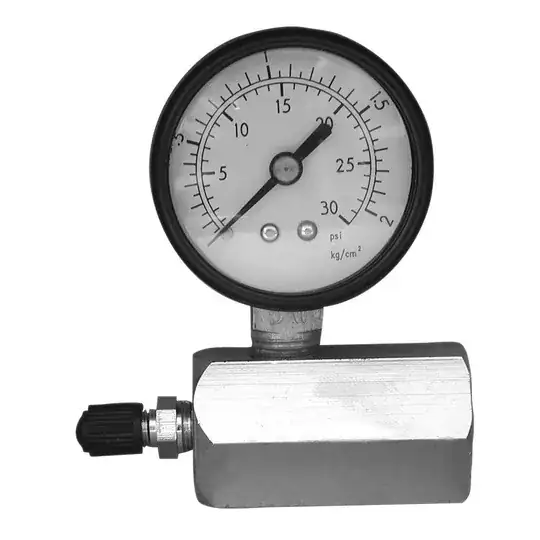
enter image description here

Since every appliance has an independent cut off valve, I closed all those and the gas meter shutoff valve, used a bicycle tire pump to pressurize the system to 30 psi and waited. If the whole system does not hold pressure for hours and hours, there is a leak somewhere. At the end, the worst leak offender was the test gauge itself. I had to clean the needle valve and use gobs of Teflon tape to get it down to reasonable levels—on the tire valve thread into the tester body, on the gauge stem's thread into the body, and a great deal of tape for the gas pipe going into the tester. For preliminary tests I tried temporary caps at the appliance feeders and those were exceedingly leaky—the pipe caps don't seem to fit tapered pipe because they lacked enough thread depth. The valves on the appliance flex hoses didn't leak at all.

Once I was satisfied that 30 psi didn't leak significantly, taking five days to drop to 22 psi (demonstrably through the test gauge), I called for inspection. The mechanical inspector walked in, saw 22 psi and said "you pass" without looking at another thing. According to the test standards (see 406.4), it has to hold pressure for 10 minutes with no perceptible drop and he had no idea if I pumped it up just as he arrived or hours before. So much for inspection insuring safety.

For the nibco valve, does that mean that it would be able to withstand up to 600 PSI of (cold) air/gas pressure, but should only be used as a main shutoff for up to 5 PSI, and an appliance shutoff where the working pressure is less than 1/2 PSI?

Yes.

Should the other shutoff valves rated at 1/2 or 5 be able to withstand the 4 PSI of the pressure test?

Yes.

I plan to do the pressure test at about 4 PSI, with a gauge that reads up to 15 PSI. Should I cap off the lines before the shutoff valves (to avoid stressing valves, but not test them), or close the shutoff valves and remove the caps on the traps so that excess pressure leaking through valves would be vented instead of damaging the appliance regulators.

Why not be thorough? If there is a leak at 4 PSI, it will be very difficult to assess. Run the test at the maximum test gauge reading.

My house's regulator is set at 7" of water column, gauge pressure, and I need to test at a minimum of 3 PSI-gauge, and I'm located in Indiana, United States.

That is standard residential delivery, same as mine.

wallyk
  • 12,399
  • 3
  • 24
  • 51
2

I'm not quite sure exactly where you are proposing to cap off the lines, but if you add a valve to supply the new appliance, you need to test every new connection you make.

If your work is located in an area that is easy to inspect and you get a permit and have your local city inspector sign it off (assuming owners are allowed to do this kind of work) you should be reasonably safe but of course I assume no liability for anything that happens.

It does sound like you've carefully studied what documentation you can find. Here's a description of the standards applying to the valve you wish to use.

Tester101
  • 133,087
  • 80
  • 327
  • 617
Philip Ngai
  • 3,503
  • 1
  • 21
  • 20
2

Any and all gas piping must be tested by a "proper pressure drop test". This requires the use of a manometer or water column gauge. A very small amount of pressure is inserted in the piping system (12 to 14 inches of water column), the system is then monitored to check for pressure drop. This is the most precise method for testing and will detect the most minute leak. It is so precise that an increase in the surrounding temperature may be detected by an increase in pressure. On new installations a 30 psi pre test is recommended to insure there are no sand or casting holes in the new fittings. The excess pressure will blow out any weak spots in the system prior to placing the system in use.

Niall C.
  • 20,909
  • 19
  • 95
  • 135
1

I have worked for a Gas Company- for 42 years. 1st: if you have run/installed new gas piping, remove all shut off valves- cap the pipes/ can use teflon pipe paste on the threads- black pipe or galvanized (which-ever) Install pressure test-gauge, pump up to 10 lbs (30 lbs is way to excessive.If test is good- bleed off test pressure. Connect shut off valves and appliance connections. Use gas leak detector soap, to verify no connection leakage. Note* If you use pounds pressure with shut-off valve attached- you will probably damage valves and possibly the appliance- if still connected.

0

Close your valves and test at 7 .that's plenty enough to spray your solution and do your repair until your not losing Any pressure. Theres no need to blow all the nice seals using 20 and up. Old valves and loose unions are usually in need of repairs so dont skip them.

0

We used to test to 20 lbs inside of the building. Yeah it's way more than what the regulator will let through but that was always the standard. I would not want to live in a home that somehow could not withstand 20 lbs of pressure without leaking. The black pipes and fittings are rated at much higher pressures than that. If your work is good there should be no problem.I started off working in a shop that was using old school methods, Lamp wick in the pipe thread with pope dope. That stuff lasted a long time. Also lamp wick in slip joint pipes lasted for 20 years, not like those crappy washers they include these days. It was old school but it worked.

https://www.youtube.com/watch?v=-yGRgv2flfs

Machavity
  • 26,498
  • 8
  • 44
  • 100
0

A liquid leak test (try Abbey leak detector or Sherlock Leak detector) is a more appropriate test for gas connections by a consumer.

Also know this, the gas pressure inside the house is low, around 3 PSIG. The gas meter contains a regulator to reduce gas main pressures.

HerrBag
  • 12,225
  • 1
  • 21
  • 37
0

The fluid kids use to make bubbles is the best liquid to test a joint in a gas pipe. At $1 per bottle, it is clear when you pour it over the joint, and just like a kid blowing bubbles a leak will show anywhere on the joint.

Niall C.
  • 20,909
  • 19
  • 95
  • 135