7

I'm considering getting an evaporative humidifier for my super-dry Northeast house, but I'm wondering if the evaporation cools off the room and is going to add to my heating bill.

It seems like evaporative humidifier work exactly the same was as evaporative air conditioners — i.e. blowing dry air across water to cause evaporation, thus transferring the heat of the air into water vapor's latent heat.

Am I wrong about the thermodynamics? Or is the effect small enough that it doesn't make much difference?

Hank
  • 14,213
  • 10
  • 46
  • 48

5 Answers5

7

You are quite correct about the thermodynamics. The heat involved in a phase change of water is so significant that professional HVAC guys specify the performance requirements for cooling as two different parameters: sensible and latent heat to be removed. The latter is the heat involved in phase change of water and is often more demanding than removing sensible heat.

"For example, in 1 kg of waste air at 20 °C with a relative humidity (RH) of 60%, the total energy is 42.5 kJ, more than half of which (22.5 kJ) is latent heat."

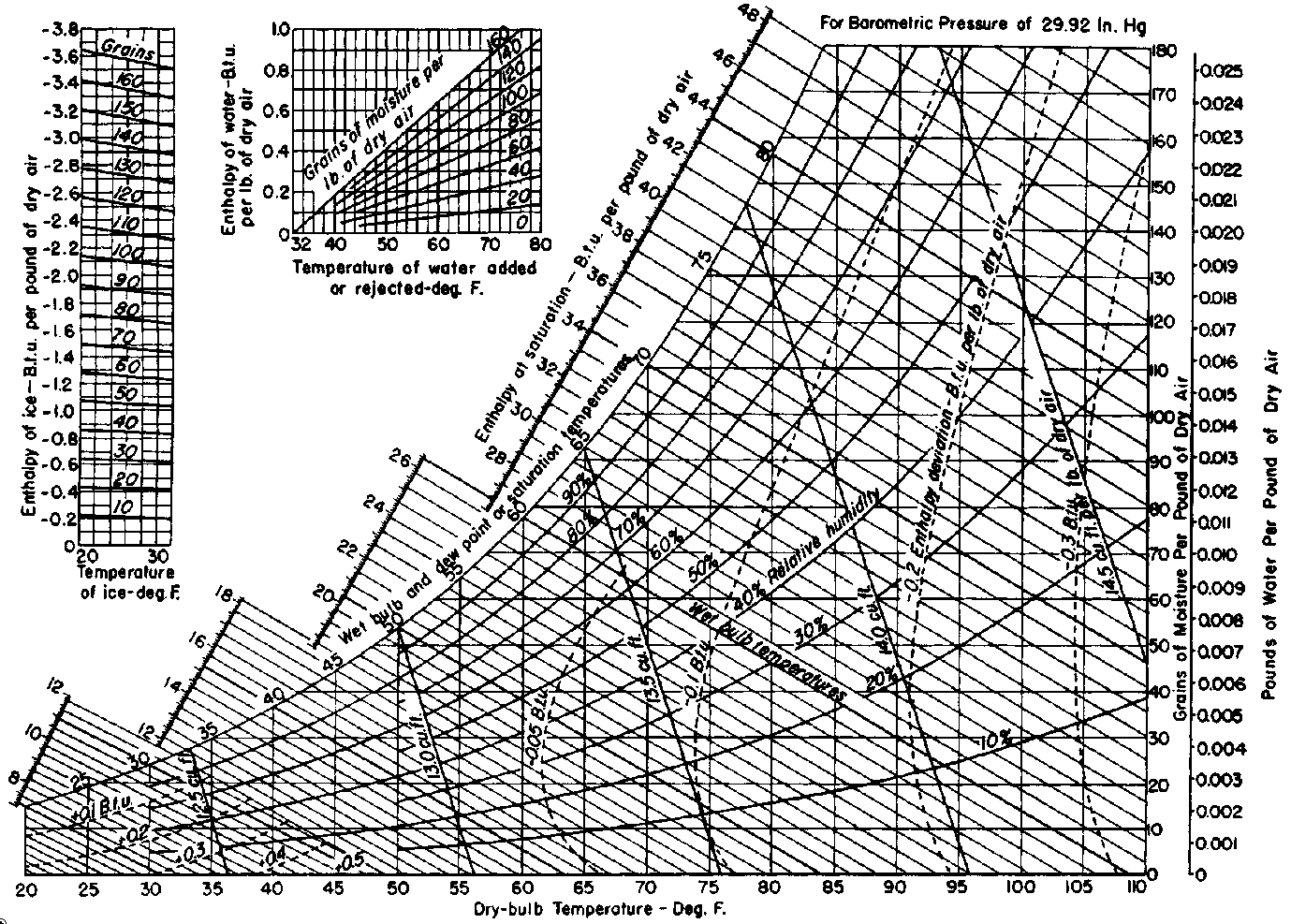
You can analyze your situation with a psychrometric chart like this: http://www.truetex.com/psychrometric_chart.gif

Just pick your desired temperature and relative humidity and you can find out how much water exists as vapor under those conditions.

Philip Ngai
  • 3,503
  • 1
  • 21
  • 20
1

You are correct. That's why some humidifiers have additive heating.

If you put your hand into the stream of created vapor, you can feel the coldness of it.

Peter Ivan
  • 358
  • 5
  • 22
1

First thing: Yes a evaporating water in a humidifier will cool the room. But, if your air is too dry (presumably health concerns like bloody noses, you need a humidifier. Besides in the winter humid air is generally more comfortable.

Other things: Humid air tends to feel warmer. And, depending on the construction (namely older homes), materials may swell with a little moisture in the air, thus help better seal tiny cracks that draft

Finally: Don't put too much humidity into the air during the winter. Some of it may condense and or freeze to ice in your insulation, thus reducing its insulative value, and worst of all promote mold growth.

-1

Evaporation cools off the room if the energy for evaporation is provided by the “latent energy of the room”.

However, you're providing the energy through electricity, not the latent energy of the room.

Niall C.
  • 20,909
  • 19
  • 95
  • 135
Miju
  • 1
-2

Little do u know in using a humidifier to cool a room, its fine of its a single flat or home. If you live in a two flat dwelling which isn't insulated, and the above flat has the humidifier. It creates a few problems First of all fumes get pulled from the stack of the water heater into the lower dwelling, causing the potential for carbon monoxide poisoning. Secondly if the control is set higher on the humidifier, the lower flat sees an increase in temperature of at least 5-9 degrees. This is from experience im speaking, i had to get out of the lower flat to get air, as the gas company rep said somethimg was pulling the exhaust away from the stack vent and pulling it into the basement. Ms. Pierce

ms p
  • 1
  • 1