7

My fridge shelves cracked and broke, and although I tried a repair mentioned in a previous question, it eventually failed as expected.
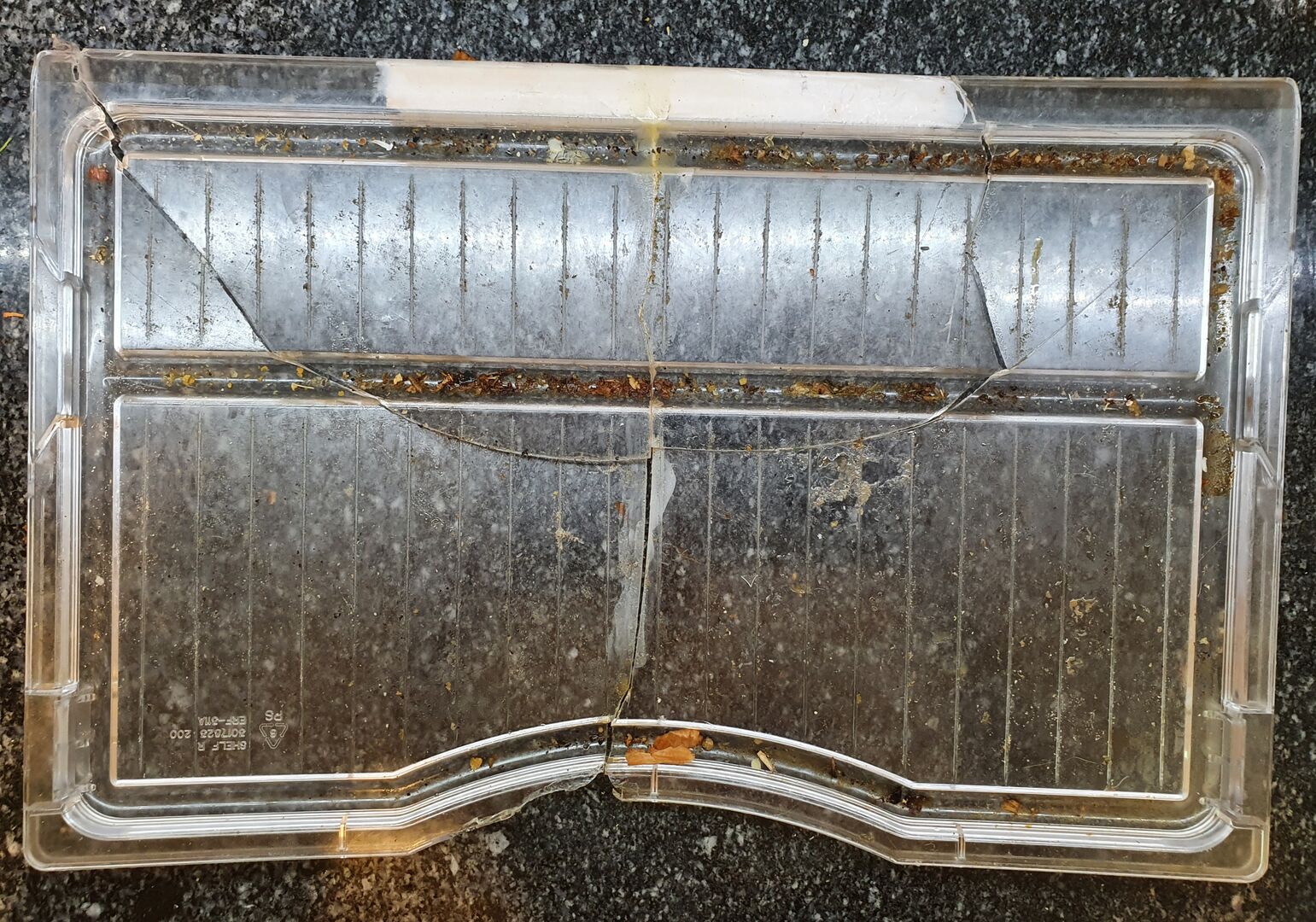
broken shelf

Since it seems that replacement shelves are no longer sold for this fridge model (Daewoo ERF-384/385/387/388 M/A), I looked for metal bar stock as suggested in the linked QA, but it seems that aluminium bar stock of the suggested width and thickness would be more expensive than purchasing a sheet of plastic. There are vendors who (e.g.) sell 'universal' replacement shelves, and those who sell plastic cut to size as replacement for shelves. Both of these are examples, but both list the thickness of the acrylic/Perspex/Plexiglass sold as 5mm.

I contacted a local plastic supplier who can supply cut cast acrylic sheets (among others) for advice, but they were unable or unwilling to make a recommendation as to material. Is there a difference between cast acrylic, Perspex, and Plexiglass? If not, is 5mm a suitable thickness for reasonable, everyday domestic fridge shelf use? My local supplier can make sheets up to 10mm if thicker is better.

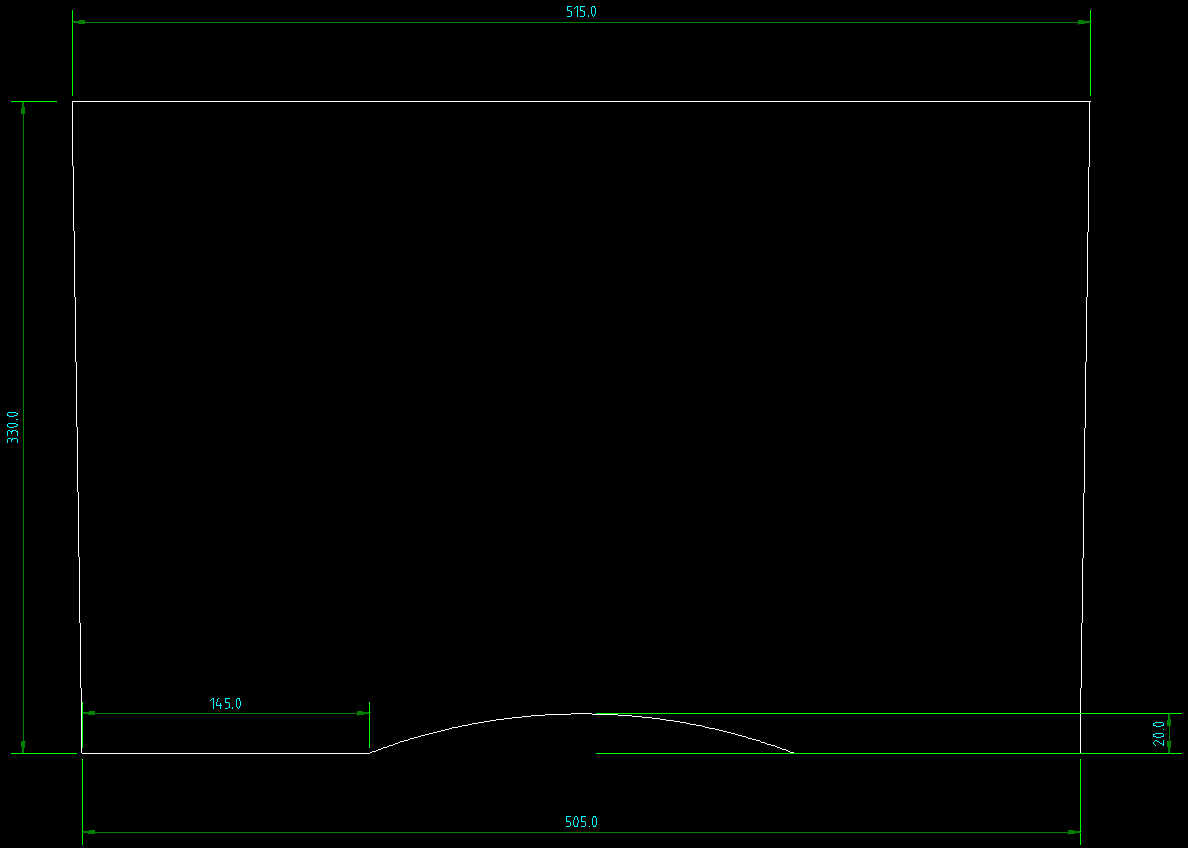
The measurements of the replacement shelf are shown below:
fridge CAD

(dimensions in mm)

The shelf seems to be very slightly tapered and so is trapezoidal, being 10mm shorter along the rear edge where the arc is. I am hoping the local plastics supplier can cut accordingly but if not I assume (hope) the plastic can be filed/abraded to fit.

My intention is to duplicate the top-down ("2d") shape of the shelf, rather than trying to mimic the "3d" shape of it with grooves and retaining stops etc- ie end up with something flat.

I would prefer to keep the fridge, rather than replace it for want of a couple of shelves!

bertieb
  • 457
  • 5
  • 17

5 Answers5

11

It's Polystyrene, according to the label (like all fridge shelves).

enter image description here

Is there a difference between cast acrylic, Perspex, and Plexiglass?

Poly(methyl methacrylate) (PMMA) belongs to a group of materials called engineering plastics. It is a transparent thermoplastic. PMMA is also known as acrylic, acrylic glass, as well as by the trade names and brands Crylux, Plexiglas, Acrylite, Astariglas, Lucite, Perclax, and Perspex,

ie, they're all the same. It's tougher than polystyrene but more expensive.

It should work alright. They make airplane windows out of this stuff, so it should withstand the environment inside a fridge. I'd pick something like 8mm so it doesn't flex when putting bottles on it.

You'll probably need to mill notches or retaining points in the sides like the original so it locks in the fridge and doesn't pull out.

Polycarbonate (Lexan) is tougher, but don't put it near your food, as it contains Bisphenol residues.

bobflux
  • 11,121
  • 29
  • 35
9

Been there, done that.

About 10 years ago I had 2 broken shelves when my wife placed a too heavy casserole dish (cast iron skillet) on the top shelf and it crashed through that shelf and the one below.

I had a couple of 5 mm thick acrylic sheets (couldn't easily source anything thicker) cut to the outer dimensions of the original shelves.
Then I used a Dremel with a burr bit to shape the cutout going into the back of the fridge and to taper the sides. (My shape was almost identical to yours. I also had to create rounded corners at the back.)

I used a burr bit because I was a bit worried that cutting into the acrylic would splinter the material. (Or scorch through overheating. It is easier to control the heat with a burr bit.)

Last, but not least. I got a piece of aluminum U-profile, 5 mm wide and 12 mm high that I slid (and glued) over the front edge of each shelf to give it more resistance against bending under weight.
The sides and back are well-supported by the ridges on which the shelves rest, but the front obviously not.
The aluminum strip gives that extra support and it looks a lot nicer than the bare edge of the acrylic.

Both shelves are still in fine shape. (I gave the fridge to my cousin a few years ago and he is still using it with my DIY replacement shelves.)

Tonny
  • 755
  • 5
  • 12
7

Polystyrene, and similar acrylic (Perspex and Plexiglass are brand names) are quickly attacked by solvents such as acetone and methyl ethyl ketone (MEK), found in nail-polish remover. Put a little nail-polish remover, acetone or MEK (all are flammable!) on a small piece of paper towel and let it sit on the damaged shelf -- if the shelf softens or gets a crazed ("frosted") appearance at that spot, it's most likely made of acrylic.

BTW, polycarbonate is a far tougher and stronger plastic, though more expensive. There are grades of polycarbonate suitable for food contact, though I don't know if it needs to be "food grade" for use as a shelf. It would be a personal choice if the extra strength were worth the cost, though.

DrMoishe Pippik
  • 10,706
  • 19
  • 32
2

Well, since it's polystyrene, it is thermoplastic and can be melted and re-formed with solvent appropriate for polystyrene. You know what else is made of polystyrene? Airplane/boat/car models that kids (of ALL ages) put together. And do you know how you glue those? "Model airplane cement" which is acetone, really.

PVC "gluing" works the same way (with a different solvent though). Everyone assumes it's a sandwich of

  plastic | magic glue | plastic 

But it's not gluing at all, it's welding. The solvent dissolves (liquefies) both pieces of plastic in the mate area, causing them to inter-flow, then the solvent dries away and you are left with

  plastic 

and that's it. It's one piece of plastic now.

Note that neither type of cement can bridge a gap. If someone is desperate they might try

 plastic | cement | AIR GAP | cement | plastic 

And that is not going to work. Fit and clamping will be everything.

All that to say, it may be possible to sand off all that incompatible PVC crud and have another go using polystyrene sheets. But they should really reinforce.

Remember that tray is a structure, exactly like a bridge. The top is in compression, the bottom is in tension. Reinforce accordingly and don't spare the material.

As far as a replacement piece, special attention will need to be paid to how the shelf docks on the side. I don't think 5mm (3/16" will be strong enough, but you are constrained by what will fit in the slots the shelf fits into. You should measure both the old shelf and the fridge itself. Measure twice, cut once LOL.

Harper - Reinstate Monica
  • 313,471
  • 28
  • 298
  • 772
2

In general, No. The original shelf has features that make it rigid that are going to be difficult to replicate. My suggestion is to make two identical copies of the shelf. One cut by the plastic shop from food-safe polycarbonate and the other by a glass fabricator out of 10mm glass. Laminate the two together with clear 3M VHB or similar. (A strong tape, just put small discs cut from VHB about an inch from the corners and one or two in the middle. ala #5 on dice). The glass will be rigid and the policarbonate will tolerate getting dinged. Put the polycarbonate sheet on top. Many fridges have glass shelves only and that can certainly work. BUt they will usually have a plastic edge protection to keep a small chip from turning into a catastrophic fail.

Aaron K
  • 146
  • 1