9

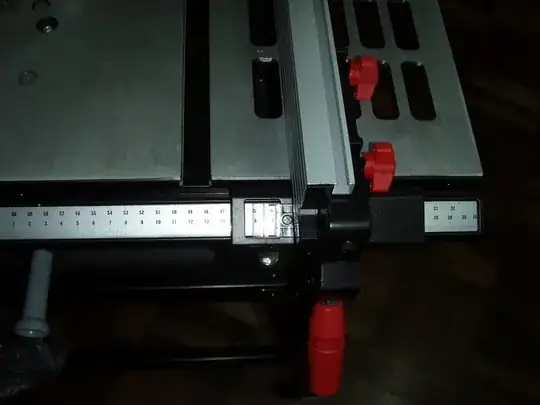
For example, in the ruler, the bottom row goes from 0 to 31 cm from left to right and the upper row goes from 32 upwards from right to left?

fence rule

EDIT: Here is the manual for the tablesaw pictured above. There is no mention of that scale, and it the drawings it looks like it should be a cm/inches scale.

EDIT2: I had e-mailed the manufacturer about it (Bosch), and they told me to contact an authorized repair store about the matter!? So even the manufacturer have no idea what it is supposed to be.

Brad Mace
  • 2,505
  • 11
  • 36
  • 48
Luiz Borges
  • 2,345
  • 16
  • 69
  • 83

3 Answers3

5

You have a "reversible" fence. One set of measurements are for when the fence is on the right side of the blade, and the other set of measurements are for when the fence is on the left side of the blade.

Remove those 2 red knobs on the right side of the fence and remove the bolts/fence. Now put the bolts through the other side (where the red knobs are) and put the fence on and the knobs. Remove the fence assembly from the track, move to the other side of the blade, put fence back onto track, now you can measure/cut from the other side of the blade.

Gunner
  • 4,445
  • 1
  • 22
  • 30
2

This is based entirely on inference and testing with some mockups (basically a paper table saw and fence measurement I made). I am not a woodworker but I found this question interesting.

My guess:

It's used to measure cuts for items wider than the table surface.

Your saw is 31 cm across, and you need to cut a sheet of plywood from 60 cm down to 55 cm.

Using your fence as currently marked you could....

1 - Lay your plywood on the table with the edge lined up on the left side of your picture (Where your measurements start, at the blade I'm guessing), to see you have overhang.

2 - Adjust the fence to 55 cm on the TOP row (6 cm on bottom)

3 - Line up the end to be cut with on the left side of the fence.

4 - CUT!

In our sample scenario this will cut off your excess 5 cm. I think the extra gap between 31-32 is for the width of your fence itself.

To phrase it another way, it looks like it's a way to cut the short end off of a very wide piece of material. The numbers increase to the left because the wider you want the sheet the less you will cut off.

You can't measure 55 cm cut off the 60 cm sheet, but you CAN measure the extra 5cm to cut off, and that's what those extra numbers are for.
JNK
  • 306
  • 5
  • 17
1

I finally discovered how this is supposed to work. It depends on an auxiliary fence that doesn't exists. I don't know if this was intended or copied from another model, but I thought about that after seeing a huge table saw that has something similar as a feature (this table in question could cut more that 270 cm in width).

It works like this: you have another fence that is affixed on the left side of a rail that has the width of the table and rides on the groove just above the ruler, the right side of this rail has an indicator on the ruler.

While this rail is completelly "inside" the table, the indicator shows 32 cm, this is the space between the blade this other fence on the left side. As this rail moves to the left the ruler indication increases and the fence goes "off" the table, therefore allowing a larger cut to be made. This goes up to 60 cm where the indicator would "cross" the blace and get in the way of the cut.

I hope this is clear enough, it's kind of hard to explain.

Luiz Borges
  • 2,345
  • 16
  • 69
  • 83