14

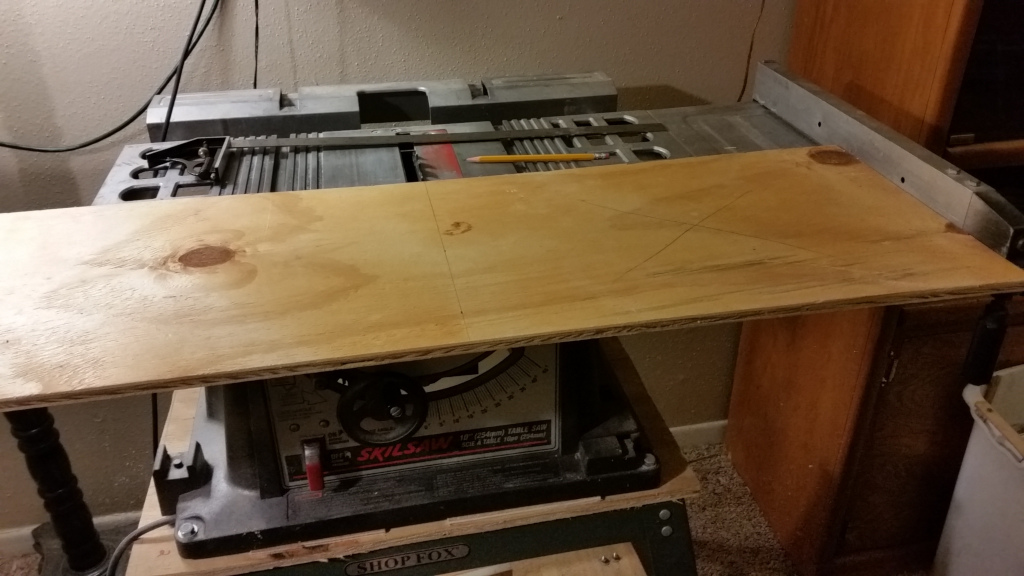
As the photo shows, I want to cut some larger pieces of plywood.

The right edge is not straight, but even if I get it straight, I will not be able to easily cut it using the rip fence.

And the miter gauge won't work because the piece is too wide.

I need pieces that are 32 inches long.

I also attached a picture of what I think is my miter gauge?

How can I achieve that?

enter image description here

enter image description here

chicks
  • 239
  • 1
  • 3
  • 13
fixit7
  • 1,329
  • 2
  • 14
  • 26

5 Answers5

21

I've found that clamping a guide board to the plywood and riding it along the edge of the table works quite well:

enter image description here

Guide board in red, clamp in blue - you should have another clamp on the front edge of the plywood for stability.

Make sure you remove the ripfence when you do this, as otherwise the off-cut is very likely to get pinched between the blade and the rip-fence, and get launched backwards.

jpa
  • 2,371
  • 13
  • 15
17

Use the table saw to build a track for your circular saw. Then use your circular saw and track to cut the plywood.

longneck
  • 21,448
  • 4
  • 52
  • 80
7

From the movie Jaws: We are going to need a bigger boat!

Your saw is simply too small to do what you want!

More seriously, using a framing square to align a guide board, clamp on the guide board and get the right side at 90 degrees using a circular saw, trimming off just a bit. Then move the guide board with the needed offset and again, clamp it to make the desired cut using the circular saw.

Amazon Dies In Darkness
  • 2,749
  • 11
  • 45
  • 70
George Anderson
  • 23,304
  • 5
  • 41
  • 83
5

Many years ago, I bought two flat plates of galvanised steel. Took them to be bent, to exactly replicate the top edge of the saw bench. Welded a couple of tabs to them, so it all lined up, when bolted to said bench. One now rests on an old table, to keep it level with the saw bench. Which now means I can cut pieces such as you want, twice the width of the saw bench,(from blade to r.h. edge) using the rip fence on the right. (Also the same on the left, if needed.)

That solves the l-r problem.

Since the r.h. edge is rough, I'd then screw a strip of, say, 2"x1/2" wood to that, overlapping and parallel to the cut line. That then butts against the rip fence, and makes the two corners 90 degrees when cutting from a larger sheet. by making the first sheet an inch or two wider than needed, that can be turned round, and the cut just made butted to the rip fence, thus cutting off the rough edge.

Sounds complex, but it works! Other than that, I have an old computer table on wheels, same height as the saw bench, which acts as a support as the work goes past the other side of the saw bench. Means I can do these jobs without bothering the missus! But I still mark the cut line regardless, as that helps me check which side of it the kerf is going.
Tim
  • 5,501
  • 14
  • 31
1

You can cut that piece with the rip fence. The 16" or so you have there is plenty. Just use good technique to keep it tight. You should apply pressure toward the fence at the fence, and forward pressure near the blade.

Otherwise, trim the end with the miter gauge, then cut all four sides with the fence. No jigs or other jiggery-pokery necessary. By trimming the end you get a straight cut. It doesn't really matter if it's not perfectly square. You'll achieve that by cutting all the way around the piece with the fence.

isherwood
  • 158,133
  • 9
  • 190
  • 463