17

I am hanging more drywall and will be doing a basement ceiling. I generally start in a corner and work my way out. I use glue on the joists and then drywall screws.

Is the glue needed? I learned to use glue on ceiling from an old drywall pro. He said his callbacks went to almost zero for sagging ceilings once he started gluing. Second question is that I try to line my pieces to meet midjoist so I can get a screw for each piece on the joist. Problem is that common drywall screwed often break the drywall when done that close to the edge and then if I angle the screw, that is another issue. So how do you screw in your middle ceiling joins?

DMoore
  • 50,637
  • 16
  • 93
  • 208

8 Answers8

9

I find that it's best to attach 1x3 furring strips across the joists. It's worth the extra cost. The 1x3 will give you 1.25 inches of screwing space, so you don't have to be quite as accurate with your cuts. Glue is not needed, but will reduce screw pops by making the assembly more 'solid'. I always use adhesive when I can (when there is no vapor barrier or insulation covering the wood).

Edwin
  • 4,678
  • 2
  • 18
  • 27
7

Some helpful pointers:

  • If you can, get sheets that cover the width or length of the room. Less seams.
  • Run sheets perpendicular to framing.
  • For the edges, you can always add a 2x4 if your cut is not accurate along the joist to give extra space to screw, All edges need to be securely fastened. Furing strips can also solve this issue. One needs to be far enough away from the edge so the drywall does not break up near the edge or it will lose holding strength and/or sag.
  • Use drywall screws - 1 screw per 12 inches on the joist, if you have an edge, every 6 inches. That should be 48 screws per 4x8. Nails are ok, but I prefer screws. Drywall screw guns make attachment a snap.
  • Glue is extra, but I don't see any harm in using it as it will add more grip, so go for it!
  • Get a drywall hoist or some friends to hold the board over their head. Your back will thank you later.
Mazura
  • 13,598
  • 2
  • 20
  • 58
Jon Raynor
  • 3,586
  • 4
  • 26
  • 28
5

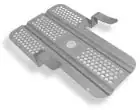
If you're not into old-school, another method is to use drywall clips. With this method, you intentionally make the drywall but together between joists, and use the clips to join the butts together. I've also used this method with success. The advantage here is that it finishes slightly better than butting the drywall over wood. Remarkably, it doesn't seem to affect strength. Make sure you use fine threaded screws with the clips.

Drywall clipsenter image description here

HerrBag
  • 12,225
  • 1
  • 21
  • 37
Edwin
  • 4,678
  • 2
  • 18
  • 27
4

No need for glue. NEVER use nails!! Always screws. I use 1 1/4" drywall screws. I start from one corner and run my boards across the ceiling framing. (As if you were applying plywood to the floor). The smooth edge of the board is called the flat. The shorter rough edge is called the butt. Make sure your boards are staggered and the butt joints don't line up with each other. If your ceiling is say 20' wide your boards would run right to left 8' 8' and 4'. Then start your next row from left to right 8', 8', and then 4'.

There is also no need for furring strips. Yes, your butt joints have to break in the middle of the 2x10 or 12. But don't put the screws right at the edge. You should have plenty of room for the screws without damaging the rock. I've been installing drywall and finishing for almost 30 years and I can honestly say I've never had a call back for poor installation or finishing.

Mazura
  • 13,598
  • 2
  • 20
  • 58
Ed Foster
  • 41
  • 1
3

I have 30 years in the drywall business. I always use screws, never ringshank, buttercup, or black coated drywall nails.

The down side of nails is that when you drive the nail to recess it you bust the gypsum between the paper, causing air to form and compromising the structure of the wallboard. That's how you get nail pops. Glue is OK; the only advantage of glue is to use less screws, but I would not recommend using less screws on a ceiling; only walls.

Mazura
  • 13,598
  • 2
  • 20
  • 58
mike
  • 81
  • 2
2

I've used coarse drywall screws into wooden joists for years and never had a failure. The fine screws tend to strip out more often. If screws do strip out (keep spinning) I get them out and try somewhere else that is close, an inch or two away. If my joists or studs are extra wavy I'll screw a length of 2"x4" along the wavy section for more holding area. I've never used glue but I like the idea. Still, I wouldn't want to be the guy scraping the drywall off the ceiling at the next remodel. When I'm working on my own home I skim-coat the entire surface and then kiss-sand it so that the texture is all the same. More work but the painted finish is really nice.

1

Nail pops are caused by many things NOT because of paper blistering. Both nails and screws will pop no matter how many or how few are used due to heat,cold,humidity and shrinkage in the wood. In answer to nailing or screwing butt joints and the drywall breaking on the edges,the solution is fairly simple. If necessary only tack the joint with one fastener and then hang the next piece making sure the joint is tight then fasten the butt joint on both pieces with nails or screws.

Wayne
  • 11
  • 1
0

I've never used glue, but then again -- I'm a DIY'er and not familiar with tons of applications outside of small home projects.

Just a comment on furring -- after tons of research. Most guys in these specialty trades and forums online will tell you they are unneeded, especially outside of the east coast. The next group will say its the only way they ever rock a ceiling, either strapping (furring) with 1x3/1x4/2x4 or metal. Huge debate. Doesn't need to be.

I say just THINK about what problem you are trying to solve and realize the better answer in most cases is IT DEPENDS! If the joists are extremely uneven or not 16 inches OC themselves, OR -- maybe you're not using 5/8 board on the ceiling and your board is bowing, maybe your ceilings are high enough that losing an inch of height isn't as important as a solid/flat ceiling, etc.. those are all reasons to potentially strap the ceiling. Sure -- there are various ways to achieve these results but leave strapping in your arsenal. Used it for add-on remodel recently and strapping improved the final result immensely.

tresstylez
  • 439
  • 2
  • 8
  • 22