6

Unfortunately, the handyman who put the tiles on my kitchen backsplash messed up the hole for this double outlet. He tried fixing it with black silicone, but it looked quite ugly, so I removed it.

Do you have a suggestion to cover these gaps that does not involve only applying silicone around it?

Poorly cut tiles pic 2 pic 3

The product is from Livolo.

Designalog
  • 183
  • 6

3 Answers3

6

You have 2 choices from what I can see.

  1. Get a bigger face plate.

  2. Pull the tile out and do it again.

of these 2 options. 1 is the easiest.

Edit:

New images helped a lot I originally thought the face plate was too small by a little bit, that is not the case, that gap is huge! I recommend going with option 2. Replace the tiles. Its not hard to do a much better job than that cut.

Questor
  • 1,281
  • 3
  • 8
4

If you don't want to replace the outlets and don't want to replace the tiles, you have options:

  • make a frame for the outlet but don't use silicone, use black acrylic sheet. Or any color you want. Maybe clear acrylic sheet with black vinyl stuck to the back of it to mimic the outlet design. Make a frame that will fit behind the outlet face plate and just inside the tile, with just enough room for a thin grout line.

    enter image description here

  • similar idea, but you don't have to make it. You can get black glass pencil tile in different widths, like 12mm, 20mm. Find the best size to solve the problem and use it instead of silicone.

    ![enter image description here

  • Set the outlet a little further back by chiseling out the wall a little so the front of the faceplate will be flush with the tile. The outlet's glass face place looks like it was designed to be tiled-in to a tile wall. Then you just grout around it with the same grout as the wall. The grout line will be a little wide but that will look better than gobs of black silicone and the flush outlet will look nice.

jay613
  • 49,543
  • 6
  • 70
  • 201
3

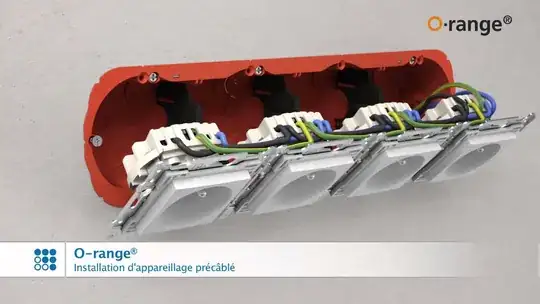
Correct way to install these in tile is to use a diamond hole saw to make the hole for the pot in the tile, then mount the pot in the wall, and mount the socket on the pot. EU pots are round, unlike US socket boxes.

enter image description here

For a double socket, it's possible to make two holes and mount two pots, or make two round holes with the diamond hole saw, then use the angle grinder to cut the middle part, and mount a double pot:

enter image description here

enter image description here

The diamond hole saw is inexpensive (€10-20) and you only need one as the diameter is standard. It takes just a few minutes to do the correct job. Now your problem is this guy did a truly garbage job.

What you should do is first cut the power, and remove the faceplate.

The sockets should be fastened to the pot with 2 screws per socket. If you unscrew these, you can pull the sockets towards yourself.

The other screws in the pot hold it to the wall, so don't touch these.

Now if you take a brand new tile (you should have some left) and drill the proper holes in it with a diamond hole saw, you should be able to mount it between the existing tile on your wall, and the socket mounting plate. What I'm suggesting is to mount the sockets properly on this new tile, then stick this new tile to your wall on top of the existing tile.

If the screws are long enough (you can get longer ones) then you don't need to destroy the tile on your wall. It will look a bit weird to have the sockets mounted on a protruding bit of tile, though.

I'm having some difficulty explaining, so I'll rephrase. The idea is to make a sandwich, starting from the wall:

  • Existing tile with terrible "wobbly rectangle" cut

  • This is covered with a new tile with proper hole cut, aligned with the existing pot

  • Then the sockets are mounted on the existing pot, with longer screws if needed

  • Then the socket face plate is mounted on the sockets.

bobflux
  • 11,121
  • 29
  • 35