I have a location in my house where I would like to install a standard 120V grounded receptacle. Currently there is a blank wall plate.
It is connected to a 2-pole 20A breaker which is labeled "heating" but appears not to actually be connected to anything other than this junction box… including any of our baseboard electrical heaters.*
When I open it up and remove the screw-on wire nuts, I find a single conduit containing:
- White wire (12 AWG solid)
- Black wire (12 AWG solid)
- Bare wire screwed to the frame
The wiring visually appears to be identical to other locations in the house where grounded 120V receptacles are connected…
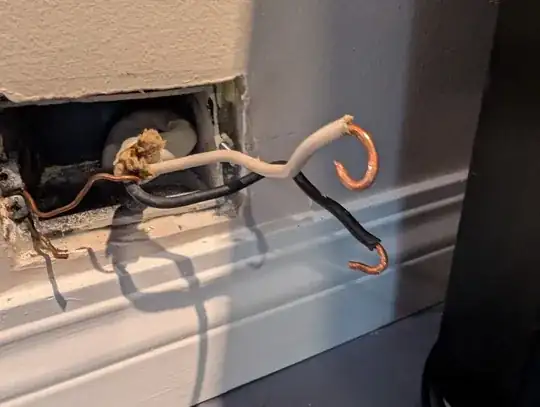
… but when I measure the AC voltages between these with a multimeter, I find:
- Bare-to-black: 120V
- Bare-to-white: 120V
- Black-to-white: about 211V
As I understand it, these voltages indicate that the white and black wires are the legs of a single-phase 208V circuit:
Here are my questions:
- Does it make sense that there is no neutral wire in this junction box?
- Is there any way to safely wire a 120V receptacle here without touching the circuit breaker?
- If not, is this page correct that the breaker needs to be replaced in order to safely wire a 120V receptacle?
- 120V Single Phase power wiring
- Install a 1 Pole Circuit Breaker (CB)
- Connect (1) 120V 1 Phase power wire to the 1 Pole CB
- Connect (1) Neutral wire to the Neutral Bar
- 120V Single Phase power wiring
* House is in western Canada, built in the 1970s. It has been remodeled a couple of times, and there might have been a baseboard heater connected here in the past. Many of the circuit breaker labels had been scratched out and rewritten, or were just wrong, when we moved in.


