7

[ I'm not going to touch anything in here without doing a lot more research, just trying to understand this as best I can, since I have several minor electrical issues including this one and the fact that the circuits are pretty much all mislabelled. ]

Here is a photo of my home's messy, old main circuit breaker box. It's a townhouse, in western Canada, built in the 1970s, part of a complex of townhouses with a shared garage and utility rooms underneath.

Do I understand this correctly? Have I labelled everything right? Is there anything important that I've missed or misunderstood?

I know that there is no main shutoff breaker here. As I understand it, Canadian electrical regulations forbid the main shutoff breaker from being in the same compartment, unlike US regulations.
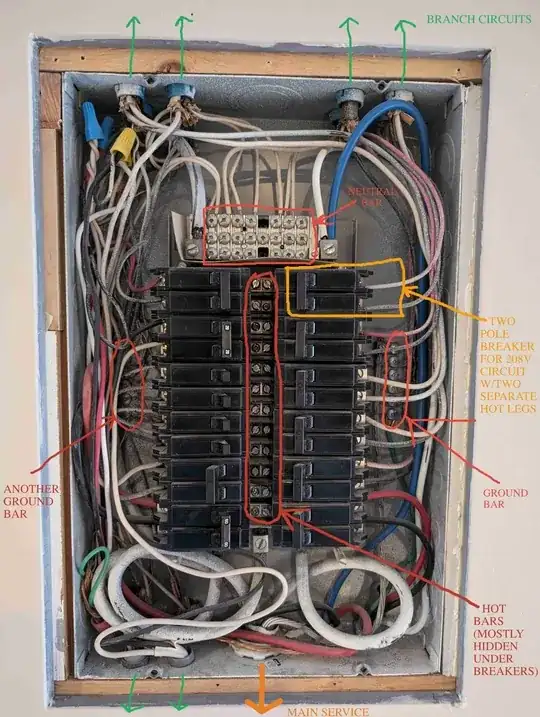
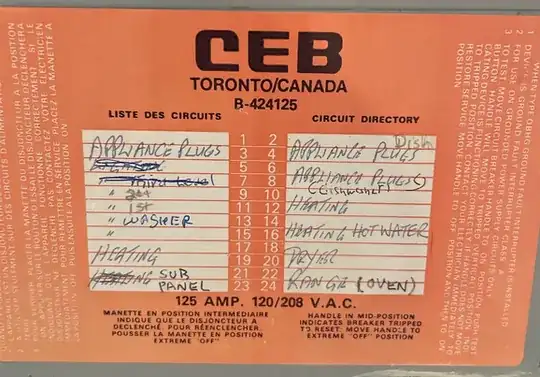
labelled photo

breaker diagram

Dan Lenski
  • 221
  • 7

3 Answers3

11

Yes, you had everything identified pretty well from the beginning.

Just to be clear, the screws down the center (between the breakers) are NOT connected to the neutral bar as some have suggested. They are hot. You have CEB/Commander type QBH "bolt-on" circuit breakers: they screw down to the hot bus bars (so they can't accidentally fall out) instead of just snapping on. You can see a picture of just a breaker (outside a panel) at https://www.simplybreakers.com/products/commander-40-amp-circuit-breaker-qbh40 with the mounting tab clearly visible.

There are some potential issues with your panel:

  • There are some claims that Commander/CEB panels are no longer CSA certified: https://theshockdoctors.ca/blog/news-article.php?id=77 Providing pictures of the various labels on the panel cover may help confirm or deny.

  • Plain breakers may be hard to find, GFCIs may not be reliable, and AFCIs may not exist. On the other hand https://diy.stackexchange.com/a/257834 says Eaton offers a full catalog of compatible breakers, including GFCI and AFCI.

  • In the upper-right, you should not have two wires (the white and blue) in one lug. They each need their own lug. Ground wires can usually go two (or even three) per screw/lug on panel bus bars, but not neutrals.

  • Generally only the colors white and gray should be used for neutral. Blue should not. It's possible that the blue should have been re-marked white, if that red/blue/black cable was legal to use in the first place.

  • Paint all over everything making it hard to identify actual wire colors is not great.

nobody
  • 7,701
  • 3
  • 36
  • 47
3

For your main question, yes you have them label correctly.

Some wire colours seem off, but bet it is paint, except the blue on neutral. Most places only allow white or grey for neutral(Alberta might allow). White should be marked as live/hot if not neutral.

You want to know where the main disconnect is, for that panel before putting your fingers in it.

Being a multi-family building, most locals only allow a licensed electrician to touch stuff in that panel, you can only look/turn on/off breakers.

crip659
  • 32,986
  • 2
  • 39
  • 85
3

Yes, your understanding as of this edit is correct. This is a bolt-on panel, which is an excellent feature when respected by tightening screws with a non metal tool i.e. metal bit but insulating shaft.

Not sure why you are calling it messy, the panel looks quite neat in that the details are correct. The neutral bar is being a bit under-used, but whatever. As far as the wire spaghetti, Once I restored some excellent CH panels in an old factory. The wire thieves had been through and took all the breakers and wire leads coming off the breakers and neutral bar, every wire was cut at the edge of the panel if not pulled completely out of the conduit. I put the breakers back in, and the panels looked absolutely beautiful, my finest work. I was so proud.

But I was disappointed with the panels' performance, at which point it came to my attention that the wires actually have to be there. Now it looks like your panel!

Harper - Reinstate Monica
  • 313,471
  • 28
  • 298
  • 772