if I know how to take the live wire off then my job is easier.
Asked
Active
Viewed 1.9k times

5 Answers
9
Never, ever, work on live electrical wires.
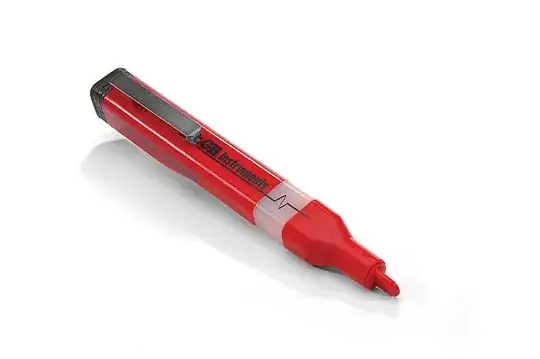
Turn the power off at the breaker/fuse. You should have a voltage detector to verify the power really is off, like one of these:

gregmac
- 29,300
- 17
- 89
- 162
6
First of all, if you don't know exactly what you are doing , working on live wires is extremely dangerous. On a three way switch circuit, (light or devise controlled by two switches) the hot wires change depending on the position of the switches. Only one switch has the hot feed on the off colored screw, the load hot on the other switch off colored screw, but this hot feed is always present on one of the idler conductors, and changes with each change of state of a switch. Do your self a favor and turn off the breaker and confirm power is off.

shirlock homes
- 58,628
- 3
- 87
- 168
5
Unless you know exactly how the circuit is wired, you should assume that both wires to the switch are live. The only safe way to work on anything electrical is to turn the circuit off at the service panel, and then check that there really is no power at the fixture before starting work.

Niall C.
- 20,909
- 19
- 95
- 135
4
As others have pointed out, you're obviously much safer if you ensure there's no power to the wires you're working with.
- Use a tester to confirm that there is power in the circuit, that your testing tool works, and that you know how to use it correctly.
- Tell people in the area what you're doing, so they don't flip the breaker back on.
- Flip the breaker off.
- Tag the breaker, so no one else turns it one while you're working.
- Close the breaker panel.
- Use the tester to confirm the power to the circuit really is off.
Risk goes up if you're working with a 240V circuit (anything in the UK; clothes dryers, ranges, heaters in the US) or if you're well grounded (standing in a puddle on a concrete floor; holding a cold water pipe).
That said, many electricians work with live wires, especially when it's only 120V. I've done it by accident, when one of my kids decided to "be like daddy" and turned on the circuit I was working on. It didn't really hurt, it was just annoying. As a shortcut to turning off the breaker, some will short across the lines with pliers or a screwdriver, which flips the breaker. I'm not advising either practice, just as I don't advise driving without a seatbelt or using a chainsaw naked.
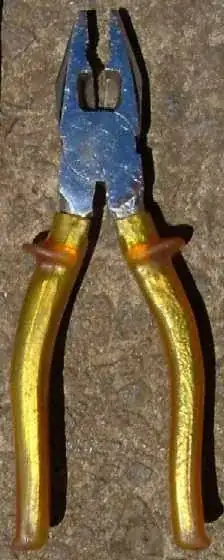
If you want to cut a live wire, try you can use a pair of insulated pliers. Every electrician (amateur or pro) should have a good pair of lineman's pliers. They can be used to strip wires and to tighten wire nuts, too.

Jay Bazuzi
- 11,778
- 34
- 100
- 143
-1
Can you work with 'hot' wires? Yes, but you'd better know what you're doing before you start. Changing outlets & even service entrances can be done with the power on but why? Find & flip the breaker before starting. Do put a sign on the breaker box so someone won't turn it back on til you've finished to avoid unpleasant surprises. My coworker accidentally did this to me & if I hadn't been working with 1 hand tucked in my leather belt (a good safety practice) you wouldn't be reading this. I had forgotten to take off my wedding ring (which I never wore to work as a rule) and it took the current alone & melted into slab on my hand. I ended up with a 3rd°burn that took months to heal, all from a split second of current! If not for the ring I would have been fine.
I had no choice on working live in one case because the electric co. couldn't make it out for 3wks to turn off the main line. That was to change a service entrance from the first house coupling in. I took every precaution: no metal on me, wore rubber shoes, stood on a wood platform, all my tools were non-conductive & I worked one handed where possible. I didn't let anybody nearby & worked fast. But I've done electrical for 40 yrs but that didn't mean I liked working hot or made a habit of doing this.
If you must do it yourself you'll need to find & shut off the breaker. Get a multimeter ($10) & test the outlet after flipping it off to make sure it's dead before starting. (the idiot who stuck his finger in the outlet to test for power has tried too many dumb shortcuts & fried his brain...or what's left of it)
You'll need a pair of insulated needle-nosed pliers (if the handle insulation is torn or worn don't use), a flat-head & Phillips-head screwdriver and some black electrical tape. A rubber mat to stand on is also recommended. Remove anything metal/conductive from you & the immediate surroundings.That includes liquids like pop or iced tea etc.
Remove the faceplate of the outlet & unscrew the existing outlet. ALWAYS assume the wire's 'hot' especially if there's a chance someone might reflip the breaker. Using the pliers swap each wire from the bad outlet to the new one, never touching either the outlets or the wires with bare fingers. If you don't have enough play in the wire's to do this, then take the old wires off one at a time & cover the tips with electrical tape. Mark each with a label noting the color (a pro knows hot from ground but amateurs tend to confuse wires once disconnected.)
Use the needle-nose pliers to make a tight 'u' at the end of the wire you're connecting (one at a time) & slip each under the screw of the new outlet making sure you're putting gold to hot, white to silver & green to ground. Mix them up & the first thing plugged into the outlet will blow anything attached to the circuit.
Tighten each screw over the wire so there's no wiggle or loosening. You can tape over each screw until you've gotten the last one screwed on so you don't accidentally make contact with one. REMEMBER! ALWAYS ASSUME THE WIRES ARE HOT!!!
When all 3 wires have been moved to the new outlet remove any protective tape & toss the old outlet aside & slide the new outlet into its place. Make sure every wire is still tightly screwed down. Then screw the outlet in place & replace the cover. Then go flip the breaker back on & test the outlet with the multimeter to ensure it's putting out the correct voltage. Or plug in a small lamp or low amperage item.
If you're not comfortable working with wiring you're much better off hiring a pro. Second best is a handyman who's done this before.If you decide to do this yourself, be careful & good luck!

Marlyn Rosent
- 1
- 1