Dishwashers can be either hardwired, or cord-and-plug connected. Check the owners manual of the unit you have, but in most cases the decision is left to the installer.
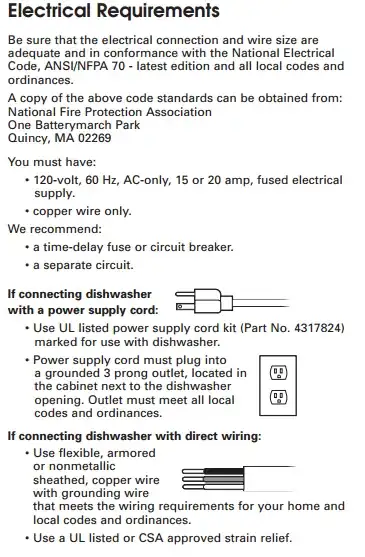
From a random Maytag Dishwasher Installation Guide (PDF)
In newer homes you'll commonly find a 125V NEMA 5-15R receptacle supplied by a 20 ampere circuit, used to supply a dishwasher and disposer. In this case, the receptacle is typically installed in the cabinet under the sink. If you don't have a receptacle under the sink, it's not likely that the dishwasher is cord-and-plug attached.
The National Electrical Code, specifies that all outlets must be accessible. Because of this, a receptacle installed in a location that requires the removal of the dishwasher is not code compliant. i.e. If you can't find where the dishwasher is plugged in, it's likely hardwired.
Checking the wiring for the disposal, might give you some clues as to how things are wired.
You might also find This answer useful, when trying to figure out what you can connect to the circuit.
Code that allows Garburators and dishwashers to be cord-and-plug-connected
National Electrical Code 2014
Article 422 Appliances
II. Installation
422.16 Flexible Cords.
(B) Specific Appliances.
(1) Electrically Operated Kitchen Waste Disposers. Electrically operated kitchen waste disposers shall be permitted to be cord-and-plug-connected with a flexible cord identified as suitable for the purpose in the installation instructions of the appliance manufacturer, where all of the following conditions are met:
(1) The flexible cord shall be terminated with a groundingtype attachment plug.
(2) The length of the cord shall not be less than 450 mm (18 in.) and not over 900 mm (36 in.).
(3) Receptacles shall be located to avoid physical damage to the flexible cord.
(4) The receptacle shall be accessible.
(2) Built-in Dishwashers and Trash Compactors. Built-in dishwashers and trash compactors shall be permitted to be cord-and-plug-connected with a flexible cord identified as suitable for the purpose in the installation instructions of the appliance manufacturer where all of the following conditions are met:
(1) The flexible cord shall be terminated with a grounding type attachment plug.
(2) The length of the cord shall be 0.9 m to 1.2 m (3 ft to 4 ft) measured from the face of the attachment plug to the plane of the rear of the appliance.
(3) Receptacles shall be located to avoid physical damage to the flexible cord.
(4) The receptacle shall be located in the space occupied by the appliance or adjacent thereto.
(5) The receptacle shall be accessible.


