13

I Will be installing a subpanel in a detached garage. The subpanel will be 60 amp. The garage is about 30' from the main-panel in-house, and I will of course get an exact length before selecting the proper gauge wiring. I'll be using pvc underground for the wiring. There is already existing wiring going underground from the house to the garage, which will no longer be used. When it comes to grounding this subpanel, should I run a grounding conductor from the main panel to the new sub, or ground the sub to earth?

Reading this answer sounds like I would have to ground the subpanel to the main, primarily because in my situation this is a new install. All other variables I have control over.

  • If so, I would be running 4 wires from the main panel to the sub, 2 hots, 1 neutral, and 1 ground correct?

  • Then, at the subpanel, the ground bus bar and the neutral bus bar would not be connected, and the grounding screw removed from the ground bus bar?

  • Lastly, a GFCI Breaker must be used at the main, right? I believe this is true for any subpanel in a detached building, just want to be sure.

MDMoore313
  • 1,094
  • 6
  • 24
  • 39

4 Answers4

13
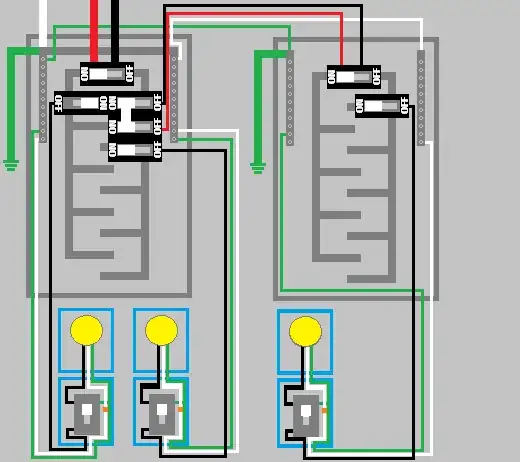
  • Pull 4 conductors (2 ungrounded (hot), 1 grounded (neutral), 1 grounding) (250.32(B)(1)).
  • Grounded (neutral) and grounding bus must be separate at sub-panel (250.32(B)(1)).
  • No need for a GFCI breaker in the main panel, unless your local code requires it.
  • A grounding electrode system is required at the second structure (250.32(A)).

enter image description here

Tester101
  • 133,087
  • 80
  • 327
  • 617
3

Doing this right now. Simple 50 amp sub feed to a shed. Two hots (ungrounded conductor), one neutral, one ground (equipment grounding conductor) in 1" pvc. Ground rod at the shed. Simple, that's how you do it.

Harper - Reinstate Monica
  • 313,471
  • 28
  • 298
  • 772
Marc
  • 31
  • 1
0

Grounds are for any equipment that becomes shorted in itself and must always have a ground attached to the equipment and then run to a ground bar that is grounded to the ground. The ground should always be attached anywhere there is a potential to have a live wire touch any metal that the ground should be tied to so that current will travel down the ground wire to the earth and not into anyone that grabs a box or piece of equipment or device that is shorted slightly but enough to hurt someone if touched. There are ground fault protection devices but fail sometimes. I feel all grounds should not be tied to any neutral because voltage will be read from the hot to ground just like from hot to neutral once a circuit is applied and current flows and this will make your meter run more since it is using current to the earth. I an not sure if i am right but if you do disconnect the ground system from the neutral then you will not see current flowing to earth at 120 volts or 220 volts i think.

Floyd
  • 11
-9

You run a hundred feet or two hundred feet. Most main 200 amp service is the neutral and grounds are all together. gfci work as long on a 110 you run three wires in seperate bar screws. And it does not matter if your grounds and neturals are tied together. All houses are grounded to code. Running two one ten breakers makes double pole makes it 220 because you got two hots. Ac current is not dc current. I look at it this way you need a hot and a neutral to make 120 with out a voltage drop you have 120. Two hots you got 240 with out a voltage drop. Most guys say 110 well you got a voltage drop. Two equal size wires you need to carry the load right. A neutral and hot on 110 you bring in always 220 in a garage or shed what happens if you need it. Four even size wires. That keeps your voltage balanced the receptacle box on a shed or a garage dont need a grond wire unless you go over head. Lighting that is what a ground rod is for. Lighting does not hit non conductive things like pvc or glass. Its going to take the short path thats why your tranformer on the pole is grounded. And the house just in case. But thirty years my house works and all breakers will trip. I had the hot from pole shorting in the the ground one night by pole one side of the house the power would come on and off went down checked my main voltage wires coming in under ground one hot keep cuttin on and off. I was hopein it was the transformer. It turned out to be the ass put one three direct burial right in the ground so someone could of died. Hot hits ground direct short. What does a ground rod do nothing. My garage 15 years 4 wires to main breaker just like wireing outlets in your house dont use ground rods massive lighting strikes near garage. The box is on the inside wood is a insulator i have a better chance of the garage getting hit and burning down. Codes half of them are nothing. They still make a ungrounded extension cord that i have temporary hooked to my garage to light it and use power tools and the lights are hooked up and not using the ground wire and the breakers do trip in garage when they need to. Im all ready to go back to house with thn 6 four wire under ground 150 feet 220split two ways run what ever i want.the only way i will.ever die is go into a swiming pool and drop the hot and neutral in it seen ground falt outlets made for that reason fail and people get killed like that. Im a ham operator i seen lighting strike the ground ad come back up this is no lie will all the strike go in the ground how much comes back to kill your appliances. Amy antenna is 48foot long 58 feet off ground 175 feet of coax to antenna twenty years i keep everything hooked up lots of money to lose. Lightning never took the long path.