31

My basement has a slight dampness issue, where if I leave things on the floor they will get wet. There are no leaks and no standing water, the moisture seems to be wicking up through the concrete.

I conducted a simple test to make sure moisture in the air was not condensing on the cold floor, by taping a small square of 3mil poly to the floor. When I returned a day later there was moisture under the poly (between the plastic and the floor), so I figure the moisture is coming in from below.

I know they make products like DryLok for water proofing walls, but can it be used on the floor as well? Are there better products available that are designed specifically for the floor?

I was also looking at Rust-Oleum EPOXY SHIELD Garage Floor Coating (since it looks nice and seems to be easy to clean), is this an appropriate product to use on a basement floor? Will it prevent moisture from leaching in?

Update:

  • The basement already has a perimeter drain, and sump pump.
  • The basement will not be finished in any way, so I'm looking for a relatively simple and cheap solution.

Update:

I found a couple other products that may or may not work.

Can products like this really do what they say they can?

Update:

There was an area of the floor that had been painted (with an unidentified paint), so I did the plastic test there and there was no moisture under the plastic (even after a couple days of rain). So now the question is what is this mysterious paint, that blocks moisture when no paint should apparently be able to do so?

I have determined that the moisture is caused by capillary action wicking moisture up slowly through the concrete, and is not caused by cracks or other sources of leaks in the slab.

isherwood
  • 158,133
  • 9
  • 190
  • 463
Tester101
  • 133,087
  • 80
  • 327
  • 617

9 Answers9

20

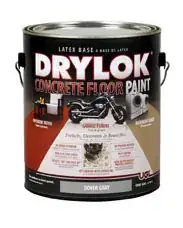
In the end, I ended up using DRYLOK® LATEX CONCRETE FLOOR PAINT

enter image description here

It's holding up well so far, we'll see how it does over the next few years.

Tester101
  • 133,087
  • 80
  • 327
  • 617
10

I am going to weigh in although I haven't had time to check specs etc on a couple of products I have used in the past. High moisture levels in a concrete floor can come form only two sources, insuffiecent curing time (new concrete) or ground water. The informal test you did with the plastic patch is a sure sign of excessive moisture in the floor. This means it will be very difficult to bond any paint product to this concrete. Normally, if the ground water level is not too high due to heavy rains etc, the drain tile system should drain it away. It sounds like your drainage system is not working well, or you do not have one. When ground water levels are above the slab level, water will seep through hairline cracks, slab to wall joints or slowly saturate the concrete mass. This is all related to the hydrostatic water pressure, which is usually only a couple of PSI. The products I have used are very specific about what percentage of moisture cannot be exceeded when applied. You will need a meter to determine this percentage. After the concrete is cleaned or etched (if any efflorescence is present) and the moisture level is below the recommended level, these products can be applied and withstand pressures up to about 4 or 5 PSI. They will not hold up to heavy traffic with one coat however. They do make a good base for a safe floor system, and some harder compatible overcoats. There are also solid sheet barriers that can be used under a floor system. If in my travels i get a chance, I will stop by my flooring supplier and ask for some spec sheets or site names of products that may help you.

James Van Huis
  • 3,547
  • 18
  • 26
shirlock homes
  • 58,628
  • 3
  • 87
  • 168
6

This does not sound like it will work. If you are sure that the moisture is coming up from below, paint will not stop it, it will only seep under the paint and start making bubbles. DryLok is a good idea, but it isn't made for the type of treatment a floor gets, I don't believe it would stand up well even if you covered it with a good quality paint.

I would re-test to make sure that it really is coming up from below, that is pretty unusual. On a very dry day when there is no moisture anywhere tape a larger piece of plastic on the floor (at least a foot square) and use duct tape to seal all the sides down. If it is indeed coming from below then you have a pretty serious drainage issue, because it would take water a long time to wick up through concrete. Hopefully this isn't the issue and then you can paint the floor.

As a side note, they make concrete paint that is cheaper than the garage floor paint and you can get it in many more colors. I think this would be preferred in a basement. Check out your local Sherwin Williams.

Good Luck

JYelton
  • 2,532
  • 9
  • 28
  • 32
boxed-dinners
  • 1,095
  • 5
  • 8
5

There is no paint-on or other surface treatment that will solve the problem. It may mitigate slightly, but under no circumstances will a surface application dry your basement enough to allow it to be finished. Any flooring will mold up pretty quickly.

There are two solutions which will solve the problem: An internal solution, which is a french drain and a sump pump or the external solution which involves entrenching the foundation, waterproofing the walls and putting in a new weeping tile system.

Essentially, the problem is that your house is sitting in a bowl of compacted earth, but the soil nearest the house is back-fill, so it's less compacted -- meaning the bowl fills with water and hydrostatic pressure forces the water through the concrete.

The first thing I would do would be to have the drains scoped. Preferably, this should be done when the basement is wet, so that they can tell if the weeping tile is actually draining water to the drain. If not, then the external solution is your best bet. I recently had this done, and they dig down below the level of the footings and install the weeper. This will help lower the water table under the slab a bit.

I just had this done, and the estimates ran from $100 - $150 per linear foot of foundation to be exposed. I had 100 ft done, and it took them 3 weeks to complete the job, but we lost about 4 days to bad weather.

Chris Cudmore
  • 14,169
  • 7
  • 61
  • 91
5

Any sealant you put in will just have moisture build up under it and cause it to flake away after time, rot or disintegrate.

The problem is that the soil has high content of moisture.. if it was not like this 5,10 years ago it is most likely it will get worse, as somewhere nearby the ground water level is rising for some reason.

For most foundations on a dry or low ground water level there is usually never any damp protection used under the concrete. Over number of years this could become problematic.

Concrete will let water pass through it, there is nothing that can be done to stop that from happening as that is how the molecular structure of concrete works, because it needs to expand,contract, twist and bend(in terms of concrete- not like twisting a cloth out but in nano metres) otherwise the concrete will just shatter and disintegrate and a house would not last 10 years.

You will seriously need to get some surveyor in to asses the problem.

Me as an experience home builder would go down the route of placing a new concrete slab, with a thicker than need Damp Course Membrane on top of your original one, than place a new reinforced 5CM slab with damp proof additives. The problem is that dampness might still leak through on the sides and eventually through the bricks... so that is another problem..

Piotr Kula
  • 5,959
  • 22
  • 32
2

Honestly your best bet may just be to stick with a dehumidifier. They're relatively cheap and if the seepage isn't too excessive, it'll dry out the surface of the concrete. A strategically placed fan to blow air to the dehumidifier will also help.

Alex Feinman
  • 3,532
  • 7
  • 30
  • 41
2

I have a dehumidifier in the basement. It does not run constantly but I have been thinking about the electricity costs. I did some exploring on the web and have discovered that newer homes often have an air exchanger that exhausts in house air and pulls in fresh air. I also found a few HVAC people are installing such exchangers in older more leaky homes like mine, specifically to draw out basement air while puling new air in. That resolves moisture as well as stagnant air issues and eliminates the noisy, electric guzzling dehumidifier that the wife keeps burying in holiday boxes so it cannot work properly anyhow.

Niall C.
  • 20,909
  • 19
  • 95
  • 135
Joe D
  • 21
  • 1
1

I don't know if the expoy will bond to the concrete well enough to keep the water out, but unlike paint, it'll actually cure in the presence of moisture, so it was my first thought on the matter.

My thought is that you might need to check what the level of the water table is, to determine if the issue's just capillary action wicking the moisture up slowly, in which case, I'd think the epoxy would be fine even if it's not bonding all that well, or if there's actual hydrostatic pressure because the ground water's above the floor of your basement.

(note ... I've never tried the epoxy stuff myself ... I've thought about it, but more because my basement looks like crap from 3-4 layers of peeling paint, and gets wet, but my moisture is coming in through the walls, where the drylock's already managed to bubble and such)

Joe
  • 7,336
  • 2
  • 33
  • 48
0

You should install a sump pump. A hole is dug in your basement floor, and all of the table water will come up there, where the sump will pump it out - either outside, or to a sink/drain in your basement.

Eric Belair
  • 101
  • 2