5

I've been getting very high electric bills since moving in last August. My winter months have averaged $350/mo and so far this spring has been the same. I live alone, work 8 hours a day, do 2 loads of laundry per week, rarely use the stove for baking, and my temperature in winter months is set at 68-69 deg, and in summer 72-73 degrees. The house remains comfortable for me. I don't watch a lot of TV or have a lot of appliances going regularly.

About the house:

  • Built in early 1990s
  • 1480 sq ft
  • 2x6 exterior walls
  • crawl space
  • geothermal heating, closed loop (unit is 2 years old, piping is over 10 years)
  • loose insulation in attic, about 10-12" thick (not the roll out type)
  • insulated garage
  • front entrance has vestibule (exterior door and interior door into living area)
  • laminate flooring, tile in bathrooms
  • high efficiency washer/dryer (new this year)
  • all electric appliances
  • rarely use the oven, just stove top, microwave

I was told geothermal systems were very efficient and people with 2k sqft homes were paying $80-100 for heating/cooling costs. I also leave the temperate the same throughout the day as told by the geothermal company and previous owners as its most efficient.

My neighbor has a similar sized house, with natural gas heating, and his total utility is half of what I pay. He also keeps his house a bit warmer (wife complains) in the winter months. This really ticked me off so I contacted my geo company and they came out to inspect the unit. Nothing was found wrong with it and the flow rate/psi/etc was all tested fine. I'm not seeing the savings with geothermal at all.

As I've mentioned, my house does not get a draft at the front door because of having a vestibule. My garage is insulated and I feel no draft coming in at the garage door or interior garage door. My two exterior doors in the rear both go into a sun room, so again, no cold/hot draft coming in. My windows are all sealed and I feel no cold/hot air coming in. Even using a thermal sensor, it was very efficient. I'm not seeing any leaks on the exterior walls. The three weak spots are - my hallway has an attic fan and the other hallway has the attic stair pull down. The fan area seems to be letting heat pass through, but not as bad as the flaps are closed. The crawl space has no insulation, but I can't see that being a big factor in the winter months as heat rises.

Majority of lighting in the house uses LED. I have a few CFLs but they are hallway lighting and set on a 1 minute timer.

Water heater is in the conditioned area of my house. Only the water pump is in the crawl space.

Other than possibly insulating the crawl space and sealing up the attic entrance better, I can't see how much more I can seal up the inside of the house.

What else can I do to with the house to be more efficient? Is it worth investing in a standard HVAC system?

Kansas City Metro Area

Last bill:

Avg Temp - mid 60s
2701 kWh Used = $231.92
Customer Charge = 10.71
ECA 64.76
ECA 1.91
EER 0.43
PTS 2.48
Taxes 23.92
Surge Protection 8.83

(Edited for more information)

wallyk
  • 12,399
  • 3
  • 24
  • 51
user1052448
  • 227
  • 2
  • 8

4 Answers4

6

Upon replacing my air filter, I noticed some warm air in the air handler. My strip heat was stuck on causing the problem the entire time. Company is replacing the circuit board.

3

From your bill, you're using about 90 kWh a day. That's completely insane. My entire 3-person family uses about 5 a day. The fact that you're using 2700 kWh a month when it's in the 60s outside tells me that your ground-source heat pump should barely be running at all, so it's probably not that. Furthermore it sounds like your house is reasonably well insulated and air sealed, so that's another sign that it's probably not the heat pump that's using all the power. However, if you're using 90 kWh a day, that's the equivalent of adding 307,000 BTUs of heat to your house. This is heat that your heat pump will have to remove if it's hot! So all this electricity usage is hurting you whenever it's not deathly cold.

So what's using up all that electricity? The first step is to actually figure that out. Don't guess or tell yourself, "I have efficient appliances!" Anything with a plug you can measure it with a kill-a-watt meter. Anything else, you can turn off the breakers one-at-a-time and see which ones make the biggest impact on slowing down the meter. At 90 kWh a day, it's probably spinning like crazy, so you should see an immediate impact when you find the circuits that are feeding the power hogs. You may have some things that use a lot of power that run 24 hours a day. Cable boxes, TVs, humidifiers, dehumidifiers, things like that. Measure everything!

It's also possible that something is wrong with your electrical system itself. I'd call the power company. If you tell them you're using 90 kWh a day with no apparent high loads, they'll come out there real quick to investigate.

Finally, and I hate to say it, but whoever told you that a ground-source heat pump ("geothermal") will save you money was selling you a load of crap. Ground-source heat pumps are notoriously finicky. Whether they'll save you any money heavily depends on a host of factors, including your electricity and natural gas prices, the cost of the system, and the standby load of the equipment itself. Inefficient ones may have pumps that constantly draw 80 watts; a good one might only draw 5 or 10. It does not surprise me in the least bit that a gas furnace would produce heat more cheaply than a ground-source heat pump in this era of historically-low natural gas prices. But if you've already got one, it doesn't make any sense to remove it if it's working properly.

iLikeDirt
  • 12,685
  • 18
  • 57
  • 98
0

I hear you loud and clear. When we built our 1800 sf house 12 years ago we were sold on geothermal by the builder, telling us it would cost us avg $50 a month. Never happened. We pay Detroit Edison, using Budget $250 per month. We are now using a radiant (no fan) space heater in the great room and keeping thermostat on 66*. We live in Michigan and it is cold here. This has saved us 20-25% off our electric bill this spring. Only started doing this.

0

As ILikeDirt says below you need to use a KillAWatt or other meter to determine where the electricity is going, circuit by circuit, outlet by outlet. Unfortunately, electricity monitoring is not easy to do, especially if the culprit is a big appliance that is hard-wired to the panel.

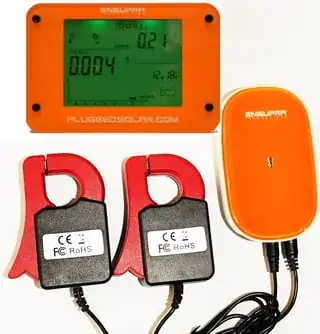
You could try something like this system from Plugged Solar:

electricity monitoring

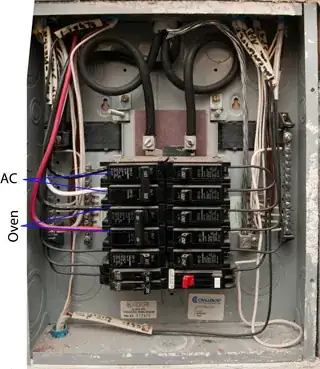
Basically the strategy is to monitor each circuit. So, you remove the panel cover. Behind it looks like this:

breaker box

You see those wires going into each breaker? Those are the hots, you want to measure them over time. You put the clamps over those wires (being careful not to electrocute yourself in the process) and then measure for a week or so. Then switch the clamps to another circuit. Eventually you will figure out which circuit is sucking down all the energy.

Note that there is another system called TED, that has a "spyder" for measuring each circuit at the same time. This is definitely better than trying to measure it one at a time. The system is pretty pricey though. The spider looks like this:

TED spyder

Tyler Durden
  • 6,971
  • 13
  • 66
  • 113