I plan on replacing my kitchen cabinets later this summer. The old ones were home made by the previous owner and are oddly sized so I need to make my own out of plywood. Is it possible to put dowel joints in the edge of a piece of plywood, or will a hole that large force the layers apart?
Asked
Active
Viewed 1.4k times

4 Answers
7
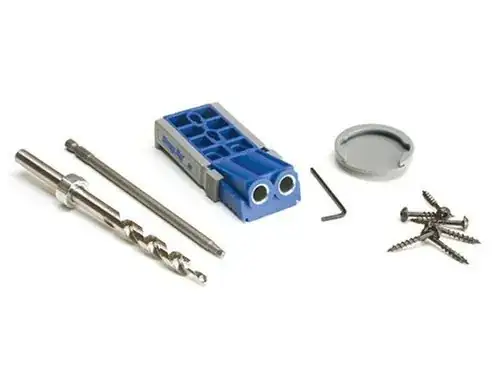
I would use a pocket screw joint. It is generally considered to be a stronger joint, and you can remove the clamps immediately after driving the screws (as opposed to waiting until the glue sets).
Along with the strength and speed, it also makes the construction process easier. You don't have to drill 2 separate holes, and then attempt to get the alignment just right. You drill the pocket hole in one piece, align the joint, and then drive the screws. Makes for a more accurate assembly.

James Van Huis
- 3,547
- 18
- 26
4
I think this is one of those cases where you are going to have to do an experiment.
Get a scrap piece of plywood and try to drill some dowel holes in the edge and see if the ply splits. I'd try different dowel sizes to strike the balance between small enough so it doesn't split the ply, but large enough to hold the piece together.
Another thing you could do is clamp strips of wood to either side of the ply while you are drilling and inserting the dowels to support the sides and (hopefully) reduce the risk of splitting.

ChrisF
- 16,973
- 5
- 51
- 74
4
Dowels work but biscuits are so much easier. They're a weaker joint, but are much faster to construct.
A Rockler Blog post on the subject states:
What we hear most – and agree with - is that biscuits joints serve best as a quick and easy way to keep glue-up parts in alignment, and that they add appreciable pull-apart to strength joints that would be otherwise too weak to stand on their own – like butt joints and miter joints. Doweled joints, on the other hand, are stronger – especially when it comes to shear strength – but usually take longer to make. This popular conclusion also echoes the findings of the “Wood Joint Torture Test”, published in the November, 2006 issue of Wood magazine, where dowels and biscuits were actually tested against one another under stress in a variety of joints.

Doresoom
- 15,873
- 32
- 83
- 122

electricsauce
- 1,341
- 9
- 8
-1
Many published test on the web shows pocket screws failing at around 125psi ~ 160psi (near the lowest scores). Top of the pyramid are dowels failing around 450psi ~ 600psi (depending on how many used). If fact the test show that they rarely fail at all and that the wood below the dowels cracks. Pocket screws tend to be tighter on one edge by their fastening design. Dowels aren't that good a choice for outdoor furniture in the long run, even when using exterior glues as humidity slowly loosens the joint. This is where exterior wood screws can benefit.
