140

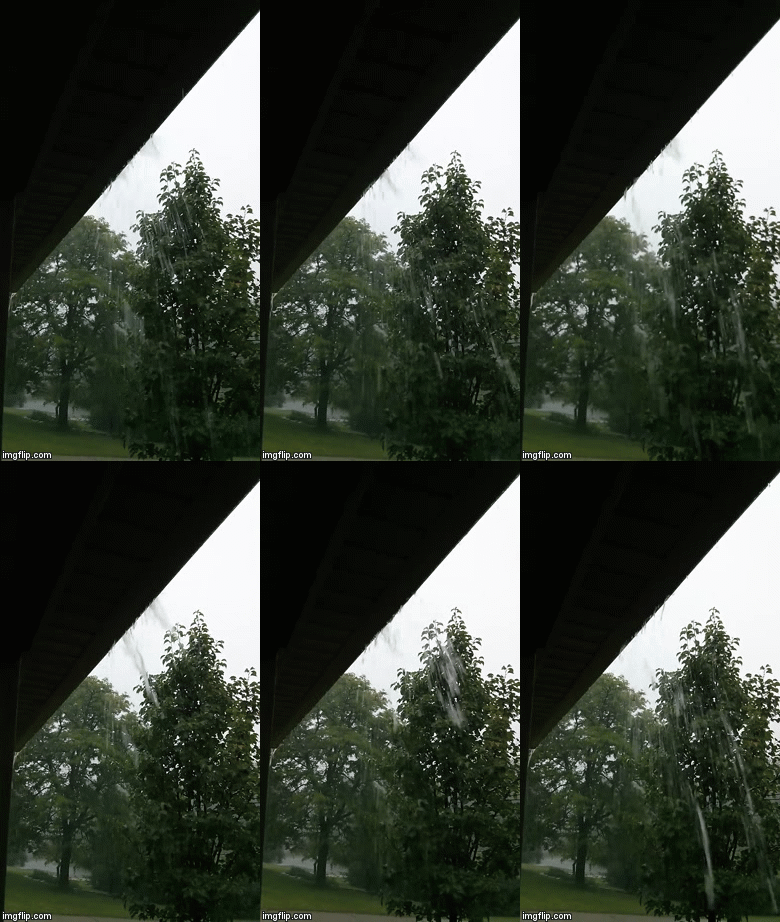
During heavy rain, the water collects from my second floor roof and runs onto the first floor roof as it should. The problem is that since all this water is now concentrated from the second floor downspout, the heavy volume causes it to race down the first floor roof and "jump over" the gutter.

Is there any way to prevent this from happening and to what extent is this a normal, unavoidable result of the heavy rainfall?

I've looked at "gusher guards" but was warned that these might cause damage to the gutters once Winter hits from the snow and ice pulling at them. I'm in Michigan, so lots of snow and ice. I've also considered adding an extension to the second floor downspout so the water is dumped directly where it should be, but I'm afraid it'll stick out like a sore thumb and look janky.

Any suggestions? Is there a "standard" way of dealing with this situation?

This is where it starts looking like a deluge

My own personal porch waterfall

Niall C.
  • 20,909
  • 19
  • 95
  • 135
Ryan
  • 1,383
  • 2
  • 8
  • 7

11 Answers11

99

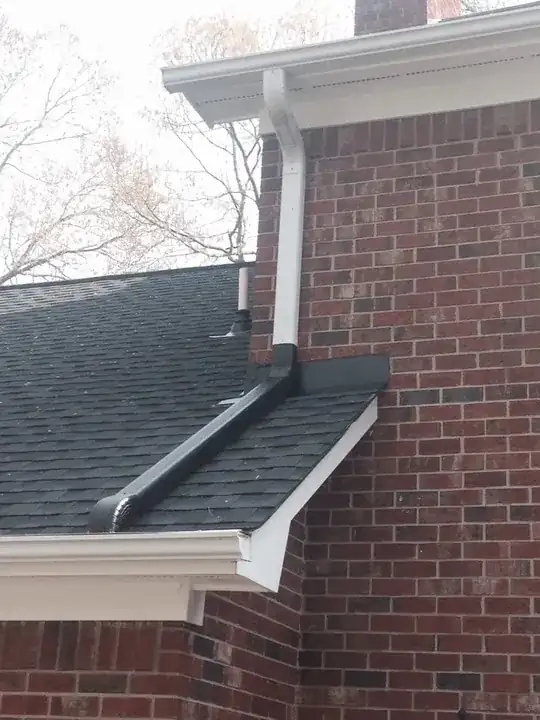
This is a common mistake, which will lead to premature roof wear. What the installer should have done, was to install an A to B transition elbow, and continued down the roof with a section of down spout. Then used an A elbow to have the water dump directly into the lower gutter.

It should end up similar to this

proper downspout on roof

Allowing the high volume of water to flow over the roof, will damage the shingles and cause them to wear prematurely. Even if you turn the spout adjacent to the slope, it will still cause damage to the roofing. Spreading the flow over the roof in this way, will not alleviate the damage that is caused. In either case, you're allowing all the water shed from the upper roof, to flow over a small section of the lower roof. It's a terrible idea, and should be avoided.

I'm not sure exactly when builders decided to try and save the $10, by not installing the downspout along the roof. But it makes me so sick every time I see it, I just want to climb up there and fix it myself.

Tester101
  • 133,087
  • 80
  • 327
  • 617
16

This is caused by:

  • poor roof design
  • poor gutter installation

Since it's not cheap to fix the roof, the solution is to fix the gutters. You simply need larger and/or repositioned gutters. The catch is if you also have heavy snow loads. In that case, you also need strong, well-installed gutters. :)

In this case, since it's really only one spot, I'd probably suggest having the second floor downspout connect to a downspout that runs along the first floor roof, out past the gutter and then down it's own downspout. So you'd take the entire load of the second floor water directly to the ground instead of trying to dump it into the first floor gutter.

DA01
  • 24,586
  • 30
  • 82
  • 153
11

Could you turn the end of the downspout 45-90 degrees so the water exits across the roof slope, rather than down it? This would help distribute the downspout flow across more roof area.

Not sure if that's a standard approach, but it seems quick and easy to try, and easy to undo if it doesn't work

Drew
  • 941
  • 3
  • 10
  • 23
10

Were it me, I'd consider a 'janky' looking roof much better than premature shingle failure due to overload.

Run a section of downspout across your roof and dump it into the existing gutter, angled in the direction of flow, so that the water doesn't splash into the gutter at a 90 degree angle, but joins water already headed for the downspout.

TX Turner
  • 1,191
  • 6
  • 9
7

I don't have enough rep to comment, so in the form of an answer: I fully agree with Tester101. You need to protect the lower roof from a large flow of water in a narrow space and incorporate the elbow at the end to bring it into the gutter.
I have a copper tile roof and did something similar to protect it. The differences in my approach were: I used an open channel PVC length (like a length of PVC gutter - may have been something else originally) instead of a length of downspout on the roof itself. This avoided contact of alumninum gutter with copper roof that could lead to electrolytic corrosion and a disappearing roof. It also avoided, or greatly reduced, the risk of a blockage in the section on the roof due to either dirt and leaves or to ice.

JKEngineer
  • 211
  • 1
  • 2
4

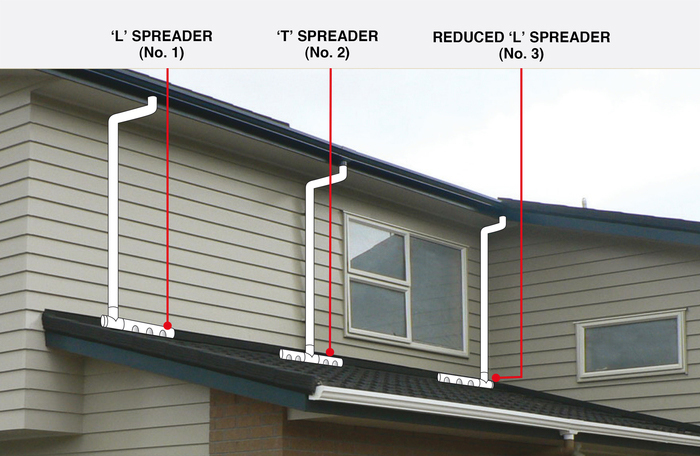
You need to use a spreader on your lower roof. It's a "standard" solution in New Zealand.

rain spreader gutter

Max Ma
  • 41
  • 2
4

I had a similar problem caused by the lower gutter being overhung by the roof too much. There was only actually about 1/3 of the gutter 'visible' for rain from the roof to fall into. It was resolved by repositioning the guttering. (In our case that was relatively trivial as the guttering was mounted on extendible brackets fitted to the rafter feet).

Tim Croydon
  • 141
  • 3
3

specific length of gutter=specific number/diameter of down spout. Do Not join together (their flow). Continue down spout to ground w/o adding to 1st fl's gutter or dwn spout. Both must B carried away frm foundation to avoid bulk water penetration into bldg. I see no consideration of either of these bldg science basics in these answ. Color, material, placement etc can B used to 'hide' the additional 'ugly' downspout (incl. doubling the existing terminal spout diameter if joined).

Chad
  • 31
  • 2
2

The easiest thing would be to get a piece of L metal maybe a foot or 2 long and tuck it up under your lowest shingle. Use a little mastic to keep it in place. When the water hits the L metal sticking up it will go right or left gently into the gutter. If you don’t like the look of that you could raise the gutter up and possibly get the next size larger gutters. I have actually ripped an inch or so off the back of gutters so I could get them up a little higher particularly on steep pitched roofs

user76730
  • 1,626
  • 9
  • 8
2

If yours is "U" type gutter fix "Ç" type gutter so that upper part will prevent water from overflowing when there is heavy rain. See the "Ç" type gutter is little bigger than the "U" type gutter.

2

I have taken these or these to alleviate a similar problem. You would just be tweaking your gutter on your own. You can push up on the gutter and put the screw or bracket in. The hope is that you would be able to do this enough so that the angle of the roof points straight into the wall of the gutter rather than over it. Though my first go would be a 90 degree elbow so that the water spreads out over the roof more. It's standard on new construction around me. It seems to work okay.

Dano0430
  • 508
  • 6
  • 12