Fiber would be ideal, but...
Bear in mind that terminating fiber is more exacting and more expensive. It requires special equipment and special skills. You can't just cut fiber with a pair of wire snips and crimp a plug on the end of it. The ends have to be angled and polished, and it sucks when you poke the little fibers in the ends of your fingers, etc. What I'm saying is that you won't be terminating the fiber yourself, you'll be hiring it out.
Equipment considerations and cost for fiber
I was going to make a statement about the cost of fiber GBIC or SFP modules, but those seem to have come down in price. I'm even seeing modules from top-shelf enterprise switch manufacturers online between $45 and $200, presuming they aren't fakes. If you're willing to go with non-enterprisey brands, I'm seeing some SFP modules between $40 and $100 each, and switches with SFP ports that might work with those modules starting around $150 each. You would need at least two such switches and two such modules (alternatively, you can find Ethernet switches that have fiber ports built-in). If you already have top-shelf switches, you're going to want to buy modules from the same manufacturer. Some of the top-shelf switches simply expect to find GBIC/SFP modules from the same manufacturer plugged into them, and in fact some recent switch firmware upgrades will disable off-brand modules that worked prior to the firmware upgrade (presumably because somebody somewhere had issues with those modules not working properly).
Practically speaking, Ethernet over copper is fine
I would do it. I would rent a trencher and bury PVC conduit (schedule 40 or 80, or liquidtight) at least 18" deep, then pull direct bury rated Cat-whichever cable through the conduit. This way, your Ethernet cable is both protected from physical damage (sch 80 is better for this than sch 40), and you have an additional electrically-insulating layer between your wire and the lightning. Caveat: lightning is weird; no guarantees.
250 feet is just fine for Ethernet. The spec is 328 feet (100 meters). But that doesn't even mean the signal suddenly stops working at 100 meters. It means the cable conductors are sized, twisted and sheathed such that, presuming competent termination, installation that respects minimum bend radius requirements and non-defective equipment, you will get full performance at 100 meters.
I would look for real copper cable, and not copper-clad aluminum (so-called CCA). If you bargain hunt really hard, you'll find CCA cable a lot cheaper than pure copper, but caveat emptor (buyer beware). On the one hand, there's a skin effect and most electrical conduction happens on the skin of the wire, which I admit is where you find the copper in a CCA wire. On the other hand, aluminum is a poorer conductor than copper, and there are also chemical breakdown issues over time with aluminum and copper in contact with each other, which means your signal quality could degrade with time if you use CCA.
If you bury conduit you can pull more or different cable later. That could be another Cat5e run or two so that you can do LACP trunking (Etherchannel in Cisco-speak, or "teaming") to combine multiple Gbps links into one higher bandwidth link. Or you could pull Cat6/6e/7 or fiber later.
Use grounded Ethernet surge protectors on both ends and make sure you bond the ground wires appropriately.
If you bury the cable reasonably deep, in PVC conduit, and take extra pains to add surge suppression and adequate grounding, you should be as safe as you can reasonably expect. In the case of a lightning strike, an Ethernet cable can only transmit so much current, which the surge suppressors stand a chance of absorbing/diverting. If that happens and somehow destroys the cable and both surge arrestors, you just pull new cable and buy a couple of new surge arrestors.
As an extra precaution, only plug the buried cable into Ethernet switches with grounded plugs, and ensure that they're plugged in to receptacles with functional grounding. Or at least make sure the switch has a grounding lug on it, and connect it to ground. Note the grounding lug on the left side of the back of the switch in this picture:
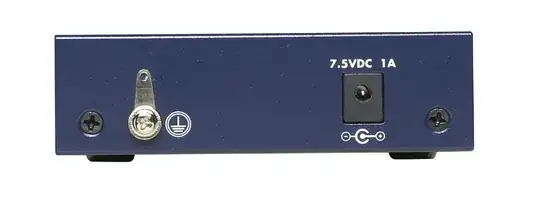
Also, data center (including wiring closet) standards call for a grounded solid copper bus bar mounted on the wall, and better network and telco equipment will have a ground lug on it so you can hard-wire it to ground.
Bear in mind that as weird as lightning is (and it is weird), it is seeking the earth. There's a massive static electric charge built up on the clouds, and the voltage potential is between that and the earth itself. It's a static discharge between clouds and the earth, through whatever conducting medium presents the least resistant path. Although, lightning is weird. Take ball lightning, for instance.
Also bear in mind that you have a cable modem or DSL modem (more than likely), which is directly plugged in to a coax or telephone cable which runs for miles underground and for the most part that works out okay. Of course, both your telephone line and your coax line are grounded where they enter your house, right? :-)
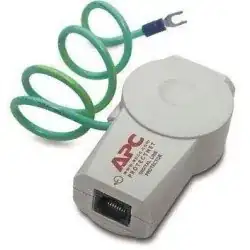
Here's an Ethernet surge protector, for example, good for up to Gigabit Ethernet for under $20:
I have definitely heard and seen issues with buried network cable and lightning in the past, but honestly that tended to be in situations where (I'm not kidding) somebody had done something like direct-burying 1000' of RG9 in a 3" to 6" trench under a gravel parking lot.


