2

I live in the USA and have one of these stoves:

enter image description here

For me who comes from Europe, the design of these stove tops always baffles me compared to flat (metal or glass) stove tops seen across Europe (it seems to be losing a more energy, the materials rust easily, and it's always so hard to clean!). Today, I met with this strange situation where the cup under the coil, after I cleaned it, started showing scary blue spots:

enter image description here

enter image description here

enter image description here

Although these marks are very photogenic, I am afraid that they might be Verdigris.

Is it possible that the material used in stove cups would be that easily corroded that it actually produces poisonous substances such as Verdigris when cleaned?

Obviously this one is a bit old and might need changing - probably for one that is made out of a material that doesn't corrode that easily (I love spending money on this stuff! ❤️ ), but if someone can confirm that these stains are not dangerous, I'll try and make it last a little longer. At least till I find a really cheap one that is rustproof on eBay (since I'm not really keen on giving to this "bad design makes the end user waste money having to fix stuff" philosophy).

Thank you for your help!

MicroMachine
  • 203
  • 5
  • 11

3 Answers3

4

Try a magnet - dollars to doughnuts, those are somewhat peeled and rusted chrome plated steel, and the blue is a normal steel oxidation color, and not toxic (also, were you planning to drip food down there, scrape it off and then eat it? If not, nothing to worry about regardless.) They are stunningly unlikely to be copper, though there may be a minuscule amount of copper plating as part of the chrome plating process

This is reinforced by the purple color, which is a slightly different temperature in the steel oxidation colors (we use them for determining temperature when tempering hardened steel.)

steel oxidation colors

Image from Maille Artisans International League website

While you could waste money and effort replacing them, you could also make them more efficient (reflect heat better) and easier to clean by applying aluminum foil to them (shiny side up - you want to reflect as much heat as possible.) As a side effect this would also contain the non-toxic steel oxidation. When something is too badly burnt onto the aluminum foil, remove it and replace with new foil. Mold the foil to the pan, wrapping over the edges - cut stars in the openings and fold the cut parts onto the backside.

FYI - stainless steel will also blue, at slightly different temperatures.

Ecnerwal
  • 235,314
  • 11
  • 293
  • 637
3

Edit3: Bleach will react with copper to produce copper hydroxychloride and as wikipedia says, is commonly found in metal corrosion products. Iron (II) chloride is often greenish colored. Iron and copper chloride will react to produce iron chloride.

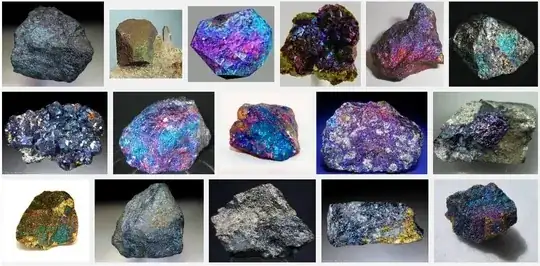
Looks like bornite (Cu5FeS4) (yes, bornite is toxic too). But it's unlikley, unless someone spilled some sulfur in the mix. It's definitely a copper mineral of some kind... copper is very commonly used when plating chrome.
enter image description here

Revised answer:

The cups are chrome plated steel. Usually chrome plating starts with copper plated to to steel, then chrome is attached to the copper layer. There may also be other trace metals including nickel, cobalt, tungsten, and zinc.

Why do they plate the cups with chrome? Because chrome plating is shiny (and shiny means it reflects heat better than stainless steel; and chrome is more resistant to corrosion and heat discoloration than steel (actually stainless steel has chrome and other minerals to impart the "stainless" qualities).

Steel will easily discolor (especially stainless steel) when it is heated (like Ecnerwal showed in the picture). However, the discoloration that I see in the picture of your cup is not at all similar to the discoloration of heated steel. The colors of your cup look like distinct "minerals" thact could be scraped off into a bag and analysed by a laboratory.

The brightness of the blue completely suggests a mineral comprised of copper. The location of the colored minerals is another strong indicator that this is a chemical reaction; the minerals were formed in areas of corrosion/oxidation where copper and iron, and possibly nickel and zinc are present. The "peacock" coloration suggests sulfur is/was also present. Sulfur may have come from garlic and onions, or possibly residues from sulfuric acid were present from the plating process, if nickel was used as well.

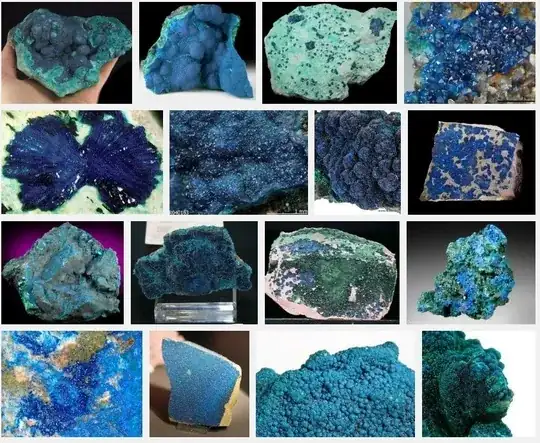
Edit2 - Other acids will also combine with copper to form other minerals. Many cleaners or "rust emovers" contain phosphoric acid, which could make a form of cornetite (a copper phosphorous mineral) which is darker blue and purple.
enter image description here

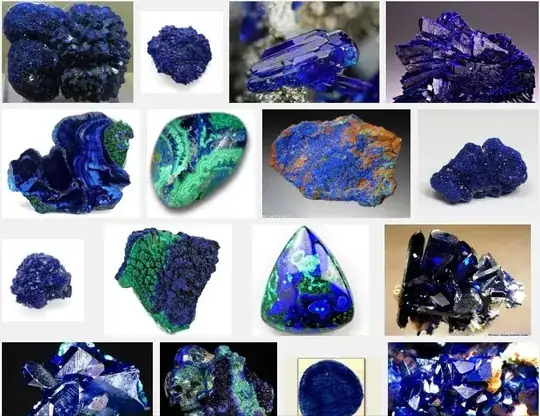
Azurite (a copper carbon mineral) is usually more blue than purplish. Malachite (another copper carbon) has just a couple extra % copper than azurite
enter image description here

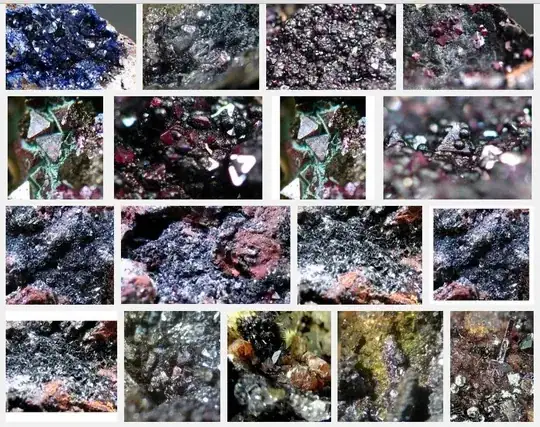
Cuprite + delefossite (CuFeO2 or Cu1+Fe3+O2) can also yield purples and blues.
enter image description here

So in essence what I'm saying is that this is that copper imparts the blue and or green, and it can combine with iron to make purples, but sulfur really brings out the "peacock" colors. The blue is copper that has oxidized most likely from acidic cleaners.

Ben Welborn
  • 6,292
  • 5
  • 23
  • 49
1

I'm a little skeptical because of how purple those stains are, but if these drip pans are made of copper then it could well be Verdigris. This is likely happening because the plates were not sealed properly and vegetable oil was spilled and not cleaned off as heat was applied over time.

If I were you I'd scrape some off (it's OK if some powder comes into contact with your skin once or twice) and set it on a paper towel somewhere. It should turn brilliant forest green over the next couple of weeks if that's the case. While you wait, you can take aluminum foil and wrap the drip pans in them; this is a common technique to help with keeping them clean/protected. The foil wont burn and can be unwrapped and tossed in the trash when you get marks or tears in it.

The danger is really up to your level of tolerance: you'd probably be safe by just cleaning them and the putting them back in; it's only toxic if you ingest the actual substance over time or once in large quantities. You'd almost definitely be safe if you wrapped them in aluminum foil. But if 100% peace of mind is what you're after, I'd ditch them and get new ones; it won't cost you much to get four new Chrome drip pans (maybe $10 to $15).

As far as I know, most drip pans are made of Chrome these days and are not susceptible to the same problem.

If you're up for some more reading, you can check out this ISCA Report on copper and its toxicity.

TylerH
  • 1,086
  • 1
  • 11
  • 22