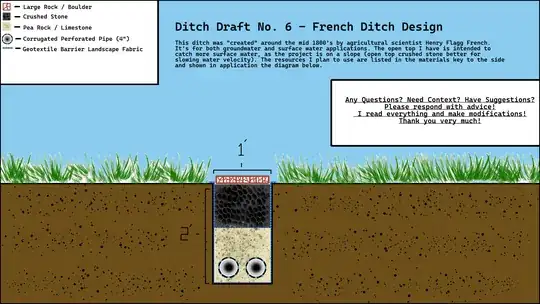
So there are considerations here that are very local. For example I am a big proponent of the four inch drain perforated drain pipe with sleeve but in areas of heavy clay and normal amounts of rain the clay can shift and crush the thin walled drain pipe. In those areas with heavy clay they use 4" PVC pipe that comes perforated. It takes a load but is not flexible. You change the pipe direction with 45 degree angles so that needs more accurate digging.
I don't know why you are planning to use two kinds of stone. It costs more to get two deliveries than one. Just get 5/8" or 7/8" crushed limestone with no fines.
I don't see the reason for the boulders at the top of the drain either. Just put down some geotextile and sod on top. The drain will only be visible during droughts when grass over it gets drier faster.
Apply the stone in layers and manually tamp down to compact it or it will settle anyway. You can water it to help compaction. (I know, watering stones!)
You mention a slight downhill. Drainage is all about grading. You need at least a 1 inch drop every 10 feet and two inches might be better as it is easier to see. A laser level is very helpful here. To get a slight grade you are going to have to do some accurate digging or water will pool in the dips and rises at the bottom of the trench.
A critter gate at the end is essential as all sorts of animals love it when we inadvertently make homes or storage for them.
To return to the local considerations how much rain does this area get? What you have specified would be suitable to drain a marsh much less a field. If you don't see water ponding in the spring or have massive rain falls this might be over engineered.