38

This might be subjective, I don't know. However, it's a serious problem for me. My electrical bill is outrageous. It's three times as large as my next-door neighbor, and four or five times the size of my neighbor's across the street. It's worse in the summer (I live in central TX), but I've had the air conditioner inspected, and while the house is right at the maximum capacity for our unit, the unit should still be able to take care of the load. That also doesn't explain why our winter bills are larger than the comparables.

What I would like to do is check the amount of current drawn by each running appliance and calculate where all my money is going. I just don't know how to go about doing this.

moswald
  • 523
  • 2
  • 5
  • 7

8 Answers8

41

For devices that plug into an electrical outlet, you can use Kill-a-Watt or equivalent to monitor how much electricity they're using.

If that doesn't give you a clear culprit, one low-tech method is to look at the electric meter as you turn off circuits at the service panel one at a time until you see a big change in speed at which the wheel is spinning (for older meters) or the digits are changing (newer meters). If you can narrow down what's using a lot of electricity, you can look at devices one at a time on that circuit to see if one is using more than its fair share.

Niall C.
  • 20,909
  • 19
  • 95
  • 135
26

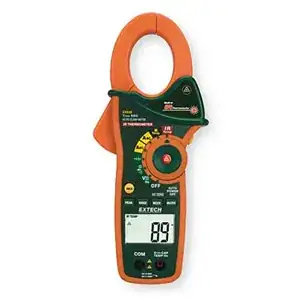
You could invest in a clamp on Ammeter like this

alt text

Then open up your electrical panel and measure the draw on each circuit, this will show you which circuits are drawing the most.

Also as Mike Powell pointed out, you could clamp on to the main lines and then turn off each breaker noting how much the value drops. (You will have to do this for each leg of the main).

Once you know which circuits are drawing the most power, you can start eliminating devices on that circuit until you find the largest consumers.

If you want you can figure out how much your devices cost to run like this.

 Watts = Amps * Volts
 Kilowatts = Watts/1000
 Kilowatt-hours = kilowatts * Hours used
 Cost = kilowatt-hours * cost per kilowatt-hour

Or

 Cost = (((Amps * Volts)/1000) * Hours Used) * Cost per Kilowatt

You could also do like I did and split an old extension cord (so you can clamp on to a single wire), then plug one end into the wall, and your device into the other end. Then you can measure the draw of just that device.

Tester101
  • 133,087
  • 80
  • 327
  • 617
24

Turn off and unplug everything and I do mean everything.

If the meter is still showing that you are using electricity the you have a fault with the meter and you should report it to your utility company.

ChrisF
  • 16,973
  • 5
  • 51
  • 74
6

One thing not addressed in your question is how many kW-hrs you are using compared to your neighbors. You can't just compare on dollars. In TX with the deregulated electrical industry, you could very easily be paying 2-3 times what your neighbors are paying per kW if you haven't checked it recently. Last summer I switched companies to get from ~$0.19 to $0.092, while keeping the 100% renewable energy sources that I had before. Go to www.powertochoose.org, a site set up by the TX Utility Commission, to compare rates.

Peranting
  • 61
  • 1
  • 1
6

Depending upon how interested you are, there are several home energy monitors on the market, some of which are DIY installs.

The Blueline Powercost Monitor is a definite DIY install (for the most common meter types). It is a little box which interfaces with the meter (even the analog style), and monitors the usage in real time. It integrates with Microsoft Hohm, and gives you real time statistics, recent usage history, fancy graphs, etc.

The other big contender is the TED 5000. This integrates with Google's competing service (PowerMeter). This is pretty much the same story (statistics, history, graphs, etc.). It is essentially an ammeter hooked up to the electric line coming in your house. Because of this, it is more accurate than the Blueline. The downside is that you have to open up the breaker box to install this (which may or may not be DIY for you).

Compared to the standalone ammeter (~$80), this is significantly more expensive (~$250). However, the usage statistics over time may help you to reduce your overall electric usage once you have found and eliminated the main hog(s) in your house.

More reading:
     Engadget Review of the Blueline - With some comparisons to the TED5000.

James Van Huis
  • 3,547
  • 18
  • 26
4

Brultech has a solution that will show you how much each circuit uses. You might need an electrician to install it. It works like the ammeter but tracks usage over time.

Joseph
  • 1,300
  • 5
  • 15
  • 21
0

I want to add/link an answer I just gave today on another question: https://diy.stackexchange.com/a/133721/82083

tl;dr: In central europe it's very common that you can borrow power meters from your electricity company or from some environmental NGOs. May/may not apply to your location.

0

All the other answers are correct, I just wanted to add that most meters read and charge for apparent power which is a combination of true power(the actual power the device is using to do useful work) and the reactive power (the power drawn when the device pushes against the true power). In well designed fully working circuits the reactive power should be eliminated but if a compensating capacitor or choke coil is failing then the reactive power can double the apparent power and double your cost of running a particular device. Unplugging or isolating certain circuits in turn and monitoring what is being used compared to what you expect to be used will show where the problem is.

Colin Ellis
  • 141
  • 3