13

My family and I are interested in buying a house that was built in 2002. This house is two floors on a concrete slab with a finished bonus room upstairs so there is no attic other than above the garage. I would like each room to have four points and I do have a 1000' roll box of Cat5e shielded cable.

What is the ideal way to run Cat5 for each room and to a com-closet when the ceiling on the first floor is finished and I don't have a crawl space? Is there a tool that I can use to fish the cable?

Niall C.
  • 20,909
  • 19
  • 95
  • 135

10 Answers10

12

This has been discussed many times on this site and maybe even a few times on Server Fault.

Step 1: The plan

Come up with a plan - how many drops per room? Where will you terminate all the wires back to? Are there clear path's from floor to floor via the walls? ie: is there an empty part of the wall on the first floor but not on the 2nd floor? Do interior walls line up from floor to floor? Running wire through exterior walls will be more difficult as they contain insulation.

Step 2: Find the framing

Get a damn good stud finder and a pencil and start marking studs and measuring from exterior walls to make sure you end up strait as you go from floor to floor. Do this in the basement also - find the floor joist for where your drops come through in the basement and mark them.

Step 3: Execute

Assuming all the paths are clear, start cutting / drilling. Use a 6 foot flexible drill bit. Cut a box on the first floor for your first set of drops. Drill down through that into the basement.

Directly above this box, cut an access hole about 6-8 inches from the ceiling big enough to get the drill bit through it - about 4 or 5 inches square (square will be easier to patch later on)

Goto the 2nd floor - cut your next box for your 2nd set of drops. Its easier to fish wire down then up, so I would start on the 1st floor, put the fish tape into the access hole at the ceiling, find it in the box hole on the 2nd floor, attach your 4 lines to it and pull the fish tape down. On the 1st floor, fish the tape up from the box hole to the access hole, connect the lines to the tape and pull down. And again, goto the basement, find the hole, fish the tape up to the box hole on the first floor, attach the lines and pull down.

Now that your in the basement, run the lines to your network closet - leave enough extra wire per drop to make sure everything reaches - rinse repeat.

When your all done, everything punched down, start patching your drywall holes.

You can do this by yourself but would be a lot easier with 2 people Lots of time and multiple boxes of cable. 1 box of 1000 feet wont help you, you'll be fishing each line individually and if you precut them, you may waste wire; get some small boxes of 250-500 ft and run all 4 lines at 1 time.

Equipment required:

  • Drill
  • Flexible drill bit
  • Utility knife
  • Fish tape
  • Electrical tape (to attach network cable to fish tape)
  • A TON of patience.
lsiunsuex
  • 2,843
  • 8
  • 29
  • 34
7

As stated in a comment, hiding behind crown molding is a possibility, as is going behind baseboard molding.

If I really wanted to do this, I'd pull the baseboards, and run them on a tablesaw with a narrow dado blade to cut a pocket for Cat6 cable. Then you can run along walls, poke through them to adjacent rooms, etc. I'd look to place switches strategically to avoid a pure star topology, to minimize multiple long parallel runs.

If you have wall to wall carpeting with perimeter tackless strips, you may even find you can tuck cat6 under the carpet, between the wall and the tackless strip.

Tim B
  • 2,488
  • 18
  • 20
4

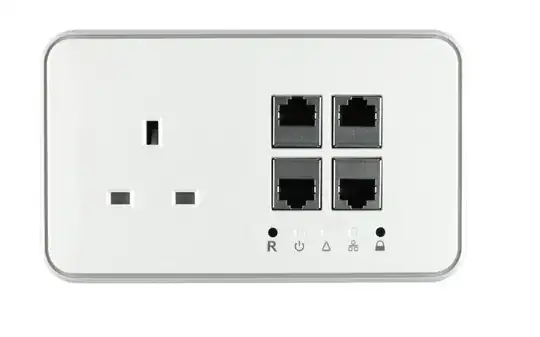
Just use the existing wires with one of these. They are awesome; a bit pricey but it saves you ripping this out and then pulling cables, sweating like mad; cables getting snagged, maybe you need two or three... forget it!

Power Ethernet Sockets

enter image description here

You can also get the smaller, cheaper and less stylish ones. THey do the same job.

Powerline Ethernet Adapter enter image description here

Usage

You need to read if they are paired or extendable. Paired devices; obviously only work with two devices that create an adhoc ethernet (extension) from one room to another. The extending ones are awesome because you can just keep on adding them to your system and you create a small network in your electrical system. (there are limits though)

Also these only work on one circuit (distribution board) If you have sub panels you need to link them up in a specific way.

You can find them at your favourite online computer store, local stores or just search for them on the web. They are fast and very capable.

You can get these in UK,EU,US,ZA,Asia - and any other plug format you need it to be.

Good Luck

Piotr Kula
  • 5,959
  • 22
  • 32
4

If you can, pull up your moulding, and run your wires behind the moulding. Secure them loosely with tacks or tie wrap holders, and put the mouldings back using silicone and/or liquid nails, not nails or screws, because accidentally nicking a perfectly run wire with a nail is frustrating.

You can also staple CAT5e to moulding, but that's a recipe for disaster. A staple in the wire or simply a tight turn will slow or stall your network. Do this as little as possible and visually inspect every single staple, twice.

You can use the inside of closets as wire chases. Pull a cable to a closet that lines up with a wall on the second floor (good) or a closet on the second floor (better), and run the line up the wall inside the closet, on the inside wall the door is cut out of, so you can't see the wire even if you look into the closet. Then branch your wire out to the location on the second floor.

As far as running around doors (to get the cable into a room): don't. Drill instead. Drill a hole about half an inch off the moulding and four to six inches away from the corner (generally speaking, try to take the straightest paths you can, and drilling at least four inches away from the corner rather than into the corner directly ensures you usuaklly miss any studs) through the wall and pull it through with a straightened wire clothes hanger or a short length of fish tape, like this: http://www.homedepot.com/p/Klein-Tools-65-ft-Steel-Replacement-Fish-Tape-56065/203194996

If you do use a fish tape, make sure you cut a six to ten foot length. Anything longer than that is going to be a major pain in the neck to control. You can use linesman's pliers to cut fishtape to required lengths and to bend hooks on the ends. If you absolutely cannot find a good cable chase, then you'll have to using flexible drill bits. Get a good, wired drill (not wireless), and try to use interior walls, not exterior walls, so you don't try to run a wire through insulation. It can be done, of course, but life is too short for that kind of thing. LSD (Labor Saving Devices) make a lot of really great specialty tools for this kind of thing not found anywhere else, despite having a terrible acronym as a name: http://www.lsdinc.com/content/main

They also have a really good line of instructional videos with tips and tricks and how too help.

The most useful bit of advice I can give you is: think. Think beforehand and try to get an idea of the best place to put your router/ switch. It should be in a centralized location that will allow each cable run to be as short as possible, preferably in a closet so you can branch out throughout the first floor and use the closet as a chase to the second floor. An hours thought can save you a day's labor, so try and plan it out beforehand.

3

From a DIY novice:

  1. drywall (purchase and repair) is CHEAP

  2. a larger drywall hole is sometimes easier to repair than smaller and makes work a lot easier

  3. closets and baseboards are great hiding places

  4. once you're working and have space(s) open, strongly consider a common chase for future access (first to second floor, basement to ground floor - if you had a basement, etc).

  5. work top down

  6. leave extra cable/slack. Cable is cheap. Redoing a run is expensive (emotionally).

The Evil Greebo
  • 25,971
  • 16
  • 91
  • 125
DIY novice
  • 31
  • 1
1

Without seeing some detailed pictures it's hard to recommend a solution. But it should be possible with a lot of patience.

I'm assuming there will be some space of some sort between the floors.

You can buy things like flexible drill bits that are designed for drilling through framing up walls. And then there tools available for drawing wire through tight spaces - e.g. fish tape.

Flexible drill bit demo

There are also some fibre optic cameras that you can hire for seeing inside walls etc.

If you absolutely need to open up you could probably cut some small holes for that and patch them later (hopefully you won't need to).

As a last resort, consider running cable outside the building. e.g. up the outside of a drain pipe. Being careful that the cable should loop down as it exits the building to prevent any water running along the cable and into the building. I was thinking you could put the cable out of a vent or something. But you've mentioned that it's on a concrete slab.

Again hard to recommend the right way.

hookenz
  • 992
  • 7
  • 18
1

Depending on the layout of your house, one option is to build a chase just for the networking. Bump out a small wall on the interior of the house by 6" or so and add a door. A similar option, though not as nice aesthetically (IMHO) would be to run it through some bulkheads in a few rooms (basically a variation on the crown moulding method).

An even lazier way is to simply run them all through the back of some closets.

But it really does depend on the floor plan you're working with.

DA01
  • 24,586
  • 30
  • 82
  • 153
0

You could always run conduit on the outside of the house for hard to reach places.

David Moritz
  • 677
  • 3
  • 5
0

On mine, the two-story house makes drops impossible. I ran a cable outside from the downstairs point (just 1 place) up the wall to the soffit, in the attic all the way across the house, and then into the router closet. The CAT5e lasted years exposed outside with no problems.

For fishing and drilling within the space between the floors, I've not even found pros who would do that. It would be cheaper to redo the drywall on the ceiling.

JDługosz
  • 1,131
  • 5
  • 13
-3

You have to have attic access to do this. Also the framing on your house would have to be without horizontal crosses in the places where you wanted the cabling. You will be ripping up flooring and drywall to accomplish this.

DMoore
  • 50,637
  • 16
  • 93
  • 208