22

OK, the one answer I got was way off target, and another commenter couldn't figure out what I was asking, so I'm restating the question...

Are 15A 3-prong grounded outlets actually rated to 20A, allowing them to be used on 20A circuits? And if so, why, when the outlet can never be asked to supply more than 15A by anything that would be plugged into it?

More info:

This question had a comment that 15A outlets were actually rated to 20A. However, by design, there is nothing that will plug into a 15A outlet that will draw more than 15A. An appliance that draws more than 15 amps would have a "T-blade" plug that wouldn't go into a standard 15A outlet.

In addition, outlets are always wired in parallel, meaning that a 15A outlet would never have to transmit the amperage draw of a "downstream" outlet; you never "daisy-chain" outlets by connecting hot to neutral, for a number of reasons.

So, there is AFAIK no situation in which a 15A receptacle would ever have to handle more than 15A, even if installed on a 12AWG, 20A-breaker circuit.

If all the above is true, why would a 15A receptacle even have to be rated to 20A?

KeithS
  • 14,367
  • 7
  • 45
  • 74

7 Answers7

31

A 15A outlet is rated for 15A, with a 20A pass through. That is to say that the 20A circuit is in continuance throughout the circuit, however the receptacle itself (the contacts) are rated for 15A continuosly. Any single appliance with a 15A plug will not normally draw more than 80% of 15A, or 12A. The total circuit draw (multiple appliances - same circuit) can be 20A before the breaker trips.

A 20A breaker used with 12awg wire can feed multiple 15A outlets, one example is the kitchen. The reasoning is so that today's demanding appliances, which draw more current, can be used with a 20A breaker without the worry of nuisance tripping. If more than a total of 20A were to be drawn from the circuit, the breaker will trip.

It should be noted that any circuit that is intended to be 20A must use a 20A recepticle.

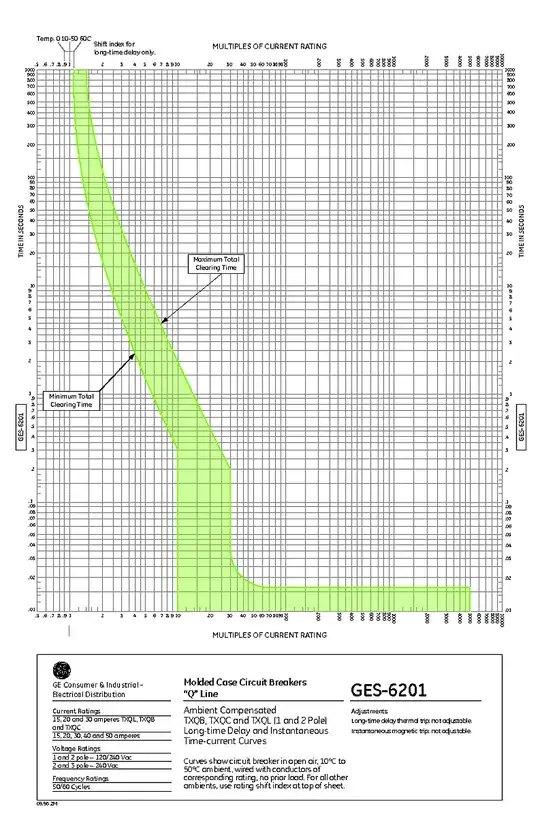
If the appliance were using 15A, it will be safe with the 20A breaker ( @ 80% = 16A). If it were to short, it will trip the 20A breaker just as it would a 15A breaker. A 15A receptacle can take 20A for a short time with no problem. The receptacle is overrated, otherwise it would blow up upon a short. A short circuit in actuality can be hundreds of amps in a very short duration. The breaker and receptacle are rated as "Time overcurrent" meaning it can take a lot of current for extremely short durations, and will trip on lesser currents that occur for a longer time.

An example one can relate to (refer to chart): Joe plugs in two electric heaters in his family room. Everything works fine until 20-100 seconds later the breaker trips! Joe overloaded his 20A circuit, by drawing 40A! The breaker will allow this overload for a short time. If the overload were bigger, say 60A the breaker would trip faster from 10-35 seconds. If the trip was due to a direct short, the breaker will trip Immediately. Breakers actually have a "Load characteristic curve" that you can tell when it will trip in time vs current. enter image description here

SteveR
  • 3,889
  • 1
  • 19
  • 17
9

I'm no electrician, but this is my understand of how the various codes work together to protect all components of the circuit.

Breakers protect wiring and trip on shorts

The really important thing is your wire gauge matches your circuit breaker. The breaker is designed to protect the wiring, as well cut power in the event of a short. If you violate code by using 14 awg wiring on a 20A circuit, then a draw of 18A will overheat the wiring and be a fire hazard, but still be under the tripping limit of the breaker. By ensuring you use 12 awg wire with 20A circuit breaker, if the wiring is overloaded, then the breaker will trip before the wiring overheats and becomes a fire hazard.

Outlet Pins protect the outlet from overrated device

The amp rating of the outlet and its pin configuration ensure you don't overload a 15A outlet with a 20A device, as the outlet itself could overheat.

The outlet can overheat if overloaded, and so we have standards that specify pin configuration for 20A devices so they cannot be plugged into a 15A outlet. You might have 12awg wire, 20A breaker, 15A outlet, which is fine, unless you somehow forced a 20A device to plugin to the 15A outlet(which would require physically modifying the plug). In which case the breaker would not trip, as the load is within 20A and the wiring would not overheat as it can handle the 20A, but the 15A outlet will be a fire hazard.

To directly answer your question, having two(or more) 15A outlets on a single 20A circuit with 12awg wire(the appropriate size for 20A circuit) is generally safe, and pretty common. A single outlet will not allow more than a 15A device to be plugged in, ensuring the outlet itself is not overloaded. If the total load of all devices across the two outlets exceeds the 20A limit of the circuit, then the breaker will protect the wiring from overheating by tripping.

Generally you don't often fully load an outlet to 15A. Things like TVs and computers will draw between 50W to 400W each. So in typical use case, you might have one outlet drawing 800W which is roughly 7A and another outlet drawing 1200W(roughly 10A), which is 17A load on the wiring within the safety threshold of 20A for the circuit breaker and wiring. Each individual outlet is within its limit of 15A so will not overheat. If you plugged in so many things across all the outlets in the circuit that you exceed 20A(roughly 2400W) then the breaker will trip and protect the wiring.

So this configuration is safe, yet allows some flexibility in outlet usage.

You could also have 14awg wire, 15A circuit breaker(to match the wiring), and multiple 15A outlets. Again, no single outlet can be overloaded due to pin configuration. If the circuit as a whole is overloaded beyond 15A from a combination of devices across the outlets, the wiring could begin overheating, but the circuit breaker will trip. IF you improperly used 20A breaker with 14awg in this scenario, you have a firehazard when the circuit is overloaded.

There is a code that I'm not completely sure of, but to my understanding says you should not use an outlet for circuit continuity. This is why pigtails are used to connect outlets so that the circuit load is not running across the outlet. I speculate the reason for this is because you don't want a 20A load on a circuit to run across a 15A outlet.

So a combination of standards combine to address several dangerous scenarios, and protect all components from becoming fire hazards.

Overloading a 15A outlet with daisy chained strips

The one exception to this is when you daisy chain power strips or things like Christmas lights. This would allow you to combine enough of a load to exceed the 15A outlet rating, while staying within the 20A tripping threshold of the breaker. In this case your outlet can overheat/fail/be a fire hazard. In such a case, it's likely the powerstrip or first xmas light plug will begin to melt at the same time. This is why it's a terrible idea to daisy chain power strips.

The danger of daisy chaining power strips is mitigated by their maximum output amperage, which must match their plug configuration. If you look at power strips(even the cheap ones that are not surge protectors), they always have a rating of maximum amperage output, which is commonly 15A. If you find a few that have a 20A output amperage, then you will also see that they are using a 20A plug configuration to ensure they can only plug into a 20A outlet. I speculate that UL standards require power strips to have a fuse which will trip/fail if the rated output amperage exceeds their rating. This should ensure if you overload a single 15A power strip with devices that total greater than 15A, then the fuse will fail and prevent the 15A outlet from being overloaded. You would think this would protect a chaining scenario since the root power strip should trip if overloaded, but I've heard this is not a completely reliable safety measure when multiple strips are chained: https://electronics.stackexchange.com/questions/34048/why-daisy-chaining-surge-protectors-not-recommended

So if you've followed codes, then your circuit is safe, so long as you don't do something really stupid such as daisy chaining devices or physically modifying plugs to fit in receptacles they don't belong.

AaronLS
  • 305
  • 1
  • 3
  • 12
3

Most receptacles are duplex and allow you to plug two appliances in. If each appliance consumes 10 A, the receptacle and the circuit would be supplying a total of 20 A.

Philip Ngai
  • 3,503
  • 1
  • 21
  • 20
-1

The rating and actual capability of all elements in a domestic power circuit is designed and regulated so that an over-current condition is detected and acted upon by the correct element in the circuit. Put another way: exceeding the current on the circuit should only ever trip the breaker. The plug and socket are going to be capable of more, and the wiring in the wall of much more (often twice as much). But you still want the breaker to trip before melting the socket.

If the breaker is rated for 20A, then you want everything else to be capable of passing more current. That means wiring, plugs, sockets and appliance wiring. The idea of a 15A plug is that devices are not supposed to draw more than 15A when sold with a 15A plug. This is where the regulation comes in.

staticsan
  • 793
  • 3
  • 6
  • 11
-1

I think the best way for a layman to understand this common question is to look at it from the appliance perspective - that is, what's being plugged INTO the receptacle? ANY appliance that draws more than 15A but less than 20A by code MUST have a 20A rated plug on it. You can't insert at 20A plug into a 15A receptacle because a 20A plug has one sideways prong. So ANY item that you CAN plug into a 15A receptacle BY DESIGN will draw at most 15A (usually at most 80% of 15A) and is safe under all normal circumstances to plug in to the 15A receptacle. That is why 15A receptacles are allowed on 20A convenience branch circuits which are intended to have multiple receptacles on a single circuit. It should be noted that a 20A APPLIANCE circuit MUST have a 20A receptacle, because it is designed to provide the full 20A to a SINGLE appliance.

-3

The purpose of a breaker is to protect everything connected downstream, whether it be an electrical cable, receptacle, switch, etc. If a breaker is rated at 20A everything downstream should be rated at 20A or it will not be protected by the 20A breaker. It's all well and good that a receptacle rated for 15A may be designed and even tested, for safety reasons, to survive a continuous current draw of more than 15A. But a 15A rated receptacle is rated for no more than 15A - meaning it is guaranteed to remain undamaged provided no more than 15A of continuous current is drawn though it; there is no guarantee at 20, 19, 18, 17 or even 16 amps. In fact a 15A branch circuit should be designed with the goal of not exceeding 80% of 15A (12 amps) for safety reasons. Also it is not uncommon for people to attach a 15A power strip, having a NEMA 5-15P plug, to a rated 15A receptacle and load it up with running devices, which together exceed a continuous 15A draw. In this case if the draw is less than 20A, a 20A circuit breaker will not protect the 15A receptacle, which could overheat and start a fire. The code may allow multiple 15A receptacles to be installed on a branch circuit protected by a 20A circuit. But I wouldn't recommend it. Don't forget many receptacles provide (in addition to the screw-down side terminals) the ability to support "backstab" wire connections which, though obviously approved, have been the cause of an untold number of house fires. USE AT YOUR OWN RISK.

Tom
  • 1
-4

If you've never had an outlet melt then you might believe you can use a 15A receptacle on a 20A line. I on the other hand believe if the line is rated at 20A the receptacles should be too. That said, 20A duplex receptacles provide 20A to the fixture, that is, to one or both plugs. If you plug two 12A devices in to the outlet and use them both (i.e. shop vac and router) you WILL blow the breaker. All the technical babble about never and can't and shouldn't by-passes the real world. Bottom line - use 15A on 14ga and 20A devises on 12ga line. The exception is 15a light switch feeding off a 20A outlet but expect problems with lights going out.