26

Living in the UK, where we have a different system of mains wiring, my curiosity was piqued by Is it okay to install a 15A outlet on a 20A dedicated circuit for a dishwasher? and its answers. Although there is some debate in comments as to whether a "duplex receptacle" counts one or two receptacles/outlets, the gist seems to be (from NoSparksPlease's comment):

NEC 210.21(B)(1) requires a single receptacle on a 20A be rated for 20A, 210.21(B)(3) says two or more receptacles says to refer to table 210.21(B)(3), which allows 15 and 20's

Can someone explain why a 15A single receptacle is not allowed on a 20A circuit?

(I recognise that "why" questions are often not suitable on StackExchange sites because – without documented reasons from the decision maker(s) – it can be a matter of speculation and opinion, but I feel such a question about electrical safety regulations should have an objective answer).

Under "normal operating conditions", I cannot see any problem with an appliance that can draw up to 15A, plugged into a 15A single receptacle fed by a 20A circuit. You may not be using the full capacity of the circuit, but that seems no different than if a 20A receptacle was fitted and an appliance that draws a maximum of 15A was plugged-in.

Obviously, though, electrical regulations are as much (if not more) about ensuring safety when not under "normal operating conditions". Here I can see how a 15A receptacle on a 20A circuit could be unsafe: if the appliance "goes wrong a bit" and ends up drawing 18A, you will probably be overloading the appliance's cable and definitely overloading the receptacle. But because the circuit and its breaker is 20A, it will not trip.

However, I cannot see how this danger would be ameliorated just by having a second 15A receptacle on that circuit. Assuming code doesn't require you to keep an appliance drawing 5A permanently connected to that second receptacle, simply having a second receptacle isn't going to make the 20A breaker trip any sooner, nor is it going to relieve the overloading of the receptacle that is connected to the faulty appliance drawing 18A.

What am I missing about why a 15A single receptacle cannot be the only connection to a 20A circuit?

(This answer quotes more of Code 210.21, and goes into more details about why multiple 15A receptacles on a 20A circuit are allowed and useful, but does not seem to address why a single receptacle is not allowed).

Dan A.
  • 548
  • 6
  • 16
TripeHound
  • 378
  • 3
  • 13

3 Answers3

33

Let me give some framework around what ThreePhaseEel said.

I can understand wondering that, since UK appliances all have fuses in their plugs, and I bet the fuses are sized to protect the appliance.

The US doesn't have those. It depends on reasonably close matching between receptacle and fuse/breaker protection. Thus, the general rule is that receptacles must match breakers: 15A must be 15A, 30A must be 30A, and 50A must be 50A.

Now there are 2 exceptions. To brush aside the other one, NEMA stubbornly refuses* to define a standard for a 40A receptacle, so 40A circuits must out of sheer necessity use 50A receps.

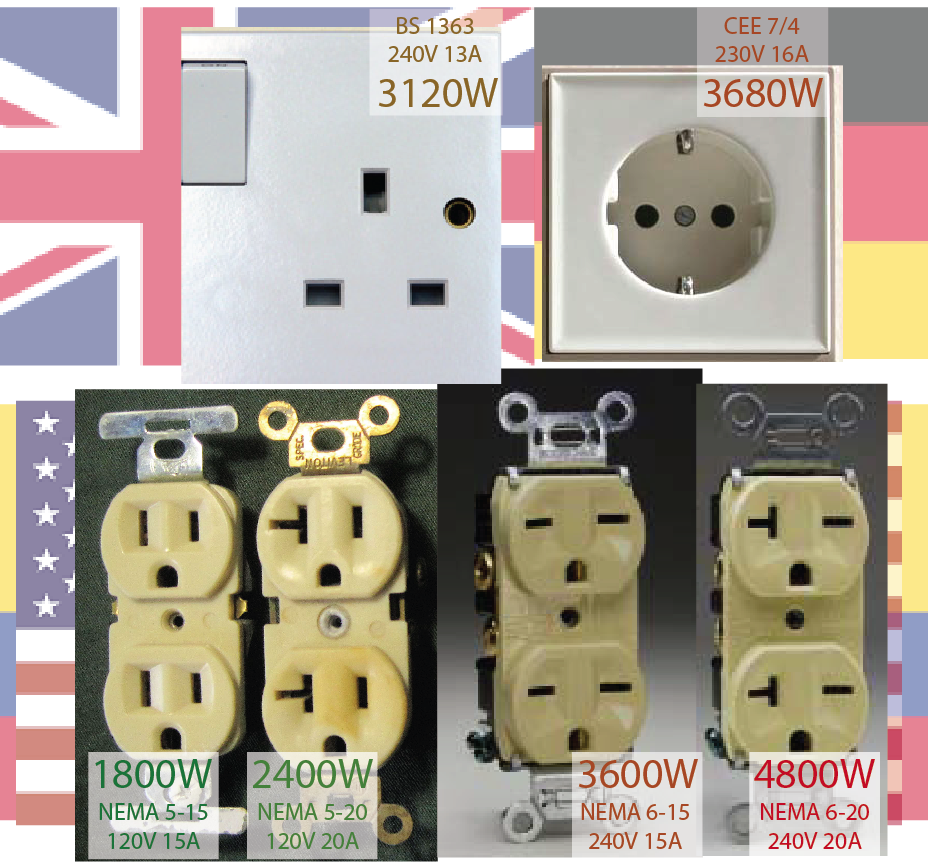
The other is allowing 15A receps on 20A circuits. (the reverse is out of the question). Note that it's already the case that 15A appliances with 15A plugs are allowed on 20A circuits; just take a look at the socket keying.

enter image description here

NEMA 6 is our standard for 240V appliances; the same rules apply. See how 20A sockets are keyed to accept 15A plugs. Even on a 1-socket dedicated 20A circuit, 15A appliances are allowed.

Really, we have two separate use-cases here.

General-use branch circuits. As you know, the ubiquitous American recep is the NEMA 5-15. Most of the time, those are made as duplex (two socket) receps, and are on circuits that have many sockets - typically 3 to 12 yokes (a yoke is the physical chassis that fits in a standard 1-gang box) so 6-24 sockets. And most things plugged into them are low current - fans, cell phone chargers, TVs, etc. In this "general use appliance" application, long experience is that 20A is "close enough" to 15A that such appliances are unlikely to find useful protection by being fused at 15A rather than 20A. UL wouldn't approve an appliance that senstitive, anyway, or would require it to have internal fusing. (note that US Christmas light strings have fuses in the plug - yes, our dainty little plugs).

enter image description here

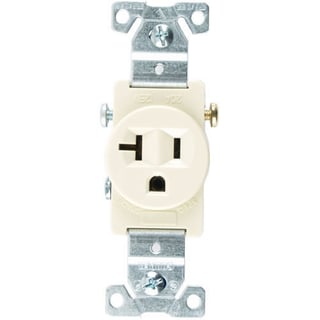
Dedicated circuits. Some appliances (think: built-in microwaves; air conditioners) are such heavy draw that they cannot share a circuit - i.e. they are running near circuit limits, or if continuous, near 80% of circuit limit Yet it is reasonable not to hardwire them and have them cord-and-plug connected. (e.g. a window air conditioner that might be removed every winter, back when they were inefficient). UL requires such appliances state in their instructions that they require a dedicated circuit. That is where simplex (1-socket) receptacles are typically used. When an appliance has such heavy draw, it makes more sense to require a close match between receptacle and breaker. So effectively UL is dictating the circuit protection.

It's a bit of a tag-team operation: our Electrical Code requires you used approved equipment (110.2), approvers defer to UL, UL writes the appliance design rules, UL certifies the appliances as safe, UL certifies the instructions and labeling, and Code requires that you obey them (110.3b).


*The reason they won't is: (rewind: in Europe, they standardized on 416V "wye" or 240V leg-neutral - while it makes for a more dangerous residential power, it allows easy 3-phase distribution and is strong enough for industrial needs; this means you only need one power system) Whereas Thomas Edison married the US to this lower-voltage split-phase thing. To work around its limitations, we went to a wide variety of schemes: 208/120V "wye" 3-phase, 240V "wild-leg" delta, and 480V delta (277V leg-neutral), just to name a few. As a result we have a huge variety of socket families, and they must ALL reject each other. So finding a new pin arrangement is like trying to find a .COM domain name lol.

Robert Chapin
  • 8,102
  • 1
  • 15
  • 37
Harper - Reinstate Monica
  • 313,471
  • 28
  • 298
  • 772
32

The key lies in the way UL tests 15A and 20A receptacles

Answering this question requires a deep dive into the standard UL tests 15A and 20A receptacle devices to, namely UL 498. In particular, we have to look at the way these receptacles are tested for acceptable loading, which is governed by Section 113 of the standard. We start with the fact that a 15A single receptacle is required to get no more than 30°C hotter than ambient at both its socket-contacts and its wire terminations when handling 15A, as per UL 498 113.1 and 113.5, as it only has a single set of terminal screws and thus can't be used to feed power through to other devices on the circuit.

However, duplex 15A receptacles, by and large, generally have two sets of hot and neutral terminals on them, thus permitting their use for through-wiring. (This goes hands in hand with the break-off tabs, or "fins", they have that allows them to be "split" into two separate receptacles.) Some of these receptacles are tested under 113.4, which requires their contacts to be tested at 15A but their wiring terminals to be tested for feeding 20A through with no more than a 30°C rise, as per 113.2.

More commonly, though, 15A receptacle devices are made to share a common set of parts with their 20A (or T-slot) counterparts, and thus fall under the effective exception in 113.4 that allows a 15A receptacle device with a 20A counterpart to be covered by the temperature testing done on the 20A receptacle. As a result, a 15A duplex receptacle's internal parts will be tested for handling 20A through them at some level, rendering them less susceptible to overheating from a low overload than a 15A single receptacle is as the latter has only ever been tested to not overheat excessively with 15A through it, never 20A.

ThreePhaseEel
  • 87,685
  • 36
  • 144
  • 243
1

Does not a single outlet on a 20A circuit rather imply at least a possible 20A load on that outlet?

I would guess that either inspectors frequently found, or those writing the code were concerned they would find, 20A circuits feeding single 15A receptacles from which 20A was being drawn. Presumably due to the installer (homeowner or an under-qualified 'electrician') not wanting to spend the time and effort to obtain a 20A receptacle, or 20A receptacles may not have been widely available at the time.

Perhaps a better regulation would be to allow a 20A breaker if the single receptacle was not the ONLY outlet on the circuit? However then you'd get the original problem, except now with duplex outlets added next to the electrical panel, essentially as decoration.

Having recently found the circuit feeding the kitchen (refrigerator, electric skillet, toaster, etc.) in my mother's home run through the link between two outlet halves (discolored and corroded by heat) in a duplex outlet that was loosely mounted, my sympathies lie with the regulators.

Technophile
  • 393
  • 2
  • 8