30

Is there a way without using junction boxes to simply splice in additional length of 12/2 NM-B cable? Can I use twist caps?

I'm putting in a dog door and as it so happens, there is some 12/2 right in the way of the location I've chosen. There's no additional slack in the cable, and I don't want to rip up more drywall than I have to. I'm tempted to just cut it and splice in an additional foot or two with twist caps to get it out of the way. I don't know if this is safe or legal. Do I need to get junction boxes? Attached some pictures for fun.

Also, there is a 1-gang electrical outlet box that is going to the outside. I'm moving that up a bit.

View of the hole with the NM-B in the upper left Close up of the cable

isherwood
  • 158,133
  • 9
  • 190
  • 463
snicker
  • 567
  • 4
  • 7
  • 12

9 Answers9

41

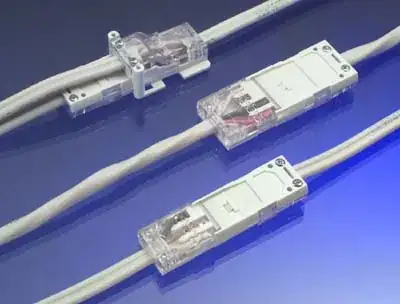
Tyco makes NM splices which are concealable and acceptable under NEC for use for rewiring in an existing building.

NM Cable Splices

enter image description here

NEC 2008

334.40 Boxes and Fittings.

(B) Devices of Insulating Material. Switch, outlet, and tap devices of insulating material shall be permitted to be used without boxes in exposed cable wiring and for rewiring in existing buildings where the cable is concealed and fished. Openings in such devices shall form a close fit around the outer covering of the cable, and the device shall fully enclose the part of the cable from which any part of the covering has been removed. Where connections to conductors are by binding-screw terminals, there shall be available as many terminals as conductors.

Tester101
  • 133,087
  • 80
  • 327
  • 617
kkeilman
  • 3,441
  • 1
  • 21
  • 17
15

The NEC says that all electrical junctions have to be accessible (and your profile indicates that you're either in Nevada or New Mexico, both of which have adopted the NEC), so you can't legally hide a junction behind the wall.

Probably the easiest route for you would be to install a retrofit gang box to the left of the stud with the other gang box (if there's room, it's hard to tell from the photographs), run the existing wire into it, then run a new, longer, wire from the gang box to the receptacle. Connect the two wires with electrical nuts, and finally, cover the gang box with a blank cover plate.

Niall C.
  • 20,909
  • 19
  • 95
  • 135
5

Splices have to be in a box, and there must be access to the box. Niall C., above, has it right. While you are at it, buy some plastic staples made for NM-B cable. The metal staple shown in your picture is asking for trouble.

Max Bucks
  • 512
  • 3
  • 2
4

There are a couple of reasons why electrical codes insist that connections are always inside a box, and that the box is always accessible.

1) The likelihood of a failure inside the cable itself is vanishingly small. Any failures will almost certainly be at connections, and you need access to correct them.

2) Any connection is liable to have more resistance than the cable itself. If the connection is poor enough, this could generate enough heat to create a hazard. Arcing is also a possibility. Containing connections in a fire resistant box makes the entire system safer.

Splicing wires together and hiding that splice inside a wall is not safe practice and is generally prohibited. Local code always override national codes, and you should check yours. As far as I know, the exceptions mentioned in kkeilman's answer are not allowed in my jurisdiction.

4

I don't know about the legality of not using them where you are, but I'd always use junction boxes for this sort of thing if only for the safety aspect.

ChrisF
  • 16,973
  • 5
  • 51
  • 74
2

You asked two questions, the first of which has been fully answered (is it acceptable for code).

The second question was about safety. Speaking as an electrical engineer, a proper splice is perfectly safe. This could be accomplished with soldering and shrink wrap, correct use of twist-on caps with proper strain relief, or a variety of other splicing techniques. The problem is too many people don't splice correctly, so code does not allow splicing (proper or otherwise) -- unless it is dummy-proof like the approved devices.

Ray
  • 21
  • 1
2

These aren't dummy-proof enough for concealing except in extremely limited situations, that do not include J-boxless cable extensions. Look up 334.40(B). The permission in 2008 version (here copied from upthread) is for "exposed cable wiring and for rewiring in existing buildings where the cable is concealed and fished". The word And before Fished is not a drafting mistake. Changed and clarified in 2014: the word rewire is replaced by repair. Same in 2017. This is discussed at length in an Inspectors Association magazine: https://iaeimagazine.org/magazine/features/enter-the-nonmetallic-sheathed-cable-interconnector/

0

Tyco and other similar types of the push-together connectors ARE legal to use according to NEC. I’m not saying they are the safest, but they are legal to cover in a wall if you are retrofitting an existing NM cable. Not that I agree, but it’s legal!

Ack
  • 5,759
  • 4
  • 21
  • 32
0

These are used in timber frame homes by Benson homes all over the country. First time I saw them was on a show about Timber frame prewired SIPS they were used between panels that were factory prewired new construction.

NEC compliant - article 334-40b, 2005 and 2008 NEC UL and CSA listed