44

I have noticed in a few different houses in Oklahoma that 20 amp breakers are used, but all of the outlets and switches only seem to be rated for 15 amps. This goes against everything I know to be proper and safe. The wire used is 12 gauge, so at least that is fine.

I have started to replace all of the switches and outlets with the decorative switches (the rectangular ones) and have found it very difficult to find switches that are rated for 20 amps. As for the outlets, I have can find them rated for 20 amps, but not in the 10 packs that I see for the 15 amp versions. To be clear I am not speaking about the shape of the plug, rather I am talking about the rating of the internal components of the outlet.

Is there something about electrical code that I am missing?

Kellenjb
  • 2,090
  • 5
  • 22
  • 29

12 Answers12

37

NEC 2008

210.21 Outlet Devices. Outlet devices shall have an ampere rating that is not less than the load to be served and shall comply with 210.21(A) and (B).

(B) Receptacles

(1) Single Receptacle on an Individual Branch Circuit. A single receptacle installed on an individual branch circuit shall have an ampere rating not less than that of the branch circuit.

Exception No. 1: A receptacle installed in accordance with 430.81(B).

Exception No. 2: A receptacle installed exclusively for the use of a cord-and-plug-connected arc welder shall be permitted to have an ampere rating not less than the minimum branch-circuit conductor ampacity determined by 630.11(A) for arc welders.

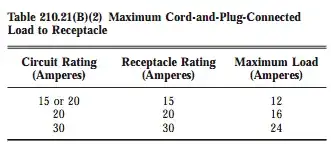
(2) Total Cord-and-Plug-Connected Load. Where connected to a branch circuit supplying two or more receptacles or outlets, a receptacle shall not supply a total cord and-plug-connected load in excess of the maximum specified in Table 210.21(B)(2).

Table 210.21(B)(2) Maximum Cord-and-Plug-Connected Load to Receptacle

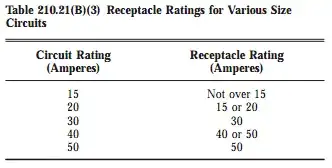
(3) Receptacle Ratings. Where connected to a branch circuit supplying two or more receptacles or outlets, receptacle ratings shall conform to the values listed in Table 210.21(B)(3), or where larger than 50 amperes, the receptacle rating shall not be less than the branch-circuit rating.

Exception No. 1: Receptacles for one or more cord-andplug-connected arc welders shall be permitted to have ampere ratings not less than the minimum branch-circuit conductor ampacity permitted by 630.11(A) or (B) as applicable for arc welders.

Exception No. 2: The ampere rating of a receptacle installed for electric discharge lighting shall be permitted to be based on 410.62(C)

Table 210.21(B)(3) Receptacle Ratings for Various Size Circuits

(4) Range Receptacle Rating. The ampere rating of a range receptacle shall be permitted to be based on a single range demand load as specified in Table 220.55.

If it is a single receptacle on a 20 Amp circuit, it must be a 20 Amp receptacle (aside from the 2 exceptions). If there are multiple receptacles on a 20 Amp circuit, the receptacles can be either 15 or 20 Amp (aside from the exceptions).

This is to allow You to have multiple devices plugged in drawing less than 15 Amps each, but the total draw on the circuit may be greater than 15 Amps.

NOTE:
Keep in mind that NEC defines a receptacle as follows.

Receptacle. A receptacle is a contact device installed at the outlet for the connection of an attachment plug. A single receptacle is a single contact device with no other contact device on the same yoke. A multiple receptacle is two or more contact devices on the same yoke.

So a duplex receptacle would be considered two receptacles, according to this definition. Which means you can install a single 15 Amp duplex receptacle on a 20 ampere circuit, without violating this code.

Tester101
  • 133,087
  • 80
  • 327
  • 617
7

SteveR...

"Apparently a 15A receptacle is safe to use @ 20A"

Scott...

This is incorrect. It is not safe. You are allowed to use a 15 amp rated outlet on a 20 amp circuit simply because it is expected that the cord that's plugged into the outlet should not exceed 15 amps (by code). The current conducted through the front of the outlet is added to the 20 amp branch total at the wire, not within the outlet itself. In theory, if heat dissipation isn't an issue, you could install a 15 amp rated duplex outlet on a 30 amp circuit and be just as safe because the top could handle 15 amps and the bottom could handle 15 amps. Yet nowhere within the receptical would it conduct 30 amps because the current is added at the conducting wire.

If you have an applicance with a 15 amp cord that's drawing > 15 amps, it is in violation of the code. There should not be any such appliances on the market. Appliances which draw > 15 amps should have a 20 amp or higher cord and plug. Since power strips are supposed to have built in breakers, thier cords should not exceed 15 amps. Unfortunately, sometime people exceed the 15 amp rating of a 15 amp receptical by using an extention cord with a triple input where the current sum of the individual cords > 15 amps. It is recommended that you do not do this since it's a fire hazzard and it violates the code. However, just because this is possible, doesn't mean it's the fault of the code. You can't blame the code because people choose not to follow instructions.

I don't want the NEC to try to make the code idiot proof. Such an effort would eliminate many many convienient electrical products which are safe when used as directed.

Kellenjb...

"But lets say I plug in a power strip and pull more than 15 amps, sounds plausible to me and not very safe."

Scott...

You are correct, it is not safe.
If you are able to do so, then you certainly do have a problem. If your power strip has a standard 15 amp (14 awg) cord and plug, then it is supposed to have a built in 15 amp breaker. In your example, your breaker isn't functioning properly and that is not the fault of the code. If you don't have a built in 15 amp breaker, then your power strip is in violation of the code and by using it, you are violating the code.

Kellenjb...

"Thanks for the answer, but it didn't really get to the point of my question. I fully understand that if you add up the possible current that can be drawn from each outlet, you can go over the current rating of the breaker. I just don't understand why it is allowed to have the situation where one outlet can have more current pulled on it then what the outlet can handle. I would hope the breaker would trip before this point in time."

Scott...

Let me be frank. I don't know exactly why the NEC chose to allow this. I could speculate based on legitamate reasons but I won't now. What I can say is what I stated above. it's possible to exceed the 15 amps when using an extention cord with more than one receptical on it whereby summing the current of multiple applicances totalling > 15 amps (violating the code). Doing so is contrary to the instructions of the extention cord. It is not safe and should not be done. You should be able to discern when you reach the 15 amp limit by adding up the current of each appliance on such an extention cord and not exceed 15 amps (or use current = power/voltage).
Now I'll exclude such possibilities of improper practices from further discussion or I'll never get done.

An outlet rated for 15 amps should only have 15 amps conducted through the front of it via a 15 amp (14 awg) cord.
Let's say you have a duplex outlet and you draw 15 amps on the top and 5 on the bottom, totaling 20 amps. There is no part of the outlet that's conducting 20 amps. The 20 amps should be conducted through the attached 12 awg wire only. If you have two different duplex outlets daisy chained (in parallel) whereas the first conducts 15 amps and the second condusts 5 amps, the current is added at the wire, not the outlet.

Scott
  • 87
  • 1
  • 1
5

It appears to be permitted to use a 15A receptacle with 20A breaker and 12 AWG wire. The reasoning is that you can't plug a 20A appliance into the 15A receptacle because of the side tang.15A receptacle on 20A breaker.

Apparently a 15A receptacle is safe to use @ 20A. The thinking is that more appliances are drawing more power these days and 15A is to low. This seems to be especially true with kitchen appliances. If you think of a kitchen appliance that uses 1750W, that exceeds 12A (15A @ 80%) rating of a 15A circuit! It should hold if it's the only appliance, but will tax the breaker at a load of 14.6A. It would be safer on a 20A circuit, at 14.6A load (resistive).

SteveR
  • 3,889
  • 1
  • 19
  • 17
3

I distinctly recall that years ago, 15-amp receptacles used to have "20-amp pass through" imprinted on the plastic back or below the ears. Apparently, this is no longer printed on most receptacles, but the UL requirements are the same.

Steve
  • 31
  • 1
1

For the most part, ALL recepticals made nowadays have guts that are rated to handle 20A. This is to ensure that you don't overload the outlet itself. This is a safety precaution. If you take apart a 20A and a 15A receptical, the internal parts are the same. The only difference is the front cover, which limits you from plugging a 20A appliance into a circuit that is only rated for 15A. This is where the different plug styles come in to play. This makes it to where the circuit breaker trips before the receptical overheats, preventing a fire hazzard. I hope this helps.

1

This is an old thread, but I think people have missed the point. 15 amp receptacles are designed for use on 20 amp circuits, but 20 amp receptacles are not designed for use on 15 amp circuits. In other words, the 15 amp rating ALLOWS the outlet to be used on a 15 amp circuit. The 20 amp rating PROHIBITS the outlet from being used on a 15 amp circuit. Either one can be used on a 20 amp circuit.

1

I totally understand what you are trying to say Kellenjb.

You are just wondering if an actual receptacles insides or "guts" are rated based on current as well. Right off the bat I will say I am not sure any electrician truly knows that. You would definitely need to call the receptacles company to see the specs. But if you take apart a 15 amp and 20 amp receptacle, do you see a difference? They look the exact same to me...

Lets create some scenarios that are applicable to your situation. Right now you have a 20 amp breaker, 20 amp wire, and a 20 amp receptacle. Now you want to plug your regular old 15 amp blender into your 20 amp receptacle.

But are the "guts" of the receptacle rated for this? Obviously they can take 15 amps but what about if the blender accidentally has something wrong with it and draws 17 amps? The breaker would not trip. The receptacle would have 2 extra amps on it. The blender has no internal breaker so isn't this a scary situation?

Not really. Yes thats two amps more than the blender cord can carry, but really that is not that much for the wire. I don't see any fires happening. And thats sort of the weird thing about all devices. The breaker is not designed to protect the device on it (unless short circuit or ground fault , but not a small extra draw within the breakers rating). Otherwise we would have to have a wide array of different breakers to protect all those random loads we have. The breaker is just to protect the wire. In which case, if the blender in question drew more than 20 amps it would trip the breaker.

Basically I am about to put a 20 amp breaker, with 20 amp wire on a 15 amp receptacle today. Why?

I have two stacked gas ovens that will draw 7.5 amps each. I just want to run one circuit. So 7.5 * 2 = 15 amps. Therefors I need the 20 amps at the receptacle to fit both plug cords on one circuit. If only one is on and drawing 18 amps... well i guess thats how it goes. The prongs should be able to take it. Till one day I think what the hell is wrong with my oven?

JollyGoodTime
  • 580
  • 2
  • 7
  • 16
0

if memory serves they call this Diversity. The expectation is that not all outlets served by the breaker will be at full current draw 100% of the time, there is a limitation on the number of outlets per floor area too yet it's still possible to have enough 13A outlets on one 32A ring to exceed 32A. In practice it won't happen and if it did, well that's what the breaker is for. I should add this is in the United Kingdom but I expect there is a similar term for over the pond albeit lower voltage, higher current then here.

dannix
  • 83
  • 1
  • 1
  • 7
0

At least in Italy it's a violation, because circuit should be rated as the lowest rated component: you can have on a 4mm^2 circuit with both 15A and 10A outlets but breaker must be 10A.

DDS
  • 2,402
  • 11
  • 15
0

you are all over thinking this and the UK answers don't help as Europe has 240 volts.

USA answer: Each duplex receptacle on a 15Amp outlet can handle 15Amps, and in this scenario the wire plugged into it can handle 20Amps (12 guage) therefore there's no chance that running even 20 amps is an issue in that outlet.

here's why: The only way to exceed 15amps per receptacle (there's 2 receptacles in a duplex "outlet") would be to connect a 20Amp device to it, which doesn't work as they have the protective side tangs to them. 20Amp devices are things like a 1.5HP pool pump. Most USA homeowners have never owned a 20Amp device, certainly not one that can bring around the house with them as thay always require a dedicated circuit and have fancy connections that cannot plug into regular outlets.

So since each receptacle on a duplex outlet is designed to handle 15Amps, there's no scenario where there could be an issue.

david
  • 1
0

A 20 amp receptacle and a 15 are the same aside from the face. It is the appliance itself which determines the draw. 20 amp plugs have the side slot to prevent attempting to power a 20amp device with a 15 amp service, under powering the device and overdrawing on the circuit. Most new microwaves and MW/good fans combos require a 20 amp circuit but come with the standard 15amp plug. This is due to the possibility of the device drawing more than 12 amps. The device will not overdraw on the available power and over heat the receptacle, it will only draw to it's rating.

0

I see this is a real old thread but I'll chime in to see if it helps clear other people's minds as they Google search this question. I think people over think it. A 15 amp plug has two vertical blades, 20 amp plug has 1 vertical and 1 horizontal. The different configurations are so you don't accidentally plug a piece of equipment that draws 20 amps into a 15 amp circuit. Everyone is going to say duh... so how many people have 20 amp plugs that come with their appliances? I doubt anyone... so, everyone is plugging in 15 amp plugs with their appliances. If the appliances have 15 amp plugs, it probably means it's not supposed to draw over 15 amps so why would you need a receptacle with a 20 amp configuration? The code requires you to install 2 circuits each capable of carrying 20 amps, not because you're plugging in 1 appliance that draws 20 amps, but because you're plugging in multiple appliances that may reach 20 amps. If I have 3-15 amp receptacles with a toaster, microwave, and fridge, they may each draw 6amps which is well below the 15 amps individually but as a sum is well over.

The reasoning behind the single receptacle being rated for the circuit breaker is... if I install a dedicated 20 amp circuit, why would I put a 15 amp receptacle on it? If I'm going through the trouble of installing a dedicated 20 amp circuit, it better be for a piece of equipment drawing 20 amps. Otherwise I'd install a dedicated 15 amp circuit for my 15 amp piece of equipment.

The reason I came across this thread is because I feel the code is a little unclear about the 80% rating of the breaker rule. I was always taught to never exceed 80% of the breaker on the entire circuit. But as I'm reading it tonight, 210.21 B2 says, where connected to a branch circuit supplying 2 or more receptacles, a receptacle shall not supply a total cord and plug connected load of table 210.21 B2 which is 80%. So the way it reads is, if I have 3 receptacles on 1 15a circuit, I can't have more than 12amps on 1 lone receptacle, but I could have 12amps on 1 and 1 amp on the other 2 receptacles and that'd be acceptable? That equals 14 amps on 15 amp breaker which I was always taught exceeds the 80% so it's wrong. But the code says I can't exceed 80% on just 1 of the 3 receptacles.